Commercial HVAC — the short answer
Heating, cooling and ventilation service for offices, retail, restaurants and other workplaces. Below: the signs that point to this job, how the work itself runs, and what shapes its scale.
Commercial HVAC serves the buildings a business runs on: offices, retail spaces, restaurants, medical and professional suites, warehouses with conditioned areas, and the mixed-use buildings in between. The equipment is larger and configured differently from residential systems — packaged rooftop units that heat and cool from above, split systems serving individual suites, multiple zones with their own controls, and ventilation sized for occupancy rather than for a family's comings and goings. The stakes are different too: a failed system in a workplace is measured in staff comfort, customer experience, product and equipment at risk, and hours of operation lost.
TempReach USA connects businesses with independent local HVAC professionals who perform commercial work. The relationship starts with the building rather than a product: its size and layout, the equipment on its roof or in its mechanical spaces, its hours and occupancy patterns, and the person who will make decisions for it. Service, repair and planned maintenance are arranged around the business's operations — quoted after assessment, before work begins — and this page describes how commercial work is structured, what it covers, and how it differs from the residential service most people know first.
The defining habit of well-run commercial HVAC is that it is planned. A building on a preventive maintenance rhythm — filters and belts on schedule, coils cleaned, drains cleared, controls checked, rooftop units inspected ahead of each season — fails less often, runs closer to its intended efficiency, and produces a service record that makes budgeting and eventual replacement decisions rational. The reactive alternative, calling only when a space becomes unusable, concentrates expense and disruption into the worst possible weeks. Most of what this page describes is the planned version: what it includes, how visits are staged around operating hours, and what the building's decision-maker receives.
Commercial systems also carry obligations residential ones do not. Ventilation for occupied spaces is a code matter as much as a comfort one. Refrigeration-adjacent spaces, server rooms and kitchens each impose their own loads and constraints. Multiple tenants in one building can mean one rooftop unit and several opinions about temperature. A professional working commercially is fluent in that landscape: the equipment, the documentation landlords and tenants each need, and the scheduling discipline that lets serious work happen over a business that cannot simply close while it is done. That fluency, as much as any wrench work, is what the service consists of. It is worth adding that commercial buildings are also hard on equipment in ways houses are not. Doors open a hundred times a day in retail; kitchens pump heat and grease-laden air for twelve hours; a south-facing glass frontage can demand cooling in a month when the offices behind it still want heat. Systems specified for those loads still need their service rhythm honored — arguably more strictly, because the gap between design conditions and real conditions widens fastest in working buildings. The professional who services the building learns its particular exaggerations and writes them into the plan.
Signs your building's HVAC needs professional attention
- Comfort complaints clustering in one zone, suite or exposure while the rest of the building is fine
- Energy costs rising across a season without changes in hours, occupancy or utility charges to explain them
- A space that feels stuffy or carries odors despite comfortable temperatures — a ventilation pattern, not a cooling one
- Rooftop units short-cycling, icing, tripping breakers, or audible from inside the space below
- Water stains on ceilings below rooftop units or air handlers, or drains found overflowing on the roof
- Tenants or staff adjusting thermostats constantly, or space heaters and fans appearing at desks — the occupants compensating for the system
- No preventive maintenance record, or equipment whose age and condition nobody can state with confidence
- A new tenancy, a changed use of space, or a fit-out that moved walls and people without revisiting the zones and ventilation
- Frequent reactive repairs on the same unit, each restoring service without addressing the pattern
- Season change approaching with the roof units uninspected since the same season last year
 PROBLEM
 SOLUTION
How commercial HVAC service works
- Building intake. The professional learns the property: equipment list, ages if known, zones and controls, operating hours, the complaints map, and who approves work — so the visit is planned around the business, not imposed on it.
- Roof and mechanical inspection. Each unit is worked through: coils, belts and bearings, drains, electrical condition, economizer and damper operation, heat and cooling sections exercised in their modes, and measurements recorded per unit.
- Ventilation and controls check. Outdoor-air delivery, exhaust and make-up air balance where relevant, thermostat schedules, sensor sanity and zone behavior are verified against how the space is actually used now.
- Service tasks completed on the visit. Filters, coil cleaning, drain clearing, belt adjustment and the routine items the inspection calls for are handled within the agreed scope, so units leave the visit serviced, not merely examined.
- The per-unit report. The decision-maker receives each unit's condition, work done, findings ranked by urgency, and recommendations with horizons — what to fix, what to watch, what to budget — in writing suitable for owners, managers and tenants.
- Scheduling the rhythm. Seasonal visits ahead of summer and winter, any follow-up repairs quoted and timed around operations, and the record updated — so the building's HVAC runs on a calendar the business chooses.
Reactive: Calling When It Breaks vs Planned Preventive Maintenance
Reactive: Calling When It Breaks
- Failures choose their timing — usually the first heat wave, the coldest week, or the busiest trading day
- No baseline or record exists, so every visit starts from zero and decisions are made under pressure
- Ventilation and efficiency faults run invisibly for seasons, paid in bills and stuffy rooms
- Replacement arrives as an emergency purchase when a unit dies, at the worst possible negotiating moment
Planned Preventive Maintenance
- Seasonal visits ahead of summer and winter catch belts, drains, coils and controls while fixes are small
- A per-unit record accumulates, so repair and replacement decisions are budgeted from evidence
- Ventilation, economizers and schedules are verified against how the building is actually used now
- Work is staged around operating hours by arrangement, instead of imposed by a breakdown
What influences the work involved
- The number, type and size of units — rooftop packaged units, split systems, or a mix — and the roof access and safety arrangements for reaching them
- How the building is zoned and controlled, from a single thermostat to networked multi-zone controls with schedules per tenant
- The building's use: a restaurant's exhaust and make-up air, a medical suite's ventilation expectations, and a retail floor's door losses are different jobs
- Operating hours and occupancy, which decide when work can happen in occupied space and when roof work is most sensibly staged
- The equipment's age, condition and service history — or the absence of one, which makes the first visit a baseline-building exercise
- Whether the engagement is a single repair, a seasonal service, or a planned maintenance program with a visit rhythm and a record per unit
- Landlord and tenant responsibilities as the lease divides them, which decide who approves and who receives documentation
- Ventilation requirements for the space's occupancy type, and whether the existing equipment and dampers can still deliver them
- Conditions found on the roof — coil fouling, belt and bearing wear, drain problems, economizer faults — each scoped as its own item when it goes beyond service
Rooftop units, zones and ventilation: the commercial landscape
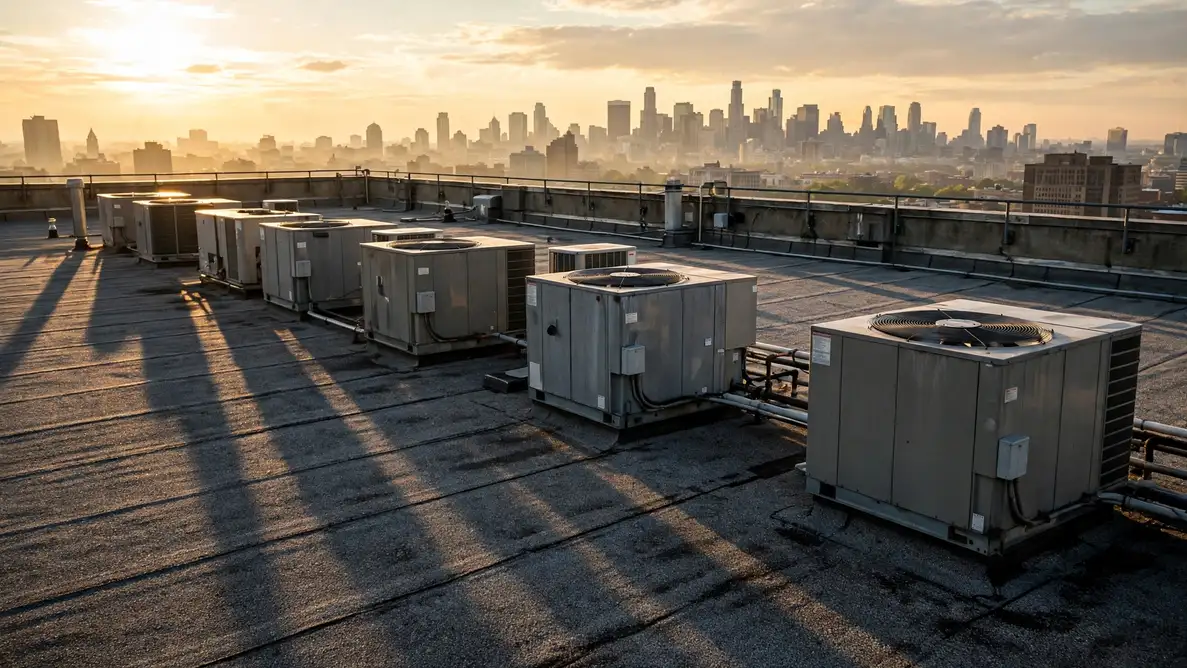
The packaged rooftop unit — the RTU — is the workhorse of small and mid-sized commercial buildings. It sits on the roof in a single cabinet containing heating, cooling, the blower and its controls, serving the space below through ductwork, often with an economizer that cools with outdoor air when conditions allow — drawing in outside air instead of running the compressor on mild days. Buildings commonly run several, zoned by exposure and use: the units over the south-facing retail frontage live a different life from the ones over storage. Servicing RTUs is roof work — access, safety, weather — and its rhythm is seasonal: coils and economizers before summer, heat sections and ignition before winter, belts, bearings and drains throughout. Replacement planning lives on the roof too. When a unit finally reaches the end of its economic life, the swap is a logistics exercise as much as a mechanical one: crane scheduling, curb dimensions — whether the new unit fits the existing roof curb or needs an adapter — electrical capacity, and a weather window chosen so the space below is not left unconditioned through a peak week. Buildings with a service record make that exercise calm, because the unit's decline was documented across seasons and the replacement was budgeted before it was forced. Buildings without one meet the same exercise at emergency tempo, which is the practical difference a maintenance file makes.
Ventilation is the commercial system's second job and its legal one. Occupied workplaces must receive outdoor air in quantities set by code according to the space's type and occupancy, delivered by the equipment and verified — a damper stuck shut or an economizer failed closed can leave a crowded space under-ventilated while its temperature feels perfectly fine. Restaurants add exhaust and make-up air that must balance, or doors pull hard, hoods spill, and the dining room's pressure fights the kitchen's. A commercial assessment measures this side of the system deliberately, because temperature complaints are the ones people report, while ventilation failures announce themselves only as stuffiness, odors and fatigue that nobody traces to the roof.
Controls are where commercial comfort is actually decided. A single thermostat governing an open floor is the simple case; most real buildings run zones — offices against a perimeter, a conference room with twenty people's heat load arriving at once, a server closet that needs cooling in January. Programmable and networked controls schedule the building's day: warm-up before staff arrive, setback overnight and weekends, ventilation matched to occupancy rather than run flat out. Much commercial service work is therefore control work — schedules corrected, sensors calibrated, a zone's damper or valve found stuck — because the refrigeration and heating equipment underneath is frequently sound while its instructions are not. Sensor drift is the quiet version of the same fault. A thermostat or zone sensor reading two or three degrees from the truth will have the equipment faithfully conditioning to the wrong temperature all season — overheating one suite, undercooling another — while every mechanical check passes. Calibration belongs in the service visit for exactly that reason: the controls are the building's senses, and a system with sound equipment and lying senses behaves, from the occupants' side of the vent, exactly like a broken one.
Finally, the commercial difference that matters most to owners: records and horizon. A maintained building accumulates a file per unit — age, condition, repairs, measurements — from which capital decisions are made in order rather than in crisis. The professional's report after each visit feeds that file: this unit has seasons of life left and is worth its repairs; this one's failures are compounding and replacement should be budgeted for a planned window, ideally in mild weather, rather than forced during a heat wave at emergency tempo. Commercial HVAC done well is partly mechanical and partly this: an equipment portfolio managed on evidence, with the building's operations — not the equipment's failures — setting the calendar. The same record serves the building at transaction time. A property being sold, refinanced or re-tenanted will have its mechanical systems examined, and a roof with years of dated, per-unit service documentation answers that examination in a way a roof with folklore cannot. Owners sometimes discover the maintenance file's value only in that moment, when it is too late to create retroactively. Every visit's report is a page of it, written while the writing was easy.
Questions about commercial hvac
How is commercial HVAC different from residential service?
What is a rooftop unit, and how often should it be serviced?
Can service and repairs happen outside our business hours?
Our space is comfortable but feels stuffy and smells linger. Is that an HVAC problem?
We have several rooftop units and no service history. Where do we start?
How much will commercial HVAC service be for our building?
Find commercial hvac in your city
Alabama: Birmingham, Huntsville, Mobile, Montgomery, Tuscaloosa, Daphne–Fairhope, Auburn, Decatur, Florence–Muscle Shoals, Dothan
Alaska: Anchorage
Arizona: Phoenix, Tucson, Prescott, Lake Havasu City, Yuma, Flagstaff
Arkansas: Little Rock, Fayetteville–Springdale–Rogers, Fort Smith
California: Los Angeles, Riverside–San Bernardino, San Francisco, San Diego, Sacramento, San Jose, Fresno, Bakersfield, Oxnard–Ventura, Stockton, Modesto, Santa Rosa, Visalia, Vallejo, Santa Barbara, Salinas, Merced, San Luis Obispo, Santa Cruz, Chico, Yuba City, Redding, El Centro, Hanford
Colorado: Denver, Colorado Springs, Greeley, Fort Collins, Boulder, Pueblo, Grand Junction
Connecticut: Hartford, Bridgeport–Stamford, New Haven, Waterbury, Norwich–New London
Delaware: Dover
District of Columbia: Washington
Florida: Miami, Tampa, Orlando, Jacksonville, North Port–Sarasota, Cape Coral–Fort Myers, Lakeland, Daytona Beach, Palm Bay–Melbourne, Port St. Lucie, Pensacola, Ocala, Naples, Tallahassee, Gainesville, Crestview–Fort Walton Beach, Panama City, Punta Gorda, Sebastian–Vero Beach, Homosassa Springs, The Villages
Georgia: Atlanta, Augusta, Savannah, Columbus, Macon, Gainesville, Athens, Warner Robins, Valdosta, Dalton, Albany
Idaho: Boise, Coeur d'Alene, Idaho Falls
Illinois: Chicago, Peoria, Rockford, Champaign, Springfield, Bloomington
Indiana: Indianapolis, Fort Wayne, South Bend, Evansville, Lafayette, Elkhart, Terre Haute, Bloomington
Iowa: Des Moines, Davenport, Cedar Rapids, Iowa City, Waterloo, Sioux City
Kentucky: Louisville, Lexington, Bowling Green
Louisiana: New Orleans, Baton Rouge, Lafayette, Shreveport, Slidell, Lake Charles, Monroe, Houma, Alexandria
Maryland: Baltimore, Hagerstown, Lexington Park
Massachusetts: Boston, Worcester, Springfield, Barnstable Town, Amherst
Michigan: Detroit, Grand Rapids, Lansing, Flint, Ann Arbor, Kalamazoo, Saginaw, Muskegon, Jackson, Traverse City, Monroe, Niles
Minnesota: Minneapolis–St. Paul, Duluth, Rochester, St. Cloud
Mississippi: Jackson, Gulfport–Biloxi, Hattiesburg
Missouri: St. Louis, Kansas City, Springfield, Columbia, Joplin, Jefferson City
Montana: Billings
New Hampshire: Manchester
New Jersey: Trenton, Atlantic City, Vineland
New Mexico: Albuquerque, Las Cruces, Santa Fe
New York: New York, Buffalo, Rochester, Albany, Poughkeepsie, Syracuse, Utica, Binghamton, Kingston
North Carolina: Charlotte, Raleigh, Greensboro, Winston-Salem, Durham, Wilmington, Asheville, Fayetteville, Hickory, Jacksonville, Burlington, Greenville, Rocky Mount
North Dakota: Fargo
Ohio: Cincinnati, Columbus, Cleveland, Dayton, Akron, Toledo, Youngstown, Canton
Oklahoma: Oklahoma City, Tulsa
Oregon: Portland, Salem, Eugene, Bend, Medford
Pennsylvania: Philadelphia, Pittsburgh, Allentown, Harrisburg, Scranton, Lancaster, York, Reading, Erie, Chambersburg, State College, Lebanon
Rhode Island: Providence
South Carolina: Greenville, Charleston, Columbia, Myrtle Beach, Spartanburg, Hilton Head Island, Florence
South Dakota: Sioux Falls, Rapid City
Tennessee: Nashville, Memphis, Knoxville, Chattanooga, Clarksville, Kingsport, Johnson City, Jackson
Texas: Dallas–Fort Worth, Houston, San Antonio, Austin, McAllen, El Paso, Killeen–Temple, Corpus Christi, Brownsville, Beaumont, Lubbock, Waco, Longview, College Station, Laredo, Amarillo, Tyler, Midland, Abilene, Odessa, Sherman–Denison, Wichita Falls, Texarkana
Utah: Salt Lake City, Provo, Ogden, St. George, Logan
Vermont: Burlington
Virginia: Virginia Beach–Norfolk, Richmond, Roanoke, Lynchburg, Charlottesville, Blacksburg, Winchester
Washington: Seattle, Spokane, Kennewick, Olympia, Bremerton, Yakima, Bellingham
West Virginia: Huntington, Charleston, Morgantown
Wisconsin: Milwaukee, Madison, Green Bay, Appleton, Racine, Eau Claire, Oshkosh, La Crosse, Kenosha, Janesville
Need commercial hvac help?
One call routes you to an independent local HVAC technician who handles this work in your area.
Call center hours: Mon-Fri 7:00 AM-10:00 PM ET | Sat 8:00 AM-10:00 PM ET | Sun 7:00 AM-9:00 PM ET