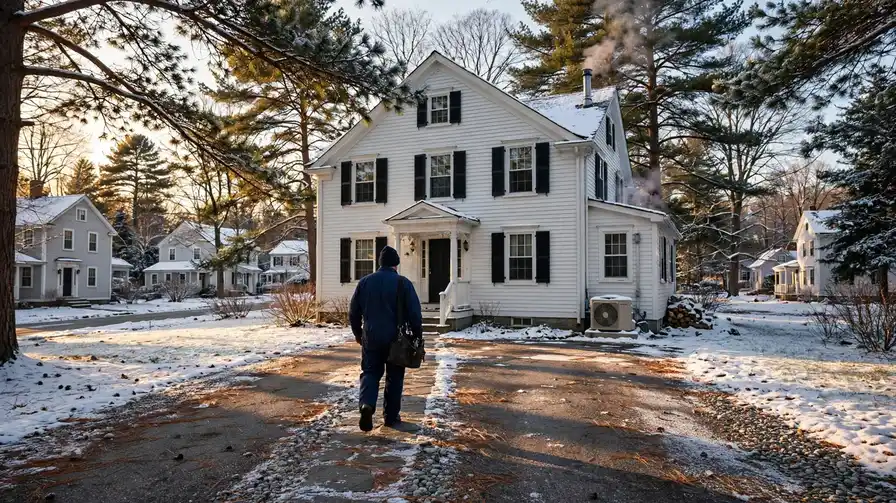


Start with the stock, and the rest of the page follows: Bangor's housing eras, its climate record at MILLINOCKET MUNI AP, ME US, and the failure patterns those two manufacture together — ranked, evidenced and answered below. When the pattern matches your home, one call routes you to an independent local HVAC technician who works these streets.
Call center hours: Mon-Fri 7:00 AM-10:00 PM ET | Sat 8:00 AM-10:00 PM ET | Sun 7:00 AM-9:00 PM ET
The median Bangor home was built in 1977; 54.4% of the stock predates 1980, and the pattern this metro's own data ranks first is the refrigerant transition reaching older systems. TempReach USA is a referral service, not an HVAC company: one call connects you with an independent local HVAC technician serving your ZIP code.
Bangor is a metro of 153,571 people and 64,769 households, and its heating and cooling is a portrait of its building history. The median home here was built in 1977; 54.4% of homes predate 1980 and 33.6% predate 1960, while 20.2% have arrived since 2000. Every one of those eras heated and cooled differently — different furnaces, different duct designs, different refrigerant generations — and they fail differently, which is why this page is organised around the patterns the data actually produces in Bangor rather than HVAC in the abstract.
The pre-1980 stock is where most of the metro's HVAC character lives. Homes from those decades in Penobscot County and across Penobscot were built with duct layouts from the first age of central systems, furnaces and condensers that have since been renewed piecemeal, and insulation standards from another era, and each of those choices is now at or beyond the age its makers expected of it. Owner-occupiers hold 70.3% of the metro's homes, so most of the people reading this page are reading about a system they own outright — one whose failures arrive as surprises only if nobody has looked at the pattern: cooling fading a little each summer, a furnace recovering a little more slowly, one room drifting a little further from the thermostat.
The growth side of the metro tells the opposite story in the same language. Orono, Brewer and the subdivisions still filling in account for much of the 15,232 homes built since 2000 — matched systems, planned ductwork, heat pumps where the lots suit them. Their HVAC is not old; it is uniform, which creates its own calendar: everything installed in the same boom reaches each wear point in the same years, from the first condenser replacements to the first control-board failures, while 293 cooling degree days of annual heat keep demand on the system high.
The weather's part in this is written at MILLINOCKET MUNI AP, ME US, where an average year carries 42.6 inches of precipitation, 4.0 days at ninety degrees or more and 168.5 nights at freezing or below. Systems experience that year as workload and as stakes in roughly equal measure — the workload in the run hours, the stakes on the single coldest night and the single hottest week. The problem ranking further down is simply the housing profile above, read under this sky.
Two public records, one metro: what was built here, and what the sky does to it.
Break the stock down by building era and the profile sharpens. Before 1960: 33.6% of homes, roughly 25,336 of them. From 1960 to 1979: 20.8%, about 15,684. From 1980 to 1999: 25.4%, about 19,153. Since 2000: 20.2%, about 15,232. Four eras, four equipment generations — and the balance among them is this metro's HVAC character in a single paragraph.
Vintage is destiny in this metro. With the pre-1960 band the largest of the four, the centre of gravity of Bangor's heating and cooling sits in houses whose systems have already outlived several generations of equipment — ducts gone leaky inside walls, furnaces renewed and renewed again, cooling retrofitted into floor plans that never imagined it. The later bands matter, and the post-2000 subdivisions will write their own chapter in time, but the calls that define HVAC here come disproportionately from the oldest streets, and they will keep coming until that stock is modernised system by system.
The runner-up era is 1980-1999, with 25.4% of homes. That stock has left its carefree decades and entered its maintenance decades, and it shows in the call pattern around Orono and the other districts of those years: condensers on their second cycle, furnaces reaching their wear points together, ducts still young enough to reward attention over replacement.
The climate column of this profile is a workload statement. 8,351 heating degree days say how long the cold half of the year keeps furnaces and heat pumps working at their hardest; 293 cooling degree days say how relentlessly the hot half loads every condenser and coil; 168.5 freezing nights and 4.0 hot days mark the extremes where the failures concentrate. NOAA keeps these figures at MILLINOCKET MUNI AP, ME US as thirty-year normals — which is to say, as the closest thing HVAC has to a settled forecast.
A profile is only useful if it predicts something, and this one predicts the shape of an HVAC diary in Bangor: which streets will call about cooling, which about heating, which about airflow, and in which months. Everything after this section is that prediction written out as services, problems and answers — the numbers first, the narrative second, the way the evidence actually runs.
Sequenced by this metro's own problem ranking, not by a national catalogue order.
Warm air from the vents is a symptom with several authors — capacitor, charge, airflow, controls — and AC repair in Bangor separates them by measurement at your unit, not by parts swapped on hope.
Air conditioning in Bangor works against the local calendar: 293 cooling degree days a year at MILLINOCKET MUNI AP, ME US, with 4.0 days at 90 degrees or more. The failures follow that load — capacitors and contactors worn by relentless summer cycling, refrigerant charges drifting low on systems that have served a decade of heat, condensate drains clogging in the humid weeks. The older districts run the oldest condensers; the subdivisions around Bangor run matched fleets installed in the same seasons, and both sides of the metro meet the repair call on the hottest week of the year. From Orono to Brewer, the pattern repeats wherever the housing era matches.
The local caseload behind this service is written in the climate figures: 293 cooling degree days a year and 4.0 days at 90 or above, pressing on a cooling fleet whose oldest members serve the 41,020 pre-1980 homes — in Orono (10,699 residents) as much as in the oldest districts.
Short cycling usually means the furnace is protecting itself — an overheating exchanger starved of airflow — so the repair in Bangor addresses the airflow cause, or the cycle simply resumes.
Furnace work in Bangor is set by 8,351 heating degree days a year at MILLINOCKET MUNI AP, ME US and 168.5 nights at or below freezing. The failures the season produces are the working parts wearing in sequence: igniters that have fired ten thousand times, blower motors tired from two seasons a year of duty — heating in winter, air handling in summer — heat exchangers stressed by decades of expansion and contraction. In the older districts, where 54.4% of the metro's homes predate 1980, many furnaces are replacements of replacements, fitted into ductwork older than the equipment itself. Count it in homes if you prefer: 41,020 built before 1980, 15,232 since 2000, one shared system of streets and seasons.
Under Bangor's winters lie 8,351 heating degree days a year, and the furnaces answering them include the ageing units of the 41,020 pre-1980 homes alongside the electronic systems of the new subdivisions. The repair diary in Old Town reads both ends of that stock in a single week.
Stabilization precedes diagnosis. The fault isolated, the water contained, the dangerous component out of service — a repair decided in a worsening house is rarely the right one, so the worsening stops first.
HVAC emergencies in Bangor keep the climate's hours: the cooling failure on the third day of a heat wave, the furnace that stops on the coldest night of the year. The metro's record at MILLINOCKET MUNI AP, ME US — 4.0 days of serious heat, 168.5 freezing nights — sets the stakes at both ends, and the housing sets the vulnerability: a well-insulated new build coasts for a day without its system, while an older home in the the 1970s districts follows the outdoor temperature indoors within hours. The emergency visit triages in order: safety first, then the fault, then the honest question of repair against replacement. With a median build year of 1977, most of the metro's 75,405 housing units are working through the same ageing curve.
The emergency caseload is written in the extremes: 4.0 days of serious heat and 168.5 freezing nights a year, against systems whose median home was built in 1977. In Millinocket as across the metro, the urgent calls arrive when the weather and the equipment's age meet.
Bangor homes heat through 8,351 heating degree days and cool through 293 cooling degree days a year, so the blower runs in both seasons and the ducts never rest — which is why what has settled in them matters here in every month, not just one.
In Bangor, the maintenance calendar writes itself from the climate: 8,351 heating degree days and 293 cooling degree days mean both systems work a real season, so the fall and spring visits each have genuine work to inspect.
From Bangor to Old Town, Bangor replacements routed through TempReach USA end in commissioning — measured charge and airflow — so the installed system matches the calculated one.
With 75,405 homes and a median build year of 1977, Bangor heating stock spans every era of furnace and flue — each installation assessed on its own house, not on the outgoing unit's label.
Heat pump services in Bangor test the whole year-round system: the independent local professional covering Penobscot reads charge and airflow in both modes, proves defrost, and checks auxiliary heat logic before quoting any work.
Ductless installation in Bangor is surveyed room by room across Penobscot: the independent local professional calculates each space's load, plans line and drain routes, and quotes the complete design before work begins.
With a median build year of 1977 across 75,405 homes, Bangor holds both air problems at once — envelopes that leak air freely and envelopes sealed tight — and the local professional assesses which house yours is before recommending equipment.
From Bangor to the metro's edge, Bangor's 75,405 homes run every system type there is — single-stage furnaces, two-stage equipment, heat pumps with auxiliary heat — and each gets a control matched to its terminals, not a shelf guess.
In Bangor, commercial work follows the stock: 75,405 housing units' worth of mixed buildings — offices, retail and restaurants from Bangor across the 41 covered ZIP codes — each with rooftop units whose service rhythm the local professional sets per building.
Two patterns generate most of the bookings behind the services above: The refrigerant transition reaching older systems and furnace wear in hard cold. That is why the order of this page's service list is what it is — the services answering those patterns come early, and the rest follow in the order the metro's data supports. A homeowner whose home matches the local profile — built in the metro's big decades, in one of its older districts — is, statistically, reading their own shortlist.
Ranked for this metro alone, from its Census housing profile and NOAA climate record.
There is a paperwork side to the transition that touches Bangor homes quietly. Refrigerant work is regulated work: recovery, handling and record-keeping rules apply to whoever services a system, and the newest refrigerants — mildly flammable by classification — arrive with their own sensors, labeling and code provisions that installers must follow. For the homeowner the visible part is small: a nameplate with a different designation, a technician explaining why a charge is measured and documented as it is, an installation that includes leak-detection provisions the older system never had. The invisible part matters more over time: as the newest generation becomes the metro's standard, parts, training and service practice consolidate around it, and the older generations become the specialty work. Owning an older-generation system is not a fault — but its service ecosystem is, year by year, becoming a smaller room.
The mechanics underneath the policy are simple. A refrigerant is the working fluid of the cooling cycle: it evaporates indoors to absorb heat and condenses outdoors to release it, thousands of times a season. Each generation of fluid was engineered to improve on the last one's environmental profile and operating pressures, and each required its own hardware — compressors built for different pressures, oils that mix with one fluid and not another, metering set for one fluid's characteristics. That is why the generations cannot be swapped like brands of the same product, and why 'topping up' an older system always means its own fluid, sourced from whatever supply its generation still commands. In Bangor, where systems from all three generations stand in neighboring yards, the diversity is a service reality: diagnosis begins with identification, because the same symptom — a system low on charge — carries three different expense structures depending on the nameplate.
The regulatory facts are the foundation: R-22 production and import ended in the United States in 2020, leaving reclaimed stock as the supply, while new equipment has moved through R-410A to the current lower-impact generation. In Bangor every generation still stands in service — the transition is not coming to this metro; it is distributed across it, yard by yard.
Cold also changes what a furnace failure means. The same breakdown that is an inconvenience in October is a property risk in a Bangor freeze: indoor temperatures fall toward the point where plumbing in exterior walls and unheated spaces starts to freeze, and the household's options narrow to space heaters and borrowed rooms. That escalation is why winter furnace work runs on triage logic — restore safe heat first, then address the wear that caused the stop — and why the pre-season check carries weight here out of proportion to its simplicity. A furnace proven in autumn, with its igniter strong, its sensor clean and its exchanger inspected, meets the 168.5 freezing nights as a routine. An unproven one meets them as a question.
The wear itself follows the physics of the machine. A gas furnace lives by controlled fire: it must move air across a heat exchanger that swings from room temperature to several hundred degrees and back, many times a day, all winter. Metal fatigues under that cycling — slowly, invisibly, and faster in a unit that short-cycles because of a dirty filter or an oversized installation. Ignition components live an equally hard life at the small scale: a hot-surface igniter is a ceramic element heated to glowing in seconds, and each heating is a thermal shock. In Bangor's 8,351 heating degree days, a furnace may fire tens of thousands of times across its life. The season's failures are rarely mysteries; they are the arithmetic of cycles, arriving on schedule in the coldest weeks because that is when the cycles concentrate.
The climate record is the prosecution's whole case: 8,351 heating degree days and 168.5 nights at or below freezing at MILLINOCKET MUNI AP, ME US in an average year. A furnace in Bangor is not occasionally cold-weather equipment; it is a machine audited by winter, annually, at full load.
When heat does stop in a freeze, the household's first hour matters more than any other. The house's thermal mass buys time — hours, not days, in a hard Bangor freeze — and the order of actions is worth knowing cold: confirm the system truly will not run through its simple causes, thermostat, breaker, filter, switch and fuel supply, because a share of no-heat calls end at one of those. Protect the water early where runs are exposed: taps on exterior walls dripping slowly, cabinet doors open to let room air reach the pipes, the vulnerable spaces given whatever warmth the home still holds. Know where the water main closes, before there is a reason to close it in the dark. And make the call promptly, describing the house's exposure honestly — a home with pipes in a crawl space and a falling thermometer is triaged differently from one that can coast until morning, and the call center can only sort by what it is told.
Judge a heating system's freeze readiness in the autumn, by evidence, not in January by outcome. The evidence is a short list: ignition proven under a real call for heat, the safety chain and fault history read rather than assumed, condensate and venting paths walked where the cold can reach them, backup heat exercised on a heat pump, and a household that knows its own water main and its own first hour by heart. MILLINOCKET MUNI AP, ME US's record — 168.5 freezing nights in an average year — is the examination date, published in advance. The homes that pass it without drama share the profile of having treated that date as real. A freeze does not grade on effort or intention; it grades the house and its heating plant exactly as it finds them, in the coldest hours, once a year, with the plumbing as the second paper. Preparation is simply the decision to sit the exam rehearsed.
The housing detail completes the case: with a median build year of 1977, much of Bangor's stock routes water through exterior walls, crawl spaces and additions — placements that are unremarkable in October and decisive in a January freeze with the heat off. The risk is built in; only its management is optional.
Living with a real winter, as Bangor does, means the season has a shape: the first hard freeze finds the unprepared systems, mid-winter tests endurance — igniters, motors and sensors carrying months of cycles — and the late thaws reveal what the cold quietly damaged. Households that prove their heating in autumn and treat mid-season symptoms as scheduling information get through most winters with nothing dramatic to report; the drama concentrates, year after year, in the systems nobody ran until the night they were needed at full load.
The season loads Bangor's systems the way its record at MILLINOCKET MUNI AP, ME US says it will: 8,351 heating degree days against 293 cooling degree days in an average year, against a housing stock whose median build year is 1977. The households that read the season early — filters, drains, a system run before the extreme weeks — are the ones whose calls stay schedulable.
In Bangor the transition's map is the housing map, lagged by one equipment generation. The districts built around Bangor and the the 1970s streets hold the metro's R-22 veterans, in homes that have already seen one full cycle of this story when the equipment before them was young. The middle suburbs hold the R-410A majority. The 15,232 homes built since 2000 carry early current-generation systems now reaching the age where their first major repairs will be quoted — into a market whose standard has already moved on again. Read as a whole, the metro's 75,405 housing units contain the refrigerant industry's last several decades standing in rows, and the service economy of the metro is, in part, the business of keeping all those decades running at once. The deep pattern for a homeowner is simple to state and slow to change: your system's generation is a property of your street's building era, and its implications were installed with the house.
The numbers underneath it, for Bangor: 75,405 housing units, a median build year of 1977, and a climate record at MILLINOCKET MUNI AP, ME US of 8,351 heating degree days against 293 cooling degree days. Cross the housing record with the weather record and this pattern is what falls out at the top — rarely the most dramatic problem in heating and cooling, but the one this metro's stock and climate manufacture most steadily.
Experienced local practice starts with the simple certainties — the observations that take minutes and decide the most:
PROBLEM SOLUTION
Population 31,663
Population 10,699
Population 9,654
Population 7,439
Population 4,937
Population 4,111
Population 2,576
Population 2,312
Population 1,866
Population 1,840
Population 1,545
Population 1,469
Also in the Bangor metro: Howland (population 1,208), Bradley (population 872).
The communities in the grid are not suburbs of the page; they are its subject as much as Bangor is. Orono (10,699 residents) and Brewer (9,654) carry their own building decades, their own equipment generations and their own positions in the problem ranking's logic — a system under a Orono roof answers to the same data as one in the centre, but to a different era of it. Coverage here is defined by the ZIP list below; understanding is defined street by street, and this page's figures are the metro-wide version of a story each community tells in its own numbers.
Also on the Bangor map: Old Town (7,439), Hampden (4,937), Millinocket (4,111), Lincoln (2,576), Milford (2,312) — communities spread across Penobscot, each with housing from its own growth years. A technician routed through TempReach USA to any of them is working from this same page: the metro data does not change at the city limit, but the housing on your street — its age, its equipment, its attic — is what the visit is really about.
Every metro has a first city and a supporting cast, and the census figures draw the billing plainly here: Bangor first, with 31,663 residents; Orono second at 10,699; Brewer third at 9,654; then the long tail of smaller communities in the grid above. The billing matters less than the building dates — each of these places was fitted with heating and cooling in its own decade, by its own builders — but between them they account for nearly every housing era, equipment generation and failure pattern this page describes.
Draw the metro by its paperwork and it resolves into Penobscot — 1 jurisdictions sharing one housing stock and one weather system. Penobscot County holds the historic centre and the densest share of the older homes; the surrounding counties hold the rings of growth around it. Permits and inspections follow those boundaries even though temperature never does, which is part of why the technician this page connects you to works these streets specifically.
Three neighbouring coverage areas begin where this one ends: Portland, ME, some 141 miles off; Burlington, VT, 221 miles; and Manchester, NH, 230 miles. Each keeps its own page because each keeps its own numbers — a different median build year, a different climate station, a different problem ranking. Boundary households should trust the ZIP list over the map: the code, not the compass, assigns the dataset.
Set Bangor among its neighbours and the contrasts sharpen the profile: Portland, ME — metro population 577,635, median build year 1977 — sits 141 miles away; Burlington, VT (227,803, median 1980) 221 miles; Manchester, NH (433,415, median 1977) 230 miles. Three different housing stocks under three nearby skies, which is why each keeps its own page and its own problem ranking rather than borrowing this one.
Count the metro per unit of itself: 1,839 housing units per covered ZIP code; 64,769 households per county; 14 communities sharing 1 county governments. Then weigh the generations against each other — 2.7 older homes for each newer one — and the service pattern on this page stops being a list and becomes a proportion: that much of the diary written by ageing systems, the rest by young ones wearing in.
One line of Bangor arithmetic — a median home 49 years old · 45,533 owner-occupied homes against 19,236 renter-occupied · 618 pre-1960 homes for every covered ZIP code · a heating-to-cooling degree-day ratio of 28.54 · 1,082 mm of rain in an average year.
County pages carry the local detail — land area, climate normals and the heating and cooling pressures on the ground in each county.
More plain-language help: the TempReach USA heating & cooling guides
One call connects you with an independent local heating and cooling professional serving Bangor and the surrounding metro.
Call center hours: Mon-Fri 7:00 AM-10:00 PM ET | Sat 8:00 AM-10:00 PM ET | Sun 7:00 AM-9:00 PM ET