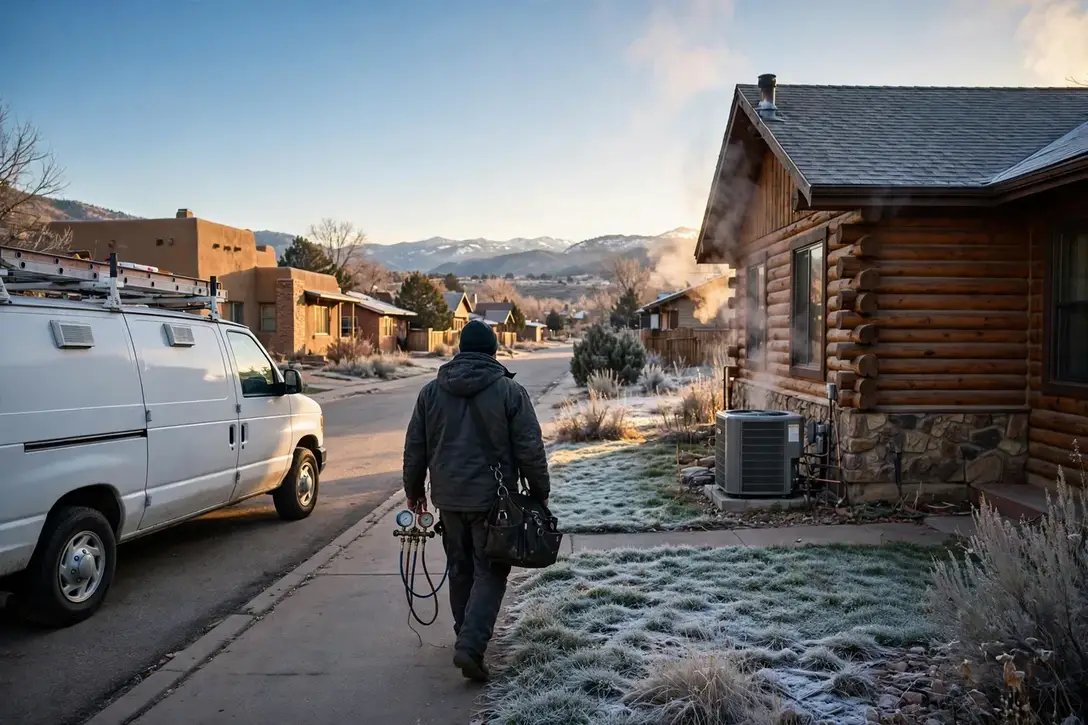


TempReach USA connects Pueblo homeowners with independent local HVAC technicians. This page is built from the metro's own Census housing data, ZIP codes and climate record — the heating and cooling problems described here are the ones Pueblo homes actually have.
Call center hours: Mon-Fri 7:00 AM-10:00 PM ET | Sat 8:00 AM-10:00 PM ET | Sun 7:00 AM-9:00 PM ET
The median Pueblo home was built in 1974; 59.3% of the stock predates 1980, and the pattern this metro's own data ranks first is the refrigerant transition reaching older systems. TempReach USA is a referral service, not an HVAC company: one call connects you with an independent local HVAC technician serving your ZIP code.
Two numbers frame everything that follows: 68.3% of Pueblo homes are owner-occupied, and the median one was built in 1974. Ownership matters to HVAC because owners inherit their systems whole — every equipment decision a builder made in the 1970s or earlier is still in the attic, the closet and the side yard, ageing on its original schedule. With 59.3% of homes predating 1980 and 21.4% arriving since 2000, the metro is really two housing stocks sharing one map, and they are taken separately below before the problems are ranked.
There is an equipment timeline buried in Pueblo's housing figures, and it reads like a technician's diary. The 25,342 homes from before 1960 were heated first and cooled later, their ducts added around floor plans that never imagined them. The 17,966 that followed between 1960 and 1979 mixed those retrofits with the first planned central systems. Then came the 14,095 homes of 1980-1999, fitted with matched systems as standard. Each band of that timeline is now a band of characteristic failures, arriving in the order the equipment tires — which is why a home's build year, in this metro, is the single most predictive fact about its heating and cooling.
The growth side of the metro tells the opposite story in the same language. Pueblo West, Colorado City and the subdivisions still filling in account for much of the 15,629 homes built since 2000 — matched systems, planned ductwork, heat pumps where the lots suit them. Their HVAC is not old; it is uniform, which creates its own calendar: everything installed in the same boom reaches each wear point in the same years, from the first condenser replacements to the first control-board failures, while 1,078 cooling degree days of annual heat keep demand on the system high.
The climate written over all of it comes from the NOAA station at PUEBLO MEM AP, CO US: an average year brings 5,334 heating degree days, 1,078 cooling degree days and 12.02 inches of precipitation. Those are not abstractions to a furnace or a condenser — they set how many hours a heating system runs each winter, how hard a cooling system cycles in July, and how much moisture every coil has to pull out of the indoor air. The problem sections that follow are selected by exactly these numbers, combined with the housing-age profile above.
Two public records, one metro: what was built here, and what the sky does to it.
The distribution, in one breath: of every hundred Pueblo homes, 34.7 were standing before 1960, 24.6 went up in the two decades after, 19.3 in the two after that, and 21.4 have arrived since 2000. Percentages flatten the picture, so hold the counts beside them — 25,342 oldest-era homes, 15,629 newest — and the metro's heating and cooling stops being an abstraction: it is that many systems, of those ages, failing in that order.
This is, by the numbers, an old-system metro. The largest slice of its housing predates 1960, which means the typical serious job here involves equipment generations in their final chapters: ducts that leak by modern standards, furnaces renewed into them more than once, cooling added decades after the houses were built for heat alone. The newer bands exist — the growth since 2000 is real — but they are the supporting cast. Pueblo's HVAC identity was fixed by its earliest builders, and its problem list is written in their floor plans.
The second band in the table is the 1960-1979 stock: 17,966 homes, 24.6% of the metro. It is the transition generation — cooling arriving, heating generations overlapping, ducts mixed street by street — and it supplies Pueblo with its most diagnostic HVAC: two homes of the same year needing opposite answers, decided by what the builder happened to specify.
The climate half of the profile, from PUEBLO MEM AP, CO US: 5,334 heating degree days against 1,078 cooling degree days, 12.02 inches of precipitation, an average temperature of 53.2 degrees. Read together, those figures describe the loads: how many hours a furnace runs in a year, how relentlessly a condenser cycles through summer, how much moisture the cooling coil must pull from the air — 165.0 nights at or below freezing, against 71.6 days at 90 or above.
Hold the two halves together and the rest of this page explains itself: the problems ranked highest here are the ones where Pueblo's dominant housing era and its climate record overlap. Change either dataset and the ranking changes — which is precisely why this profile is rebuilt from the records for every metro instead of carried over from the last one.
Selected and ranked from this metro's housing-age profile and climate record — not copied from another city's page.
There is a paperwork side to the transition that touches Pueblo homes quietly. Refrigerant work is regulated work: recovery, handling and record-keeping rules apply to whoever services a system, and the newest refrigerants — mildly flammable by classification — arrive with their own sensors, labeling and code provisions that installers must follow. For the homeowner the visible part is small: a nameplate with a different designation, a technician explaining why a charge is measured and documented as it is, an installation that includes leak-detection provisions the older system never had. The invisible part matters more over time: as the newest generation becomes the metro's standard, parts, training and service practice consolidate around it, and the older generations become the specialty work. Owning an older-generation system is not a fault — but its service ecosystem is, year by year, becoming a smaller room.
Judge a refrigerant-era system by its leak history and its trend, not by a single charge reading. One low reading after many tight years is an event; a pattern of small losses is a biography, and the biography is what the economics should be based on. Pueblo's climate record loads the question at both ends — a leaking system underperforms exactly when PUEBLO MEM AP, CO US's 71.6 hot days demand its full capacity, and its owner pays for refrigerant and lost performance simultaneously. The households that navigate this transition well keep one habit: they can state their system's age, refrigerant and last three repairs without looking them up. That small command of the facts converts an industry-wide generational change into a single household's managed decision, which is the scale at which it was always going to be decided anyway.
Housing arithmetic shows the exposure: with 59.3% of Pueblo's homes built before 1980 and equipment replaced in long cycles ever since, a substantial share of the metro's systems belong to refrigerant generations the market has already succeeded. The nameplates say so, one address at a time.
Renovation writes its own chapter in this pattern. Homes in Pueblo have been extended, finished and re-divided for decades — a garage converted, a basement finished, an addition tied into ductwork sized for the original house. Each alteration borrows air from the existing network, and the borrowing is rarely repaid with new capacity or rebalanced runs. The result is a duct system whose map no longer matches the house it serves: original rooms over-supplied, added rooms fed by a hopeful tap into a trunk that was never asked to carry them. Add the slow leaks of age on top of the redesigns of renovation, and the far rooms' complaints stop being mysterious. The remedy starts with honesty about the map — what was designed, what was improvised, and what each run can actually deliver — before any cleaning, sealing or resizing is worth doing.
Households judge their heating and cooling at the thermostat, but the thermostat only reports the room it sits in. Judge the system at its furthest register instead: the air arriving there, its temperature against the supply at the unit, its volume against the room's need. In Pueblo that furthest room is the honest auditor of the duct network — it inherits every leak, every sag and every degree of attic heat between it and the air handler. The homes whose far rooms match their near rooms have networks that were sealed when they were built and checked as they aged. The homes whose far rooms lag are not necessarily homes with weak equipment; they are homes whose delivery network has been quietly resigning, joint by joint, while the equipment took the blame and the service calls. The register, not the nameplate, is where the resignation is announced.
The housing numbers frame the exposure: 73,031 housing units in Pueblo, a median build year of 1974, and duct networks installed era by era in attics, crawl spaces and wall cavities. Every one of those networks is a set of joints ageing in the dark — the loss pool is the size of the metro itself.
The oldest systems in Pueblo carry one more complication: their supporting cast is old too. Ductwork sized for an earlier furnace, refrigerant lines run for a refrigerant generation that has since been phased down, thermostats wired before communicating controls existed, electrical panels with no spare capacity for a modern system's starting load. Ageing, in an older home, is a property of the whole installation rather than a single appliance. That is why the honest maintenance conversation in an the 1970s home ranges wider than the nameplate: the machine, its air path, its refrigerant generation and its controls are ageing on four clocks at once, and the visit that checks all four is the one that predicts the year rather than reacting to it.
Judge an ageing system by its trend line, never by its kindest day. On its kindest day — mild weather, light load — almost any system in Pueblo can still argue for itself. The trend line is written elsewhere: in run times lengthening season over season, in the setting creeping to hold the same comfort, in the rooms that quietly dropped out of the system's reach. PUEBLO MEM AP, CO US's climate record ensures the trend will be tested at both ends of the year — 71.6 hot days and 165.0 freezing nights in an average year. The households that read their trend early choose the terms of the ending, whether that ending is a renewed component, a planned replacement in a shoulder season, or a few more good years bought with honest maintenance. The households that wait for the system's verdict receive it in the weather least suited to hearing it.
Look at the replacement echoes: the 15,629 homes built since 2000 are now carrying first-generation equipment deep into its service life, joining the older cohorts. In Pueblo, ageing is not a niche condition of old houses; it is the metro's standard equipment profile.
Twice a year, Pueblo changes its mind. The shoulder seasons — the weeks when a house can need heating in the morning and cooling by afternoon, sometimes within the same day — ask more of a system and its household than either deep season does: both modes in working order at once, controls set for change rather than for a settled pattern, and equipment that may sit idle for stretches and then be called on without ceremony. The record at PUEBLO MEM AP, CO US frames the workload honestly — 5,334 heating degree days against 1,078 cooling degree days, a genuinely two-season climate — and the shoulders are where the two halves meet and negotiate. The checks that matter are changeover checks: the season just ending reviewed for what it spent — the filter, the wear items, the symptoms it filed — and the season arriving proven before it is needed, with a full run in the new mode while the weather is still forgiving. The thermostat's program belongs in the same check; last season's schedule, carried forward unexamined, is how a house ends up heating against an open-window afternoon. Households that treat the shoulders as their maintenance seasons get two calm, well-timed looks at their system a year — which is exactly the rhythm the equipment's manufacturers had in mind.
The season loads Pueblo's systems the way its record at PUEBLO MEM AP, CO US says it will: 5,334 heating degree days against 1,078 cooling degree days in an average year, against a housing stock whose median build year is 1974. The households that read the season early — filters, drains, a system run before the extreme weeks — are the ones whose calls stay schedulable.
The closer look reveals an irony at the transition's core. The systems most exposed to it — the oldest refrigerant generation — are concentrated in the homes least able to treat replacement casually: Pueblo's older housing, whose owners inherited their equipment's generation along with its era's ductwork and electrical service. For those households the repair-versus-replace decision carries more weight per dollar, and the quality of the conversation matters accordingly. Good local practice in this metro recognizes the stakes explicitly: present the leak, the machine's full condition, and both paths with their honest horizons, and let the decision be the household's, made with the nameplate fact on the table. The transition will complete itself across this metro one household decision at a time; the households served well are the ones whose decisions were informed rather than hurried.
Why here and not everywhere: Pueblo pairs 43,307 pre-1980 homes with 71.6 days a year at 90 degrees or more and 165.0 nights below freezing. Every metro pairs its housing with its weather somehow; this particular pairing is what puts the pattern where it sits on this page's list, ahead of problems that dominate metros built in other decades, under other skies.
On a first visit for this pattern, a local technician's checks run in a practised order:
Sequenced by this metro's own problem ranking, not by a national catalogue order.
Age informs an AC repair decision without deciding it — a sound system with a failed motor earns its repair, and an honest diagnosis in Pueblo will tell you which side of that line your unit stands on.
Cooling failure in Pueblo is rarely random. It bunches on the first serious heat wave, again in the late-summer grind, and it concentrates where the equipment is oldest — the pre-1980 districts, 59.3% of the metro's housing — and where the newest subdivisions' identical units reach the same wear points in the same seasons. The technician who works these streets stocks the van for both patterns: the ageing system's slow decline and the young fleet's shared failures. Locally the workload concentrates where the stock is oldest — the districts built around the 1970s first.
Count the exposure from the Census side: a median build year of 1974 across 73,031 housing units means half the metro's air conditioners are older than the systems in the growth suburbs around Pueblo West, and summer runtime is the statistic that matters — the repair calls follow it street by street.
Clean ducts that leak are still leaking. The inspection folded into a cleaning visit finds the crushed flex run, the separated joint, the filter slot that never sealed — the conditions that decide whether cleaned air actually reaches the rooms.
What comes out of a Pueblo duct system tells the home's biography: drywall dust from the renovation, pet hair in proportion to the household, the fine grit that 12.02 inches of yearly rain and the dry seasons between them work into every return. Cleaning matters most where the biography is long — the pre-1980 homes, 59.3% of the stock — and where a household's breathing argues for it. A technician who shows the before and after, and says plainly when a system does not need the work, is the one whose advice holds up. Ask in Salt Creek and the answer rhymes with Pueblo: same eras, same equipment generations, same calendar of failures.
Duct demand concentrates in the metro's long-biography homes: 43,307 pre-1980 systems that have carried decades of household air, and the renovated homes around Salt Creek (852 residents) whose construction dust is still in the runs.
Honest limits, stated plainly: a tune-up does not make an old system new and cannot prevent every failure. It converts surprises into plans — which, across a system's life, is most of what reliability is made of.
Maintenance also has a paperwork virtue in Pueblo: the recorded visit. Readings dated season by season — refrigerant pressures, temperature splits, capacitor values, the exchanger's noted condition — turn a system's decline from a surprise into a schedule. Households across Pueblo who keep those records meet replacements as appointments, and the technicians who write them are leaving the next visit, whoever makes it, a map of the system's life. In a metro of this size, that map is most of what local knowledge means. Count it in homes if you prefer: 43,307 built before 1980, 15,629 since 2000, one shared system of streets and seasons.
Tune-up demand follows the fleet's waves: the subdivisions' matched systems reaching service points together, the pre-1980 districts' individual units on individual schedules. Blende sits inside one of those patterns; the readings taken there this season predict its systems' next one.
Across Pueblo, the local professional who answers knows the stock — a median build year of 1974 across 73,031 homes means systems of every age failing in their characteristic ways, from Pueblo to the metro's newest subdivisions.
Across 12 ZIP codes, Pueblo heating stock reflects a median build year of 1974 — furnaces at every age, each diagnosed on its own sequence and condition rather than its birthday.
With a median build year of 1974, many Pueblo systems are reaching replacement age together; the professional you are connected with inspects ducts and electrics across 12 ZIP codes before recommending equipment.
Heating installation in Pueblo starts with a heat-loss calculation across Pueblo: the independent local professional measures the home's loss, inspects ducts and venting, and quotes the full scope before work begins.
Across 12 ZIP codes and housing from a median build year of 1974, Pueblo heat pumps are specified and serviced from heat-loss figures and low-temperature performance data, not nominal tonnage.
Across 12 ZIP codes, Pueblo mini-split systems installed through local professionals are commissioned zone by zone in heating and cooling, with the filter and drain routine handed over in person.
In Pueblo, air work follows the climate ledger: 5,334 heating degree days dry the indoor air out each winter while 1,078 cooling degree days load it with humidity each summer — most homes here need the humidity answer in both directions across the year.
In Pueblo, the thermostat question splits by housing era: homes from around the median build year of 1974 often lack a common wire in the wall, while newer builds across the 12 covered ZIP codes usually carry one — the local professional checks the cable before choosing the control.
Across Pueblo, one climate ledger drives the calendar: 5,334 heating degree days and 1,078 cooling degree days mean roof units work both seasons hard, so the spring and fall visits each carry a full checklist here.
There is a plainer way to say what this page's ranking means in practice: most calls in Pueblo are two calls. The first answers The refrigerant transition reaching older systems; the second answers leaky ducts losing air and energy. Between them they account for the shape of a local technician's week here — the districts visited, the parts stocked, the diagnoses made fastest because they are made most often. The remaining services divide the rest of the diary among them, essential but episodic, the supporting work around two leading patterns.
PROBLEM SOLUTION
Population 111,514
Population 34,992
Population 1,791
Population 852
Population 762
Population 646
Population 332
Population 298
Population 247
Read the grid as a building programme spread over a century. The oldest communities sit where the metro began; the youngest are still adding streets at its edge; and Pueblo West and Colorado City, with 34,992 and 1,791 residents, stand for the rings in between. Each ring was fitted in its era's equipment, and each is now failing, wearing or holding in its era's characteristic order. The ZIP codes below draw the coverage boundary; the eras inside it draw everything else on this page — the problems ranked, the services ordered, the checks advised.
Beyond the largest communities sit Salt Creek (852), Beulah Valley (762), Blende (646), Vineland (332), Avondale (298) — smaller places across Pueblo, covered on the same terms. Their housing tends to be older on average than the big suburbs', and their calls follow the older patterns on this page. One routing covers them all: find your ZIP code below and the rest is a phone call.
Pueblo (111,514 residents) anchors the metro, and Pueblo West (34,992) is its second centre of gravity. Between them they hold the bulk of the 67,816 households — and, not coincidentally, the bulk of every housing era this page discusses, from the pre-1960 core to the newest subdivisions. Colorado City (1,791) and the communities beyond it repeat the same eras at smaller scale.
One metro, 1 county lines drawn through it: Pueblo. The lines are invisible to the weather, but they structure everything administrative around an HVAC job — which office permits it, which inspector signs it, which code edition applies. Pueblo County, at the centre, carries the oldest housing and the heaviest share of the work this page describes; its neighbours carry the growth. A routed local technician navigates the patchwork so the homeowner does not have to.
Beyond the metro line, the nearest covered metros are Colorado Springs, CO (51 miles away), Denver, CO (104 miles) and Boulder, CO (142 miles) — separate pages, separate profiles, because their housing and weather records are their own. Homeowners near the boundary sit between two datasets; the ZIP list above, not the map's edge, decides which page was written about your stock.
The region around Pueblo is a set of variations on its theme: Colorado Springs, CO, 51 miles off, runs a median build year of 1988 on a metro population of 781,796; Denver, CO (104 miles) medians 1986 on 3,092,037; Boulder, CO (142 miles) medians 1986 on 328,560. Nearness is not sameness — a few decades of median build year separate their heating and cooling as surely as the miles separate their maps.
Divide the stock by the map and the densities appear: roughly 6,086 housing units for every covered ZIP code, 67,816 households to a county, 9 named communities in the grid. The balance between the generations reads 2.8 pre-1980 homes for every home built since 2000 — a single ratio that quietly predicts whether a metro's HVAC week leans toward renewal work in the old districts or first-generation upkeep in the new ones.
Pueblo by the derived numbers — median home age 52 years · owners in 46,318 homes, renters in 21,498 · each covered ZIP code carrying about 2,112 pre-1960 homes · a heating-to-cooling degree-day ratio of 4.95 · 305 mm average annual rainfall.
County pages carry the local detail — land area, climate normals and the heating and cooling pressures on the ground in each county.
More plain-language help: the TempReach USA heating & cooling guides
TempReach USA routes your call to an independent local heating and cooling professional serving Pueblo — the assessment and the work are theirs.
Call center hours: Mon-Fri 7:00 AM-10:00 PM ET | Sat 8:00 AM-10:00 PM ET | Sun 7:00 AM-9:00 PM ET