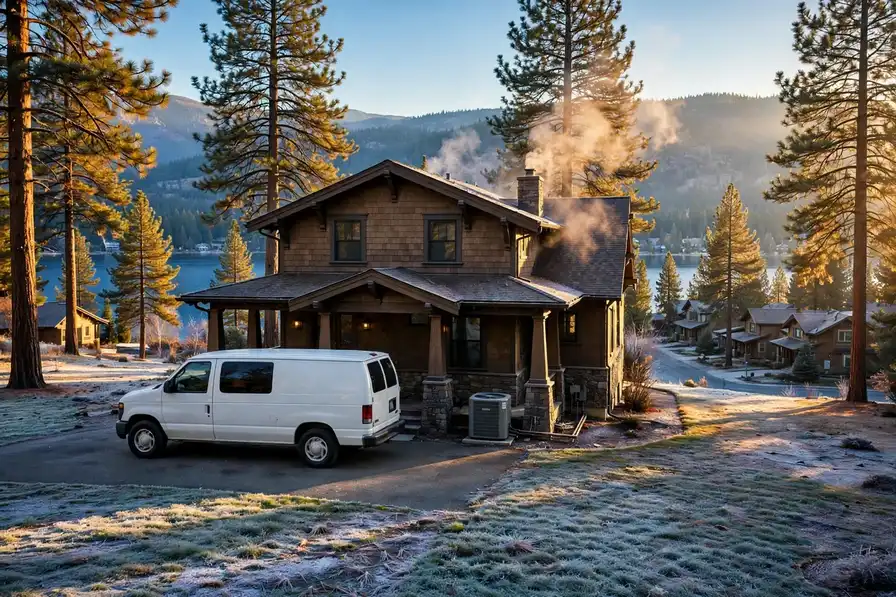


This is Coeur d'Alene's heating and cooling page, built from Coeur d'Alene's own numbers: Census housing figures, the metro's ZIP codes and its NOAA climate record. TempReach USA routes your call to an independent local HVAC technician; the homework below is here so you know your home's likely problems before you ever make it.
Call center hours: Mon-Fri 7:00 AM-10:00 PM ET | Sat 8:00 AM-10:00 PM ET | Sun 7:00 AM-9:00 PM ET
The median Coeur d'Alene home was built in 1995; 30.4% of the stock predates 1980, and the pattern this metro's own data ranks first is uneven temperatures and airflow across the house. TempReach USA is a referral service, not an HVAC company: one call connects you with an independent local HVAC technician serving your ZIP code.
Two numbers frame everything that follows: 72.2% of Coeur d'Alene homes are owner-occupied, and the median one was built in 1995. Ownership matters to HVAC because owners inherit their systems whole — every equipment decision a builder made in the 1990s or earlier is still in the attic, the closet and the side yard, ageing on its original schedule. With 30.4% of homes predating 1980 and 41.2% arriving since 2000, the metro is really two housing stocks sharing one map, and they are taken separately below before the problems are ranked.
Stand in one of Coeur d'Alene's older neighbourhoods and you are standing in its HVAC's back catalogue. The homes there — part of the 23,716 built before 1980 across this metro — went up when a furnace was built to serve for a generation and central cooling was still spreading street by street. That generation has now elapsed several times over. What it leaves behind is not universal failure but universal exposure: every duct joint, igniter and condenser coil in those districts is operating past the horizon its makers planned for, in Kootenai County and beyond, and the failures arrive in the order the parts tire.
Growth wrote this metro's newest HVAC chapter in matched equipment and planned ducts: systems sized as a single design, controls by the catalogue, outdoor units placed by the plat across the subdivisions near Post Falls and Hayden. The chapter is young — its systems have decades in hand — but it is not exempt from the metro's arithmetic: 507 cooling degree days of demand work its condensers hard, and the winters test its heat pumps with the same cold that tests the oldest furnace in Kootenai County.
The climate written over all of it comes from the NOAA station at SPOKANE FELTS FLD, WA US: an average year brings 6,019 heating degree days, 507 cooling degree days and 17.36 inches of precipitation. Those are not abstractions to a furnace or a condenser — they set how many hours a heating system runs each winter, how hard a cooling system cycles in July, and how much moisture every coil has to pull out of the indoor air. The problem sections that follow are selected by exactly these numbers, combined with the housing-age profile above.
Housing eras and climate, joined — the two datasets every section of this page is built from.
Break the stock down by building era and the profile sharpens. Before 1960: 10.5% of homes, roughly 8,191 of them. From 1960 to 1979: 19.9%, about 15,525. From 1980 to 1999: 28.4%, about 22,156. Since 2000: 41.2%, about 32,141. Four eras, four equipment generations — and the balance among them is this metro's HVAC character in a single paragraph.
A metro that mostly built itself after 2000 has HVAC with a distinctive trait: uniformity. The same subdivisions, the same system designs, the same installation years — and therefore the same maintenance waves, arriving at the same streets in the same seasons. Coeur d'Alene's older pockets still produce the deepest individual jobs, but the volume lives in the new stock: condensers cycling together, thermostats ageing together, heat pump questions surfacing together. Reading those waves early is most of what local knowledge means here.
Second in the table, the 1980-1999 band: 22,156 homes, 28.4% of the metro. Its systems are mature rather than ancient — ducts still sound, first-generation efficiency equipment wearing toward its verdicts, controls reaching their wear points in waves — and its HVAC is the schedulable kind: work that rewards being booked before it becomes urgent.
Start the climate half where the system starts: at the thermostat's two seasons. Coeur d'Alene's cooling answers 507 cooling degree days of load and its heating answers 6,019 heating degree days of cold at SPOKANE FELTS FLD, WA US — an average temperature of 49.8 degrees that no individual week actually delivers. A heating and cooling system here is never in neutral; the record keeps it working at one end or the other all year.
That is the whole method of this page in one section: era shares from the Census, loads from NOAA, and a problem list that is simply where the two overlap most in Coeur d'Alene. The services and guidance that follow are ordered by the same profile — local first, generic last.
Selected and ranked from this metro's housing-age profile and climate record — not copied from another city's page.
There is a daily rhythm to the complaint that helps diagnose it. Rooms that diverge mostly in the afternoon are reporting solar load and roof heat; rooms that diverge all day are reporting delivery; a house whose floors swap roles between summer and winter — upstairs hot in July, downstairs cold in January — is reporting stack effect and a single system asked to average two buildings' worth of physics. In Coeur d'Alene all three rhythms run through the housing stock, sorted loosely by plan and era: the two-storey colonials of the growth decades, the sprawling single-level homes whose far wings were always a duct run too far, the renovated houses whose additions rewrote the load map without rewriting the network. Naming the rhythm correctly is most of the work; the remedy, once the name is right, is usually obvious to homeowner and technician alike.
Airflow is the substrate everything else stands on, and its rules are unforgiving. A blower moves a volume of air against the network's resistance; lengthen a run, crush a section, close registers, or clog the path and the volume redistributes itself according to physics, not intention — favoring short, wide, open paths and starving long ones. Balancing is the craft of arranging that redistribution deliberately: damper positions, register adjustment, return paths sized for the supply they serve. In a Coeur d'Alene home the balance drifts over the years as filters load, furniture rearranges the rooms' air, renovations close paths that used to be open, and duct sections sag or separate. A system can therefore be out of balance without anything being broken — which is both the good news and the diagnostic difficulty, since the remedy is a methodical walk of the whole network rather than a replaced part.
The solar arithmetic testifies daily: on the 28.8 days a year at 90 degrees or more recorded at SPOKANE FELTS FLD, WA US, a roof-loaded second storey is a measurably hotter building than the floor below it, served by the same machine and judged by the same single thermostat. The divergence is not a malfunction; it is the design being outvoted by physics.
There is a paperwork side to the transition that touches Coeur d'Alene homes quietly. Refrigerant work is regulated work: recovery, handling and record-keeping rules apply to whoever services a system, and the newest refrigerants — mildly flammable by classification — arrive with their own sensors, labeling and code provisions that installers must follow. For the homeowner the visible part is small: a nameplate with a different designation, a technician explaining why a charge is measured and documented as it is, an installation that includes leak-detection provisions the older system never had. The invisible part matters more over time: as the newest generation becomes the metro's standard, parts, training and service practice consolidate around it, and the older generations become the specialty work. Owning an older-generation system is not a fault — but its service ecosystem is, year by year, becoming a smaller room.
A transition-aware service visit has a recognizable order. First, identification: the nameplate's refrigerant, model and year, stated aloud so the household and technician share the fact. Second, the leak question, taken seriously — a system low on charge has a leak until proven otherwise, and recharging without finding it is buying the same refrigerant twice on an installment plan. Third, the condition audit around the failure: compressor health, coil condition, electrical wear, because the decision the household faces is about the whole machine, not the one part that stopped. Fourth, the comparison itself, presented as what it is — the repair path with its realistic horizon, the replacement path with its — so the choice is made on the machine's merits and the household's plans for the home. In Coeur d'Alene that conversation, held in a calm season, is unhurried and genuinely optional-feeling; held in a heat wave, the same facts arrive wearing a deadline.
Housing arithmetic shows the exposure: with 30.4% of Coeur d'Alene's homes built before 1980 and equipment replaced in long cycles ever since, a substantial share of the metro's systems belong to refrigerant generations the market has already succeeded. The nameplates say so, one address at a time.
A furnace earns its keep in the weeks a Coeur d'Alene winter stops being polite. The record at SPOKANE FELTS FLD, WA US counts 123.3 nights a year at or below freezing and 6,019 heating degree days across the season, and in the coldest stretches a furnace that idled through autumn runs nearly without pause. That duty wears the parts that move and the parts that ignite: inducer and blower motors accumulate hours, igniters cycle thousands of times, flame sensors foul a little with every firing, and heat exchangers expand and contract through temperature swings that test their metal daily. The failures that follow have a rhythm homeowners recognize — a furnace that lights and quits, one that runs but heats unevenly, one that was fine in November and silent in the coldest week of January. Cold does not usually break a sound furnace; it collects the wear the furnace had been carrying quietly, and it collects at the moment the household can least spare the heat.
The wear itself follows the physics of the machine. A gas furnace lives by controlled fire: it must move air across a heat exchanger that swings from room temperature to several hundred degrees and back, many times a day, all winter. Metal fatigues under that cycling — slowly, invisibly, and faster in a unit that short-cycles because of a dirty filter or an oversized installation. Ignition components live an equally hard life at the small scale: a hot-surface igniter is a ceramic element heated to glowing in seconds, and each heating is a thermal shock. In Coeur d'Alene's 6,019 heating degree days, a furnace may fire tens of thousands of times across its life. The season's failures are rarely mysteries; they are the arithmetic of cycles, arriving on schedule in the coldest weeks because that is when the cycles concentrate.
Housing adds its evidence: with a median build year of 1995, much of Coeur d'Alene's heating plant serves homes whose ductwork and insulation ask more per cold night than modern construction would. The furnace wears against the house as well as the weather.
This is the season the metro's housing is examined by the weather, and the examination is practical: heating plant against 6,019 heating degree days, envelopes against 123.3 freezing nights, condensate lines and vent terminations against snow and ice. The older districts sit the hardest paper — systems of advancing age serving the 23,716 pre-1980 homes across the metro — but no system is exempt; a new furnace with a frozen condensate run stops as completely as an old one with a spent igniter. Between cold snaps, the season's quieter work continues — filters loading, ducts breathing with the temperature swings — and the households that keep the small rhythm are the ones the big cold never gets a chance to interview.
The season loads Coeur d'Alene's systems the way its record at SPOKANE FELTS FLD, WA US says it will: 6,019 heating degree days against 507 cooling degree days in an average year, against a housing stock whose median build year is 1995. The households that read the season early — filters, drains, a system run before the extreme weeks — are the ones whose calls stay schedulable.
Beneath the geometry sits a quieter truth: the single thermostat was a compromise the industry made with smaller, simpler houses, and Coeur d'Alene's housing has outgrown it. A modern household also lives unevenly — bedrooms empty all day while a home office is occupied, a nursery that must hold its temperature while the rest of the house sets back, an elderly parent's suite kept warmer than the family prefers. Those are scheduling and zoning needs no single measurement point can express. The deep pattern is therefore not a defect in any particular home; it is a mismatch between a one-number control and a many-room life, arriving in this metro as its homes grew larger and its households' patterns more varied. The remedies — zones, dedicated room equipment, controls that measure where people actually are — are the industry catching up to the floor plans it helped create.
Strip the pattern down to its inputs and the ranking stops being mysterious: 69,104 households depending on systems installed across a median build year of 1995, in a climate that swings between 28.8 days of serious heat and 123.3 freezing nights. Whatever pattern a metro with those inputs manufactures most, it manufactures here — the lead position is less a title than a consequence, recalculated from the same public records any sceptic can check.
Experienced local practice starts with the simple certainties — the observations that take minutes and decide the most:
Listed in the order this metro's housing and climate data supports.
Through TempReach USA, a Coeur d'Alene ductless installation is quoted as a complete design before work begins: units, positions, line routes, drainage and electrics, each room's reasoning shown.
Mini-splits also answer a Coeur d'Alene housing pattern the census tables only hint at: the multigenerational home, the converted space, the workshop that became an office. Across 69,104 households, the rooms that need conditioning keep multiplying faster than duct systems can follow, and a ductless head follows in an afternoon's installation where a duct extension would take a renovation. The assessment stays the same — the space, its exposure, its use — but the question it answers is as much about how the household lives as how the house was built. That is the daily reality for the 69,104 households spread across Kootenai.
The search territory for ductless is the metro's unducted stock: 8,191 pre-1960 homes built before central systems, plus the additions and conversions scattered through 69,104 households — in Post Falls and the historic core alike, spaces the main system never reached.
Every repair through TempReach USA follows the same order: diagnosis at the equipment, findings explained, quote given before work begins, and a full test cycle before the technician leaves your Coeur d'Alene home.
Ask what fills an AC repair diary in Coeur d'Alene and the answer is written in its housing. The median home was built in 1995, and a good share of the metro's cooling equipment is older than the homes' current owners realise — units sized for a different era of insulation, charged with refrigerant generations that have since been phased down. A system in Kootenai County that cools a little less each summer is telling a story in instalments, and the repair visit reads the whole story: pressures, airflow, the coil's condition, the duct losses behind the walls. In Coeur d'Alene that holds across 11 ZIP codes, from Coeur d'Alene out to Hayden.
Count the exposure from the Census side: a median build year of 1995 across 78,013 housing units means half the metro's air conditioners are older than the systems in the growth suburbs around Rathdrum, and summer runtime is the statistic that matters — the repair calls follow it street by street.
The lights-then-dies pattern in a Coeur d'Alene home is most often a flame sensor whose signal has weakened with oxidisation; measured in minutes by a professional, misdiagnosed for weeks by guesswork.
There is a safety grammar to furnace repair in Coeur d'Alene that every visit observes: combustion checked, venting verified, the exchanger's integrity read before comfort is discussed. A cracked exchanger or a lazy flame is not a comfort fault wearing a disguise; it is the one finding that changes the visit's whole direction. In a metro where 23,716 homes predate 1980 and their furnaces have been swapped into ageing duct systems more than once, that grammar is the difference between a repair and a recommendation — and honest technicians here will show the homeowner the evidence either way. Ask in Rathdrum and the answer rhymes with Coeur d'Alene: same eras, same equipment generations, same calendar of failures.
Under Coeur d'Alene's winters lie 6,019 heating degree days a year, and the furnaces answering them include the ageing units of the 23,716 pre-1980 homes alongside the electronic systems of the new subdivisions. The repair diary in Spirit Lake reads both ends of that stock in a single week.
In Coeur d'Alene, emergency means weather-relative: 6,019 heating degree days put no-heat calls on a freezing clock each winter, while 507 cooling degree days make a dead system a health question each summer — the call center triages against both, using the hours shown on this page.
Coeur d'Alene homes heat through 6,019 heating degree days and cool through 507 cooling degree days a year, so the blower runs in both seasons and the ducts never rest — which is why what has settled in them matters here in every month, not just one.
From Coeur d'Alene to Rathdrum, Coeur d'Alene replacements routed through TempReach USA end in commissioning — measured charge and airflow — so the installed system matches the calculated one.
From Coeur d'Alene to Rathdrum, Coeur d'Alene installations routed through TempReach USA finish with commissioning — combustion, temperature rise and airflow verified — so the fitted system is the specified system.
Heat pump services in Coeur d'Alene test the whole year-round system: the independent local professional covering Kootenai reads charge and airflow in both modes, proves defrost, and checks auxiliary heat logic before quoting any work.
Across Kootenai, the housing split decides the starting point: older, leakier homes around Coeur d'Alene usually need filtration and moisture work first, while tighter newer builds in the 11 covered ZIP codes usually need deliberate ventilation most.
Across Kootenai, one climate fact shapes the configuration: 6,019 heating degree days against 507 cooling degree days tells whether the control's year is mostly a heating story, mostly a cooling story, or a genuine heat pump balancing act.
In Coeur d'Alene, the maintenance calendar writes itself from the climate: 6,019 heating degree days and 507 cooling degree days mean both systems work a real season, so the fall and spring visits each have genuine work to inspect.
Coeur d'Alene's commercial buildings span every era around a median build year of 1995 — and with the era goes the equipment, from aging single units over old storefronts to multi-zone systems in new developments, all serviced from a per-unit record.
Ask where this metro's HVAC diary fills up and the answer is a short story: Uneven temperatures and airflow across the house first, the refrigerant transition reaching older systems close behind, and the services that answer them doing the bulk of the booked work. Everything else on the list above is the supporting cast — necessary, frequent enough, but not what Coeur d'Alene's housing stock, at its age and in its climate, principally demands. Read the service list as a weather report for the metro's systems and it stops looking like a catalogue.
PROBLEM SOLUTION
Population 55,558
Population 41,716
Population 16,021
Population 10,133
Population 2,526
Population 1,768
Population 901
Population 896
Population 830
Population 308
Population 249
Population 243
Also in the Coeur d'Alene metro: Huetter (population 219), Fernan Lake Village (population 138).
Read the grid as a building programme spread over a century. The oldest communities sit where the metro began; the youngest are still adding streets at its edge; and Post Falls and Hayden, with 41,716 and 16,021 residents, stand for the rings in between. Each ring was fitted in its era's equipment, and each is now failing, wearing or holding in its era's characteristic order. The ZIP codes below draw the coverage boundary; the eras inside it draw everything else on this page — the problems ranked, the services ordered, the checks advised.
The map continues: Rathdrum (10,133), Dalton Gardens (2,526), Spirit Lake (1,768), Hayden Lake (901), Hauser (896). Different names, different decades — each community in Kootenai was fitted with heating and cooling in its own growth years, which is why two streets in the same metro can need entirely different HVAC conversations. The ZIP list below is the working definition of coverage; the housing behind each code is the working definition of the job.
Every metro has a first city and a supporting cast, and the census figures draw the billing plainly here: Coeur d'Alene first, with 55,558 residents; Post Falls second at 41,716; Hayden third at 16,021; then the long tail of smaller communities in the grid above. The billing matters less than the building dates — each of these places was fitted with heating and cooling in its own decade, by its own builders — but between them they account for nearly every housing era, equipment generation and failure pattern this page describes.
Administratively the metro is drawn from Kootenai — 1 in all — with Kootenai County at its centre. County lines do not change how a system runs, but they do shape the paperwork around the work: permits, inspections and code details are county and city business, which is one reason the professional who serves your street is a local one.
This page ends at the metro boundary, but the region does not: Boise, ID, Idaho Falls, ID and Spokane, WA continue the coverage in their own directions, each with a profile built from its own Census and NOAA figures. If your home sits near the line between metros, go by your ZIP code — it places you in the dataset that describes your housing.
The region around Coeur d'Alene is a set of variations on its theme: Boise, ID, 287 miles off, runs a median build year of 1996 on a metro population of 864,243; Idaho Falls, ID (349 miles) medians 1985 on 173,851; Spokane, WA (49 miles) medians 1978 on 608,012. Nearness is not sameness — a few decades of median build year separate their heating and cooling as surely as the miles separate their maps.
The stock has a shape as well as a size. Owners hold 72.2% of it and renters 27.8%, a split that decides who notices a comfort problem first and who arranges the repair. The generations split 0.7-to-one in favour of the pre-1980 homes. And the map divides into 14 named communities across Kootenai, each carrying its era's share of the 78,013 housing units the Census counts here.
The Coeur d'Alene record in one line — median home age: 31 years · owner-occupied homes: 49,893 · renter-occupied homes: 19,211 · pre-1960 homes per covered ZIP code: 745 · heating-to-cooling degree-day ratio: 11.88 · average rainfall: 441 mm a year.
County pages carry the local detail — land area, climate normals and the heating and cooling pressures on the ground in each county.
More plain-language help: the TempReach USA heating & cooling guides
TempReach USA routes your call to an independent local heating and cooling professional serving Coeur d'Alene — the assessment and the work are theirs.
Call center hours: Mon-Fri 7:00 AM-10:00 PM ET | Sat 8:00 AM-10:00 PM ET | Sun 7:00 AM-9:00 PM ET