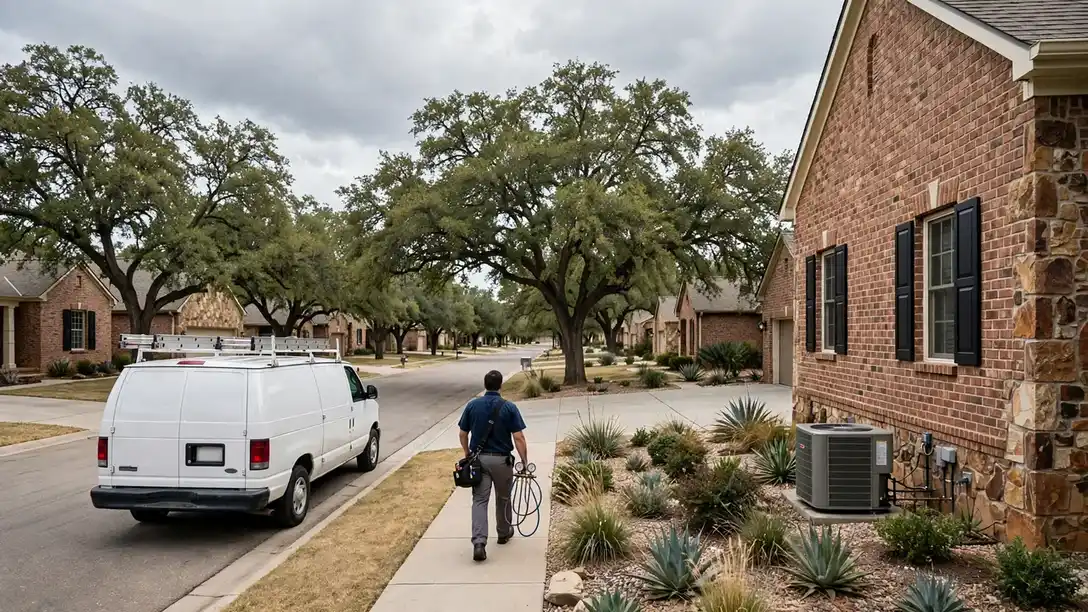


Everything on this page was computed for Abilene and nowhere else: the problem ranking from its Census housing profile, the seasonal risks from its NOAA station record, the coverage from its own ZIP codes. TempReach USA connects you to an independent local HVAC technician; the page itself is the homework, done in public, so the call you make is an informed one.
Call center hours: Mon-Fri 7:00 AM-10:00 PM ET | Sat 8:00 AM-10:00 PM ET | Sun 7:00 AM-9:00 PM ET
The median Abilene home was built in 1976; 54.9% of the stock predates 1980, and the pattern this metro's own data ranks first is the refrigerant transition reaching older systems. TempReach USA is a referral service, not an HVAC company: one call connects you with an independent local HVAC technician serving your ZIP code.
Abilene is a metro of 178,244 people and 65,655 households, and its heating and cooling is a portrait of its building history. The median home here was built in 1976; 54.9% of homes predate 1980 and 33.1% predate 1960, while 20.8% have arrived since 2000. Every one of those eras heated and cooled differently — different furnaces, different duct designs, different refrigerant generations — and they fail differently, which is why this page is organised around the patterns the data actually produces in Abilene rather than HVAC in the abstract.
Stand in one of Abilene's older neighbourhoods and you are standing in its HVAC's back catalogue. The homes there — part of the 41,265 built before 1980 across this metro — went up when a furnace was built to serve for a generation and central cooling was still spreading street by street. That generation has now elapsed several times over. What it leaves behind is not universal failure but universal exposure: every duct joint, igniter and condenser coil in those districts is operating past the horizon its makers planned for, in Callahan County and beyond, and the failures arrive in the order the parts tire.
The growth side of the metro tells the opposite story in the same language. Potosi, Clyde and the subdivisions still filling in account for much of the 15,634 homes built since 2000 — matched systems, planned ductwork, heat pumps where the lots suit them. Their HVAC is not old; it is uniform, which creates its own calendar: everything installed in the same boom reaches each wear point in the same years, from the first condenser replacements to the first control-board failures, while 2,696 cooling degree days of annual heat keep demand on the system high.
The weather's part in this is written at ABILENE RGNL AP, TX US, where an average year carries 25.24 inches of precipitation, 102.4 days at ninety degrees or more and 47.7 nights at freezing or below. Systems experience that year as workload and as stakes in roughly equal measure — the workload in the run hours, the stakes on the single coldest night and the single hottest week. The problem ranking further down is simply the housing profile above, read under this sky.
Two public records, one metro: what was built here, and what the sky does to it.
The distribution, in one breath: of every hundred Abilene homes, 33.1 were standing before 1960, 21.8 went up in the two decades after, 24.2 in the two after that, and 20.8 have arrived since 2000. Percentages flatten the picture, so hold the counts beside them — 24,879 oldest-era homes, 15,634 newest — and the metro's heating and cooling stops being an abstraction: it is that many systems, of those ages, failing in that order.
Some metros are defined by their growth; this one is defined by its inheritance. The largest share of Abilene's homes was built before 1960, and inheritance in HVAC means system designs from another era serving households who did not choose them. The work that follows from that fact is the metro's staple: furnaces renewed, condensers renewed, ducts sealed and rebalanced — the patient, house-by-house modernisation of a founding stock. Newer districts exist and matter, but they are not where this metro's HVAC character was decided.
Second in the table, the 1980-1999 band: 18,190 homes, 24.2% of the metro. Its systems are mature rather than ancient — ducts still sound, first-generation efficiency equipment wearing toward its verdicts, controls reaching their wear points in waves — and its HVAC is the schedulable kind: work that rewards being booked before it becomes urgent.
A profile needs its climate column, and Abilene's comes from ABILENE RGNL AP, TX US: an average year of 66.0 degrees, built from extremes at both ends. The heating load (2,319 degree days) and the cooling load (2,696) together set the system's working life; the precipitation total (25.24 inches) sets the moisture the cooling half must remove; the freeze count (47.7 nights) sets the stakes of every heating failure. Four numbers — and most of the metro's HVAC behaviour follows from them.
That is the whole method of this page in one section: era shares from the Census, loads from NOAA, and a problem list that is simply where the two overlap most in Abilene. The services and guidance that follow are ordered by the same profile — local first, generic last.
Sequenced by this metro's own problem ranking, not by a national catalogue order.
The local professional you are connected with reads the system the way it fails: electrical values first, then temperatures and pressures, then airflow, until one finding explains all of the symptoms at once.
Air conditioning in Abilene works against the local calendar: 2,696 cooling degree days a year at ABILENE RGNL AP, TX US, with 102.4 days at 90 degrees or more. The failures follow that load — capacitors and contactors worn by relentless summer cycling, refrigerant charges drifting low on systems that have served a decade of heat, condensate drains clogging in the humid weeks. The older districts run the oldest condensers; the subdivisions around Abilene run matched fleets installed in the same seasons, and both sides of the metro meet the repair call on the hottest week of the year. Count it in homes if you prefer: 41,265 built before 1980, 15,634 since 2000, one shared system of streets and seasons.
The local caseload behind this service is written in the climate figures: 2,696 cooling degree days a year and 102.4 days at 90 or above, pressing on a cooling fleet whose oldest members serve the 41,265 pre-1980 homes — in Potosi (4,524 residents) as much as in the oldest districts.
The evidence lives in the returns. Matted dust, debris from construction, hair woven into the load: that is the case for cleaning, made by the ductwork itself. A light film in a tidy system is the case for waiting, and an honest visit says so.
A word on timing, since Abilene households ask: duct cleaning earns its appointment when the evidence calls for it — after construction or renovation dust, when a home changes hands after years of one household's accumulation, when the registers show visible load or the blower compartment tells the story. Booked on evidence, it is honest work with visible results. Booked on a calendar superstition, it is a van ride. Local technicians who work from the evidence are the ones this page's routing favours, in Abilene and across the metro alike. That is the daily reality for the 65,655 households spread across Callahan, Jones, Taylor.
Duct demand concentrates in the metro's long-biography homes: 41,265 pre-1980 systems that have carried decades of household air, and the renovated homes around Merkel (2,630 residents) whose construction dust is still in the runs.
The condition report is the product that outlasts the visit. Specific measurements, watch items named, urgency ranked — and next year's visit comparing against this year's numbers, so drift becomes visible before it becomes failure.
Maintenance in Abilene is a calendar with two appointments a year, written by the climate: one before the 102.4 hot days arrive, one before the 47.7 freezing nights do. The cooling visit works the outdoor unit — coils washed, refrigerant pressures read, capacitors and contactors tested, the condensate drain cleared before the humid weeks can clog it. The heating visit works the furnace or heat pump — burners and ignition, the exchanger's condition, venting, airflow. Between them they catch the failures this metro's systems rehearse every year, while those failures are still small. It is why two Abilene homes of the same age, on different streets, so often need the same visit in the same year.
Tune-up demand follows the fleet's waves: the subdivisions' matched systems reaching service points together, the pre-1980 districts' individual units on individual schedules. Anson sits inside one of those patterns; the readings taken there this season predict its systems' next one.
In Abilene, air work follows the climate ledger: 2,319 heating degree days dry the indoor air out each winter while 2,696 cooling degree days load it with humidity each summer — most homes here need the humidity answer in both directions across the year.
With a median build year of 1976, many Abilene systems are reaching replacement age together; the professional you are connected with inspects ducts and electrics across 23 ZIP codes before recommending equipment.
From Abilene to Merkel, a no-heat call through TempReach USA reaches a local professional whose visit includes the exchanger and venting checks that furnace work owes a Abilene household.
From Abilene to Merkel, Abilene installations routed through TempReach USA finish with commissioning — combustion, temperature rise and airflow verified — so the fitted system is the specified system.
From Abilene to Merkel, Abilene heat pump calls through TempReach USA reach a local professional who explains findings plainly and quotes after assessing — in the heating season and the cooling season alike.
Across 23 ZIP codes, Abilene mini-split systems installed through local professionals are commissioned zone by zone in heating and cooling, with the filter and drain routine handed over in person.
Across Callahan, Jones, Taylor, one climate fact shapes the configuration: 2,319 heating degree days against 2,696 cooling degree days tells whether the control's year is mostly a heating story, mostly a cooling story, or a genuine heat pump balancing act.
One call from anywhere in Abilene's 23 covered ZIP codes reaches the routing: the failure's details taken, safety advice given on the spot, and the visit sequenced the same way everywhere — safety, stabilization, diagnosis, then repair or an honest scope.
Abilene's commercial buildings span every era around a median build year of 1976 — and with the era goes the equipment, from aging single units over old storefronts to multi-zone systems in new developments, all serviced from a per-unit record.
Two patterns generate most of the bookings behind the services above: The refrigerant transition reaching older systems and leaky ducts losing air and energy. That is why the order of this page's service list is what it is — the services answering those patterns come early, and the rest follow in the order the metro's data supports. A homeowner whose home matches the local profile — built in the metro's big decades, in one of its older districts — is, statistically, reading their own shortlist.
Chosen by this metro's own housing and weather data — the same two records this whole page is built from.
A generation change is moving through Abilene's cooling equipment, and it arrives one repair decision at a time. For decades, residential systems ran on R-22; production and import of that refrigerant ended in the United States in 2020, so the supply that remains is reclaimed stock, and servicing a leaking R-22 system means weighing a scarce, aging refrigerant against the age of the machine it serves. Newer systems moved to R-410A, and equipment now arriving uses lower-impact refrigerants such as R-454B, with their own handling and code requirements. The transition matters to a homeowner at specific moments: when an older system needs a charge, when a coil or compressor fails on a machine whose refrigerant is effectively retired, when a repair quote must be compared honestly against replacement. Nothing about it is a reason for panic — R-22 systems are not banned from being serviced — but every significant repair on one is now also a planning conversation, and households in Abilene with equipment from the R-22 era benefit from having it before the hottest week, not during it.
A transition-aware service visit has a recognizable order. First, identification: the nameplate's refrigerant, model and year, stated aloud so the household and technician share the fact. Second, the leak question, taken seriously — a system low on charge has a leak until proven otherwise, and recharging without finding it is buying the same refrigerant twice on an installment plan. Third, the condition audit around the failure: compressor health, coil condition, electrical wear, because the decision the household faces is about the whole machine, not the one part that stopped. Fourth, the comparison itself, presented as what it is — the repair path with its realistic horizon, the replacement path with its — so the choice is made on the machine's merits and the household's plans for the home. In Abilene that conversation, held in a calm season, is unhurried and genuinely optional-feeling; held in a heat wave, the same facts arrive wearing a deadline.
The regulatory facts are the foundation: R-22 production and import ended in the United States in 2020, leaving reclaimed stock as the supply, while new equipment has moved through R-410A to the current lower-impact generation. In Abilene every generation still stands in service — the transition is not coming to this metro; it is distributed across it, yard by yard.
The rooms tell the story before any instrument does. In a Abilene home with tired ductwork, the pattern is geographic: the rooms nearest the air handler are comfortable, the far rooms lag, and the rooms over the longest or leakiest runs barely participate. Households adapt without noticing — a fan in the far bedroom, a space heater in the end office — treating as architecture what is actually plumbing for air. Duct runs installed in the metro's big building decades have now spent years in attic heat and crawl-space damp; flex sections sag, inner liners tear, and connections at the plenum work loose a fraction with every season's expansion and contraction. The equipment cycles faithfully and the house still under-delivers, because a system can only condition the air that actually arrives.
Households judge their heating and cooling at the thermostat, but the thermostat only reports the room it sits in. Judge the system at its furthest register instead: the air arriving there, its temperature against the supply at the unit, its volume against the room's need. In Abilene that furthest room is the honest auditor of the duct network — it inherits every leak, every sag and every degree of attic heat between it and the air handler. The homes whose far rooms match their near rooms have networks that were sealed when they were built and checked as they aged. The homes whose far rooms lag are not necessarily homes with weak equipment; they are homes whose delivery network has been quietly resigning, joint by joint, while the equipment took the blame and the service calls. The register, not the nameplate, is where the resignation is announced.
Consider the delivery assumption: every system in Abilene was sized on the expectation that its air would arrive. With 54.9% of homes built before 1980 — and their networks renovated, extended and re-sealed by turns ever since — that expectation's reliability varies house by house, which is why the measurement, not the assumption, has to govern.
An ageing system rarely announces its age in one event. It negotiates. In Abilene the negotiation sounds like a house that takes longer to cool on the same afternoon weather, a furnace that needs two cycles to do what one did, a blower audible through a vent that used to be silent. The equipment in the metro's the 1970s homes has usually been repaired in pieces across the years — a motor here, a board there — so its age is not a single number but a profile of generations bolted together. That profile is what a thorough maintenance visit actually reads: which components are original, which are renewed, and where the next failure is most likely to file from. Households that know their system's profile make calm decisions; households that meet it for the first time in a breakdown make hurried ones.
The mechanics of ageing are unglamorous and cumulative. Bearings wear and draw more current. Capacitor values drift downward year by year, weakening every start they assist. Coil surfaces oxidize and foul, shedding their ability to exchange heat a fraction at a time. Refrigerant leaves through seals and joints at a pace too small to notice in a season and large enough to matter in five. Electrical connections loosen under thermal cycling and add resistance that becomes heat. None of these processes stops, but most of them are measurable long before they are fatal — which is precisely what separates maintenance from repair. A tune-up measures the drift; a repair replaces whatever the drift finally claimed. The household that buys measurement regularly buys the choice of when to spend on renewal, and that choice is worth the most on the oldest equipment.
Look at the replacement echoes: the 15,634 homes built since 2000 are now carrying first-generation equipment deep into its service life, joining the older cohorts. In Abilene, ageing is not a niche condition of old houses; it is the metro's standard equipment profile.
The season does not need to be survived in one heroic effort; it needs to be read in chapters. Early heat exposes weak starting parts. The long middle stretch exposes capacity — systems sized or charged marginally fall behind a degree at a time while running without pause. The humid weeks expose drainage, as condensate runs at full volume and a slowing drain announces itself. Late season exposes fatigue, when components worn by months of starts begin to fail on ordinary days. Between chapters, the household's work is mostly attention: a filter's condition, a drain's flow, the sound of a startup, the temperature at a far register. The season is the metro's longest HVAC fact — 2,696 cooling degree days of it — and it rewards the households that pace their systems through it instead of discovering it all at once.
The season loads Abilene's systems the way its record at ABILENE RGNL AP, TX US says it will: 2,319 heating degree days against 2,696 cooling degree days in an average year, against a housing stock whose median build year is 1976. The households that read the season early — filters, drains, a system run before the extreme weeks — are the ones whose calls stay schedulable.
There is a supply-side depth as well. A shrinking refrigerant does not vanish; it circulates — recovered from retired systems, reclaimed to specification, and returned to service at an expense that reflects the shrinking pool. In Abilene that means the R-22 in a system serviced this year may have cooled three other homes before it, and may cool another after this system retires, provided it is recovered rather than vented. The chain gives older equipment a managed twilight rather than a cliff: service remains possible, performed by technicians qualified for the work, for as long as the economics hold for the household. Understanding that chain replaces two common errors — that old systems are already unserviceable, and that they can be serviced forever as cheaply as ever — with the true picture: a gradually tightening supply, a gradually aging fleet, and a decision that improves with information and worsens with delay.
The numbers underneath it, for Abilene: 75,164 housing units, a median build year of 1976, and a climate record at ABILENE RGNL AP, TX US of 2,319 heating degree days against 2,696 cooling degree days. Cross the housing record with the weather record and this pattern is what falls out at the top — rarely the most dramatic problem in heating and cooling, but the one this metro's stock and climate manufacture most steadily.
On a first visit for this pattern, a local technician's checks run in a practised order:
PROBLEM SOLUTION
Population 127,130
Population 4,524
Population 3,899
Population 2,630
Population 2,178
Population 1,765
Population 1,687
Population 1,089
Population 989
Population 933
Population 580
Population 508
Also in the Abilene metro: Lawn (population 347), Putnam (population 41).
Read the grid as a building programme spread over a century. The oldest communities sit where the metro began; the youngest are still adding streets at its edge; and Potosi and Clyde, with 4,524 and 3,899 residents, stand for the rings in between. Each ring was fitted in its era's equipment, and each is now failing, wearing or holding in its era's characteristic order. The ZIP codes below draw the coverage boundary; the eras inside it draw everything else on this page — the problems ranked, the services ordered, the checks advised.
Beyond the largest communities sit Merkel (2,630), Hamlin (2,178), Anson (1,765), Baird (1,687), Cross Plains (1,089) — smaller places across Callahan, Jones, Taylor, covered on the same terms. Their housing tends to be older on average than the big suburbs', and their calls follow the older patterns on this page. One routing covers them all: find your ZIP code below and the rest is a phone call.
Every metro has a first city and a supporting cast, and the census figures draw the billing plainly here: Abilene first, with 127,130 residents; Potosi second at 4,524; Clyde third at 3,899; then the long tail of smaller communities in the grid above. The billing matters less than the building dates — each of these places was fitted with heating and cooling in its own decade, by its own builders — but between them they account for nearly every housing era, equipment generation and failure pattern this page describes.
Draw the metro by its paperwork and it resolves into Callahan, Jones, Taylor — 3 jurisdictions sharing one housing stock and one weather system. Callahan County holds the historic centre and the densest share of the older homes; the surrounding counties hold the rings of growth around it. Permits and inspections follow those boundaries even though temperature never does, which is part of why the technician this page connects you to works these streets specifically.
Three neighbouring coverage areas begin where this one ends: Wichita Falls, TX, some 116 miles off; Midland, TX, 135 miles; and Killeen–Temple, TX, 139 miles. Each keeps its own page because each keeps its own numbers — a different median build year, a different climate station, a different problem ranking. Boundary households should trust the ZIP list over the map: the code, not the compass, assigns the dataset.
Set Abilene among its neighbours and the contrasts sharpen the profile: Wichita Falls, TX — metro population 149,448, median build year 1973 — sits 116 miles away; Midland, TX (193,139, median 1989) 135 miles; Killeen–Temple, TX (511,497, median 1993) 139 miles. Three different housing stocks under three nearby skies, which is why each keeps its own page and its own problem ranking rather than borrowing this one.
Count the metro per unit of itself: 3,268 housing units per covered ZIP code; 21,885 households per county; 14 communities sharing 3 county governments. Then weigh the generations against each other — 2.6 older homes for each newer one — and the service pattern on this page stops being a list and becomes a proportion: that much of the diary written by ageing systems, the rest by young ones wearing in.
The Abilene record in one line — median home age: 50 years · owner-occupied homes: 41,691 · renter-occupied homes: 23,964 · pre-1960 homes per covered ZIP code: 1,082 · heating-to-cooling degree-day ratio: 0.86 · average rainfall: 641 mm a year.
County pages carry the local detail — land area, climate normals and the heating and cooling pressures on the ground in each county.
More plain-language help: the TempReach USA heating & cooling guides
TempReach USA routes your call to an independent local heating and cooling professional serving Abilene — the assessment and the work are theirs.
Call center hours: Mon-Fri 7:00 AM-10:00 PM ET | Sat 8:00 AM-10:00 PM ET | Sun 7:00 AM-9:00 PM ET