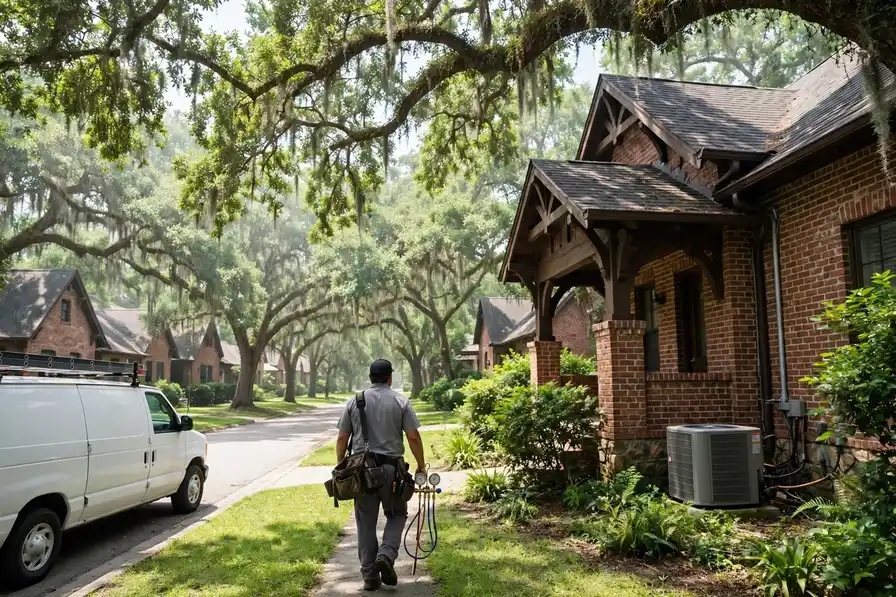


Everything on this page was computed for Lake Charles and nowhere else: the problem ranking from its Census housing profile, the seasonal risks from its NOAA station record, the coverage from its own ZIP codes. TempReach USA connects you to an independent local HVAC technician; the page itself is the homework, done in public, so the call you make is an informed one.
Call center hours: Mon-Fri 7:00 AM-10:00 PM ET | Sat 8:00 AM-10:00 PM ET | Sun 7:00 AM-9:00 PM ET
The median Lake Charles home was built in 1987; 42.1% of the stock predates 1980, and the pattern this metro's own data ranks first is humidity burden on homes and cooling systems. TempReach USA is a referral service, not an HVAC company: one call connects you with an independent local HVAC technician serving your ZIP code.
Two numbers frame everything that follows: 73.3% of Lake Charles homes are owner-occupied, and the median one was built in 1987. Ownership matters to HVAC because owners inherit their systems whole — every equipment decision a builder made in the 1980s or earlier is still in the attic, the closet and the side yard, ageing on its original schedule. With 42.1% of homes predating 1980 and 34.5% arriving since 2000, the metro is really two housing stocks sharing one map, and they are taken separately below before the problems are ranked.
The pre-1980 stock is where most of the metro's HVAC character lives. Homes from those decades in Calcasieu Parish County and across Calcasieu Parish, Cameron Parish, Jefferson Davis Parish were built with duct layouts from the first age of central systems, furnaces and condensers that have since been renewed piecemeal, and insulation standards from another era, and each of those choices is now at or beyond the age its makers expected of it. Owner-occupiers hold 73.3% of the metro's homes, so most of the people reading this page are reading about a system they own outright — one whose failures arrive as surprises only if nobody has looked at the pattern: cooling fading a little each summer, a furnace recovering a little more slowly, one room drifting a little further from the thermostat.
Growth wrote this metro's newest HVAC chapter in matched equipment and planned ducts: systems sized as a single design, controls by the catalogue, outdoor units placed by the plat across the subdivisions near Sulphur and Moss Bluff. The chapter is young — its systems have decades in hand — but it is not exempt from the metro's arithmetic: 3,063 cooling degree days of demand work its condensers hard, and the winters test its heat pumps with the same cold that tests the oldest furnace in Calcasieu Parish County.
One more record sits over the whole metro, and it is the one the equipment itself keeps: the weather's. LAKE CHARLES, LA US logs 59.75 inches of precipitation in an average year and swings between 88.5 days at 90 degrees or more and 10.9 nights at or below freezing. Heating systems ride that swing in their run hours; cooling systems ride it in their cycle counts; ducts ride it in the attics, expanding and contracting between the seasons. Cross the swing with the housing ages above and the selection of problems further down this page stops looking like a list and starts looking like an arithmetic result.
The metro's building eras on one side, its weather record on the other — and its heating and cooling where the two meet.
Lay the eras side by side instead: 18.8% pre-1960 (21,059 homes), 23.3% from 1960-1979 (26,100), 23.4% from 1980-1999 (26,212), and 34.5% since 2000 (38,646). No single era tells the story — the proportions among them do, and those proportions are different in every metro this site covers.
Growth is the headline in Lake Charles: the post-2000 band is the largest, much of it subdivisions fitted with matched modern systems and ductwork designed as a single plan. The work here is young-stock work — first replacements arriving in waves as whole streets age together, heat pumps standard where their neighbours have furnaces, controls and sensors failing in preference to iron. The metro's older pockets still generate the deep problems, but the volume of its HVAC future is being written in the new subdivisions.
The runner-up era is 1980-1999, with 23.4% of homes. That stock has left its carefree decades and entered its maintenance decades, and it shows in the call pattern around Sulphur and the other districts of those years: condensers on their second cycle, furnaces reaching their wear points together, ducts still young enough to reward attention over replacement.
The climate column of this profile is a workload statement. 1,315 heating degree days say how long the cold half of the year keeps furnaces and heat pumps working at their hardest; 3,063 cooling degree days say how relentlessly the hot half loads every condenser and coil; 10.9 freezing nights and 88.5 hot days mark the extremes where the failures concentrate. NOAA keeps these figures at LAKE CHARLES, LA US as thirty-year normals — which is to say, as the closest thing HVAC has to a settled forecast.
Hold the two halves together and the rest of this page explains itself: the problems ranked highest here are the ones where Lake Charles's dominant housing era and its climate record overlap. Change either dataset and the ranking changes — which is precisely why this profile is rebuilt from the records for every metro instead of carried over from the last one.
Selected and ranked from this metro's housing-age profile and climate record — not copied from another city's page.
Indoor air quality work begins, in a humid climate, with the admission that moisture is the master variable. Control the moisture and the mold risk falls, the dust mite population thins, the musty chemistry of damp materials quiets, and the cooling system stops fighting a second invisible load. In Lake Charles that control is a layered project: the envelope and crawl space deciding what enters, the cooling system and any dedicated dehumidification deciding what is removed, ventilation deciding what is exchanged deliberately rather than accidentally. No single gadget carries the project; the layers do. The households that get there describe the result in comfort language — the house feels right at a normal setting — but the mechanics underneath are moisture mechanics, measured in indoor relative humidity readings taken room by room, season by season, against the record at LAKE CHARLES, LA US.
Working a humidity complaint follows the water. The first measurements are indoor: relative humidity readings in several rooms, at several times, since a single reading at the thermostat flatters the story. The second look is at the equipment's drying setup — system size against the home's actual load, airflow across the coil, cycle length on a typical afternoon, and the condensate drain's condition and output. The third look is at the sources: crawl space or basement moisture, bathroom and kitchen exhausts that vent into attics instead of outdoors, plumbing weeping quietly somewhere, grade and gutters delivering rainwater to the foundation. Only then does the remedy conversation make sense, because each layer has its own remedy — equipment setup, dedicated dehumidification, ventilation correction, source control — and prescribing from one layer for a problem living in another is how humidity complaints survive multiple service visits.
Count the load the way the coil experiences it: through the humid months, each pass of indoor air delivers moisture that must condense and drain before the air can feel finished. In Lake Charles, where cooling degree days reach 3,063 a year, that invisible water work rivals the temperature work the system was named for.
The transition is, at bottom, a story about what is inside the pipes. A cooling system is not a generic appliance; it is built around a specific refrigerant, with a compressor, metering device and oils chosen for that chemistry, and the generations do not interchange. In Lake Charles all the generations are in service simultaneously — R-22 veterans in the older districts, R-410A systems across the middle decades, the newest refrigerant generation arriving in current installations — and a technician's van effectively serves three eras of the same trade at once. The homeowner's part in the story is knowledge of a single fact: which generation is in the backyard. That fact, readable from the nameplate, decides the economics of every leak, every charge and every major component from now on, and it is the first thing a good service conversation establishes.
The mechanics underneath the policy are simple. A refrigerant is the working fluid of the cooling cycle: it evaporates indoors to absorb heat and condenses outdoors to release it, thousands of times a season. Each generation of fluid was engineered to improve on the last one's environmental profile and operating pressures, and each required its own hardware — compressors built for different pressures, oils that mix with one fluid and not another, metering set for one fluid's characteristics. That is why the generations cannot be swapped like brands of the same product, and why 'topping up' an older system always means its own fluid, sourced from whatever supply its generation still commands. In Lake Charles, where systems from all three generations stand in neighboring yards, the diversity is a service reality: diagnosis begins with identification, because the same symptom — a system low on charge — carries three different expense structures depending on the nameplate.
Housing arithmetic shows the exposure: with 42.1% of Lake Charles's homes built before 1980 and equipment replaced in long cycles ever since, a substantial share of the metro's systems belong to refrigerant generations the market has already succeeded. The nameplates say so, one address at a time.
The cruelest feature of heat failure is its scheduling. A Lake Charles air conditioner under extreme load does not stop on a mild morning; it stops at the peak of the hottest afternoon, when every other strained system in the metro is stopping too. The parts it needs, the symptoms it shows and the questions a technician asks are all shaped by that timing. Households that know their system's age and service history answer those questions faster and get a better-matched visit. The heat itself is forecast days ahead; the strain it will apply is the most predictable workload in the home's year, and the systems that come through it are the ones whose wear items were renewed before the forecast, not after the failure.
The physics underneath is simple enough. An air conditioner does not create cold; it moves heat from indoors to outdoors, and it moves that heat against the temperature difference between the two. The hotter it is outside, the harder the compressor must work to push heat uphill, and the longer the system must run to hold the same indoor temperature. In Lake Charles the design assumptions behind older systems were written for a milder version of this contest. A unit installed when the surrounding streets were newer now serves a home with more heat gain — mature trees gone or grown, additions built, attic insulation settled — while its own capacity has thinned with age. The gap between what the house asks and what the unit can give widens a degree at a time, and extreme heat is when the gap becomes a number the thermostat reports every afternoon.
Read Lake Charles's housing and weather together and the strain stops looking random: a median build year of 1987 means much of the metro's cooling equipment is deep into its working life, and the heat at LAKE CHARLES, LA US asks the oldest systems for the longest runs of the year.
In Lake Charles the warm season carries water with it. An average year at LAKE CHARLES, LA US brings 59.75 inches of precipitation, and the air between rains arrives humid enough that cooling a house and drying it are genuinely two jobs. The season's checks follow the moisture: the condensate drain — the hardest-working small pipe in the house during these months — kept clear and flowing, because the water the coil pulls from the air has to leave the building or it returns to it. Airflow and cycle length matter as much as temperature: a system that cools in short bursts satisfies the thermostat while leaving the house's humidity behind, so settings and equipment behavior that let the system run longer and steadier do quiet, essential work. Inside the house, the wet rooms earn their ventilation — bathroom and kitchen exhausts actually used, and checked to be venting outdoors rather than into an attic. The households that read the season well judge comfort with two senses, temperature and feel: a house that is cool and dry at a moderate setting is a system doing both its jobs; a house kept cold to feel dry is a moisture problem paying rent in runtime.
The season loads Lake Charles's systems the way its record at LAKE CHARLES, LA US says it will: 1,315 heating degree days against 3,063 cooling degree days in an average year, against a housing stock whose median build year is 1987. The households that read the season early — filters, drains, a system run before the extreme weeks — are the ones whose calls stay schedulable.
The burden has an address pattern in Lake Charles, and it follows water's own map. The low ground and the older districts — the streets around Lake Charles and the housing that grew before modern drainage and vapor standards — carry the metro's dampest houses: crawl spaces close to grade, foundations that have managed a century of rain, ductwork running through the wettest air in the home. The 47,159 pre-1980 homes concentrate these conditions, and their cooling systems inherit a drying load that newer construction on higher, drier detailing simply does not present. Add the climate's own delivery — the wet season pressing in through every envelope leak — and the humidity map of the metro is drawn twice over, once by its terrain and once by its building history. Technicians who work the map know which neighborhoods' calls will mention the smell, the sweating registers and the sticky rooms before the homeowner finishes the sentence.
Why here and not everywhere: Lake Charles pairs 47,159 pre-1980 homes with 88.5 days a year at 90 degrees or more and 10.9 nights below freezing. Every metro pairs its housing with its weather somehow; this particular pairing is what puts the pattern where it sits on this page's list, ahead of problems that dominate metros built in other decades, under other skies.
On a first visit for this pattern, a local technician's checks run in a practised order:
Ordered by what this metro's data says its homes need most.
Tight houses need deliberate breathing. A ventilator exchanges stale air for fresh while recovering energy between the streams — the managed version of what leaky construction used to do by accident, with filtration on the intake.
The air quality conversation in Lake Charles starts with humidity more often than with gadgets. A home whose summer indoor humidity rides high grows musty at the coil and uncomfortable at the thermostat, and a home dried out by 1,315 heating degree days of winter runtime irritates skin, wood and sinuses in the opposite direction. The assessment measures before it prescribes: humidity in both seasons, the filter's actual condition and fit, the duct leakage that pulls attic or crawl-space air into the supply stream in the metro's older districts. The 59.75 inches of rain in an average year here is part of the story too — humidity loads every cooling coil in the metro.
Air quality demand in this metro is written by its sealed seasons: 88.5 hot days with the windows shut around the cooling, 10.9 freezing nights with them shut around the heat. The 38,646 post-2000 homes hold their air tightest; the older districts around Sulphur exchange theirs with attics and crawl spaces.
Warm air from the vents is a symptom with several authors — capacitor, charge, airflow, controls — and AC repair in Lake Charles separates them by measurement at your unit, not by parts swapped on hope.
Cooling failure in Lake Charles is rarely random. It bunches on the first serious heat wave, again in the late-summer grind, and it concentrates where the equipment is oldest — the pre-1980 districts, 42.1% of the metro's housing — and where the newest subdivisions' identical units reach the same wear points in the same seasons. The technician who works these streets stocks the van for both patterns: the ageing system's slow decline and the young fleet's shared failures. The LAKE CHARLES, LA US record — 1,315 heating degree days, 3,063 cooling — is the backdrop Calcasieu Parish County technicians plan around.
The local caseload behind this service is written in the climate figures: 3,063 cooling degree days a year and 88.5 days at 90 or above, pressing on a cooling fleet whose oldest members serve the 47,159 pre-1980 homes — in Jennings (9,679 residents) as much as in the oldest districts.
Lake Charles homes heat through 1,315 heating degree days and cool through 3,063 cooling degree days a year, so the blower runs in both seasons and the ducts never rest — which is why what has settled in them matters here in every month, not just one.
Ductless installation in Lake Charles is surveyed room by room across Calcasieu Parish, Cameron Parish, Jefferson Davis Parish: the independent local professional calculates each space's load, plans line and drain routes, and quotes the complete design before work begins.
With a median build year of 1987, many Lake Charles systems are reaching replacement age together; the professional you are connected with inspects ducts and electrics across 27 ZIP codes before recommending equipment.
Across 27 ZIP codes, Lake Charles heating stock reflects a median build year of 1987 — furnaces at every age, each diagnosed on its own sequence and condition rather than its birthday.
With 112,016 homes and a median build year of 1987, Lake Charles heating stock spans every era of furnace and flue — each installation assessed on its own house, not on the outgoing unit's label.
From Lake Charles to Jennings, Lake Charles heat pump calls through TempReach USA reach a local professional who explains findings plainly and quotes after assessing — in the heating season and the cooling season alike.
From Lake Charles to the metro's edge, Lake Charles's 112,016 homes run every system type there is — single-stage furnaces, two-stage equipment, heat pumps with auxiliary heat — and each gets a control matched to its terminals, not a shelf guess.
In Lake Charles, the maintenance calendar writes itself from the climate: 1,315 heating degree days and 3,063 cooling degree days mean both systems work a real season, so the fall and spring visits each have genuine work to inspect.
One call from anywhere in Lake Charles's 27 covered ZIP codes reaches the routing: the failure's details taken, safety advice given on the spot, and the visit sequenced the same way everywhere — safety, stabilization, diagnosis, then repair or an honest scope.
Across Calcasieu Parish, Cameron Parish, Jefferson Davis Parish, one climate ledger drives the calendar: 1,315 heating degree days and 3,063 cooling degree days mean roof units work both seasons hard, so the spring and fall visits each carry a full checklist here.
There is a plainer way to say what this page's ranking means in practice: most calls in Lake Charles are two calls. The first answers Humidity burden on homes and cooling systems; the second answers the refrigerant transition reaching older systems. Between them they account for the shape of a local technician's week here — the districts visited, the parts stocked, the diagnoses made fastest because they are made most often. The remaining services divide the rest of the diary among them, essential but episodic, the supporting work around two leading patterns.
PROBLEM SOLUTION
Population 81,679
Population 21,004
Population 11,451
Population 9,679
Population 8,248
Population 5,184
Population 4,794
Population 3,323
Population 3,246
Population 3,245
Population 2,990
Population 1,132
Also in the Lake Charles metro: Hackberry (population 830), Gillis (population 763).
The communities in the grid are not suburbs of the page; they are its subject as much as Lake Charles is. Sulphur (21,004 residents) and Moss Bluff (11,451) carry their own building decades, their own equipment generations and their own positions in the problem ranking's logic — a system under a Sulphur roof answers to the same data as one in the centre, but to a different era of it. Coverage here is defined by the ZIP list below; understanding is defined street by street, and this page's figures are the metro-wide version of a story each community tells in its own numbers.
Beyond the largest communities sit Jennings (9,679), Prien (8,248), Carlyss (5,184), Westlake (4,794), Welsh (3,323) — smaller places across Calcasieu Parish, Cameron Parish, Jefferson Davis Parish, covered on the same terms. Their housing tends to be older on average than the big suburbs', and their calls follow the older patterns on this page. One routing covers them all: find your ZIP code below and the rest is a phone call.
Start with Lake Charles itself: 81,679 residents, 33.2% of the metro — the centre the rest of the map orbits. Sulphur (21,004) and Moss Bluff (11,451) form the next ring out, housing with its own building decades and its own equipment generations. Beyond them the metro thins into the smaller communities in the grid above, each a few thousand households deep — small in population, identical in one respect: their systems answer to the same eras and the same weather as the big city's.
One metro, 3 county lines drawn through it: Calcasieu Parish, Cameron Parish, Jefferson Davis Parish. The lines are invisible to the weather, but they structure everything administrative around an HVAC job — which office permits it, which inspector signs it, which code edition applies. Calcasieu Parish County, at the centre, carries the oldest housing and the heaviest share of the work this page describes; its neighbours carry the growth. A routed local technician navigates the patchwork so the homeowner does not have to.
Beyond the metro line, the nearest covered metros are Lafayette, LA (60 miles away), Alexandria, LA (94 miles) and Baton Rouge, LA (121 miles) — separate pages, separate profiles, because their housing and weather records are their own. Homeowners near the boundary sit between two datasets; the ZIP list above, not the map's edge, decides which page was written about your stock.
The region around Lake Charles is a set of variations on its theme: Lafayette, LA, 60 miles off, runs a median build year of 1987 on a metro population of 423,758; Alexandria, LA (94 miles) medians 1981 on 147,952; Baton Rouge, LA (121 miles) medians 1989 on 888,699. Nearness is not sameness — a few decades of median build year separate their heating and cooling as surely as the miles separate their maps.
Count the metro per unit of itself: 4,149 housing units per covered ZIP code; 30,244 households per county; 14 communities sharing 3 county governments. Then weigh the generations against each other — 1.2 older homes for each newer one — and the service pattern on this page stops being a list and becomes a proportion: that much of the diary written by ageing systems, the rest by young ones wearing in.
The Lake Charles record in one line — median home age: 39 years · owner-occupied homes: 66,507 · renter-occupied homes: 24,226 · pre-1960 homes per covered ZIP code: 780 · heating-to-cooling degree-day ratio: 0.43 · average rainfall: 1,518 mm a year.
County pages carry the local detail — land area, climate normals and the heating and cooling pressures on the ground in each county.
More plain-language help: the TempReach USA heating & cooling guides
Describe the problem and the call center routes you to an independent local HVAC technician who works in the Lake Charles metro.
Call center hours: Mon-Fri 7:00 AM-10:00 PM ET | Sat 8:00 AM-10:00 PM ET | Sun 7:00 AM-9:00 PM ET