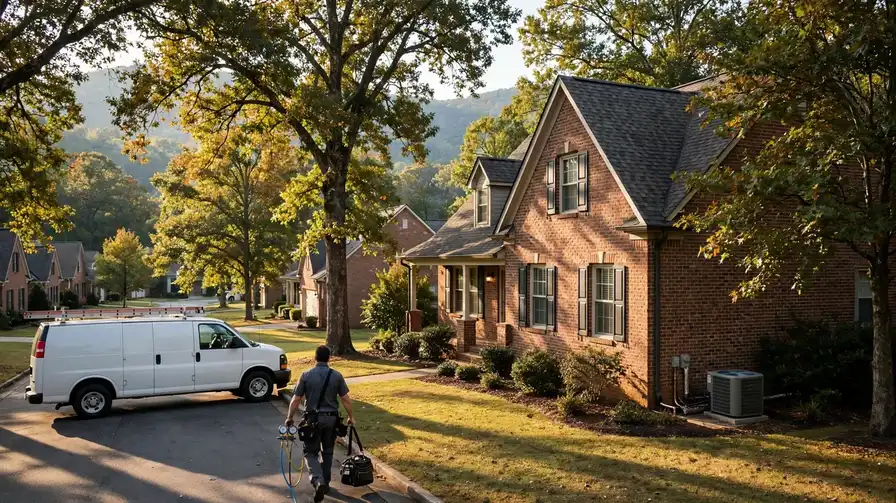


Everything on this page was computed for Spartanburg and nowhere else: the problem ranking from its Census housing profile, the seasonal risks from its NOAA station record, the coverage from its own ZIP codes. TempReach USA connects you to an independent local HVAC technician; the page itself is the homework, done in public, so the call you make is an informed one.
Call center hours: Mon-Fri 7:00 AM-10:00 PM ET | Sat 8:00 AM-10:00 PM ET | Sun 7:00 AM-9:00 PM ET
The median Spartanburg home was built in 1987; 41.3% of the stock predates 1980, and the pattern this metro's own data ranks first is the refrigerant transition reaching older systems. TempReach USA is a referral service, not an HVAC company: one call connects you with an independent local HVAC technician serving your ZIP code.
Read Spartanburg through its counties and the picture sharpens. Spartanburg, Union were not built in the same decades or for the same households, and their heating and cooling carries those differences: an older core where 17.4% of the metro's homes predate 1960, growth corridors where the subdivisions arrived in waves, and edges still being built out. The metro-wide medians — a middle home built in 1987, 154,594 housing units in all — are the average of those local stories, and the sections below are organised by the patterns the combined record produces, from the oldest equipment generations to the newest failure modes.
There is an equipment timeline buried in Spartanburg's housing figures, and it reads like a technician's diary. The 26,899 homes from before 1960 were heated first and cooled later, their ducts added around floor plans that never imagined them. The 36,948 that followed between 1960 and 1979 mixed those retrofits with the first planned central systems. Then came the 42,359 homes of 1980-1999, fitted with matched systems as standard. Each band of that timeline is now a band of characteristic failures, arriving in the order the equipment tires — which is why a home's build year, in this metro, is the single most predictive fact about its heating and cooling.
The growth side of the metro tells the opposite story in the same language. Boiling Springs, Union and the subdivisions still filling in account for much of the 48,388 homes built since 2000 — matched systems, planned ductwork, heat pumps where the lots suit them. Their HVAC is not old; it is uniform, which creates its own calendar: everything installed in the same boom reaches each wear point in the same years, from the first condenser replacements to the first control-board failures, while 1,720 cooling degree days of annual heat keep demand on the system high.
The weather's part in this is written at GREER, SC US, where an average year carries 49.67 inches of precipitation, 47.6 days at ninety degrees or more and 54.4 nights at freezing or below. Systems experience that year as workload and as stakes in roughly equal measure — the workload in the run hours, the stakes on the single coldest night and the single hottest week. The problem ranking further down is simply the housing profile above, read under this sky.
Housing eras and climate, joined — the two datasets every section of this page is built from.
Lay the eras side by side instead: 17.4% pre-1960 (26,899 homes), 23.9% from 1960-1979 (36,948), 27.4% from 1980-1999 (42,359), and 31.3% since 2000 (48,388). No single era tells the story — the proportions among them do, and those proportions are different in every metro this site covers.
New-stock metros have their own signature, and Spartanburg has it in full: most homes built since 2000, most systems young, most HVAC work a matter of waves — the condenser wave, the control-board wave, the first furnace questions — arriving street by street as identical subdivisions age in lockstep. The older pockets still produce the deepest single jobs, but the metro's HVAC centre of mass sits in its newest postcodes, and every year the waves get closer together.
The runner-up era is 1980-1999, with 27.4% of homes. That stock has left its carefree decades and entered its maintenance decades, and it shows in the call pattern around Boiling Springs and the other districts of those years: condensers on their second cycle, furnaces reaching their wear points together, ducts still young enough to reward attention over replacement.
The climate column of this profile is a workload statement. 3,019 heating degree days say how long the cold half of the year keeps furnaces and heat pumps working at their hardest; 1,720 cooling degree days say how relentlessly the hot half loads every condenser and coil; 54.4 freezing nights and 47.6 hot days mark the extremes where the failures concentrate. NOAA keeps these figures at GREER, SC US as thirty-year normals — which is to say, as the closest thing HVAC has to a settled forecast.
A profile is only useful if it predicts something, and this one predicts the shape of an HVAC diary in Spartanburg: which streets will call about cooling, which about heating, which about airflow, and in which months. Everything after this section is that prediction written out as services, problems and answers — the numbers first, the narrative second, the way the evidence actually runs.
Ordered by what this metro's data says its homes need most.
Ice on the line, a tripping breaker, run times that lengthen week by week — in Spartanburg these are the early chapters of a cooling failure, and a diagnosis caught at that stage is usually a component, not a system.
One more pattern belongs in the Spartanburg picture: repair calls here are also a refrigerant story. Systems fitted in the older decades run on refrigerant generations the industry has been retiring, and every repair on those units weighs the charge's scarcity against the system's remaining life. The technician who explains that arithmetic plainly — what the repair restores, what it cannot assure anyone about next summer — is giving the household the real choice, and in the 63,847 pre-1980 homes it is a conversation held weekly. It is why two Spartanburg homes of the same age, on different streets, so often need the same visit in the same year.
The local caseload behind this service is written in the climate figures: 1,720 cooling degree days a year and 47.6 days at 90 or above, pressing on a cooling fleet whose oldest members serve the 63,847 pre-1980 homes — in Boiling Springs (12,609 residents) as much as in the oldest districts.
Moisture cuts both ways. Too little through a heating season cracks wood and dries airways; too much through a cooling season feeds what grows in damp corners. Whole-home control aims at the moving middle, set against the weather outside.
Indoor air in Spartanburg is a two-season problem. The hot season — 47.6 days at 90 or above — seals homes shut around their air conditioning, and whatever the system recirculates stays in circulation: pollen tracked in during the green months, humidity the coil cannot fully pull down, the ordinary chemistry of a lived-in house. The cold season seals homes the other way, around their heating. Air quality work — filtration, humidity control, ventilation, purification — is sized to that sealed-house reality and to the housing: older homes leak air freely, newer ones hold it tightly, and the remedies differ. In Spartanburg that holds across 33 ZIP codes, from Spartanburg out to Union.
Air quality demand in this metro is written by its sealed seasons: 47.6 hot days with the windows shut around the cooling, 54.4 freezing nights with them shut around the heat. The 48,388 post-2000 homes hold their air tightest; the older districts around Valley Falls exchange theirs with attics and crawl spaces.
Clean ducts that leak are still leaking. The inspection folded into a cleaning visit finds the crushed flex run, the separated joint, the filter slot that never sealed — the conditions that decide whether cleaned air actually reaches the rooms.
What comes out of a Spartanburg duct system tells the home's biography: drywall dust from the renovation, pet hair in proportion to the household, the fine grit that 49.67 inches of yearly rain and the dry seasons between them work into every return. Cleaning matters most where the biography is long — the pre-1980 homes, 41.3% of the stock — and where a household's breathing argues for it. A technician who shows the before and after, and says plainly when a system does not need the work, is the one whose advice holds up. Count it in homes if you prefer: 63,847 built before 1980, 48,388 since 2000, one shared system of streets and seasons.
Duct demand concentrates in the metro's long-biography homes: 63,847 pre-1980 systems that have carried decades of household air, and the renovated homes around Woodruff (4,337 residents) whose construction dust is still in the runs.
Maintenance is a partnership with a division of labor: the household changes filters and keeps the outdoor unit clear; the professional brings instruments, the checklist and the judgment to read what the measurements are saying.
Maintenance also has a paperwork virtue in Spartanburg: the recorded visit. Readings dated season by season — refrigerant pressures, temperature splits, capacitor values, the exchanger's noted condition — turn a system's decline from a surprise into a schedule. Households across Spartanburg, Union who keep those records meet replacements as appointments, and the technicians who write them are leaving the next visit, whoever makes it, a map of the system's life. In a metro of this size, that map is most of what local knowledge means. From Boiling Springs to Union, the pattern repeats wherever the housing era matches.
The maintenance caseload is the installed base itself: 154,594 housing units whose systems each face 47.6 hot days and 54.4 freezing nights a year. Around Saxon (4,139 residents) as in the old core, the twice-yearly visit is what stands between that calendar and the emergency diary.
From period homes near Spartanburg to newer builds toward Valley Falls, Spartanburg's ductless projects serve the rooms central systems miss — additions, conversions and homes built without ductwork.
Replacement in Spartanburg begins with a load calculation across Spartanburg, Union: the independent local professional measures the home — not the old unit's label — and quotes the full scope before work begins.
From Spartanburg to Valley Falls, a no-heat call through TempReach USA reaches a local professional whose visit includes the exchanger and venting checks that furnace work owes a Spartanburg household.
With 154,594 homes and a median build year of 1987, Spartanburg heating stock spans every era of furnace and flue — each installation assessed on its own house, not on the outgoing unit's label.
Heat pump services in Spartanburg test the whole year-round system: the independent local professional covering Spartanburg, Union reads charge and airflow in both modes, proves defrost, and checks auxiliary heat logic before quoting any work.
In Spartanburg, the thermostat question splits by housing era: homes from around the median build year of 1987 often lack a common wire in the wall, while newer builds across the 33 covered ZIP codes usually carry one — the local professional checks the cable before choosing the control.
Across Spartanburg, Union, the local professional who answers knows the stock — a median build year of 1987 across 154,594 homes means systems of every age failing in their characteristic ways, from Spartanburg to the metro's newest subdivisions.
Across Spartanburg, Union, one climate ledger drives the calendar: 3,019 heating degree days and 1,720 cooling degree days mean roof units work both seasons hard, so the spring and fall visits each carry a full checklist here.
Two patterns generate most of the bookings behind the services above: The refrigerant transition reaching older systems and humidity burden on homes and cooling systems. That is why the order of this page's service list is what it is — the services answering those patterns come early, and the rest follow in the order the metro's data supports. A homeowner whose home matches the local profile — built in the metro's big decades, in one of its older districts — is, statistically, reading their own shortlist.
Ranked for this metro alone, from its Census housing profile and NOAA climate record.
It is worth saying plainly what the transition is not. It is not a mandate to replace working equipment, not a deadline after which older systems become unusable, and not a verdict on the many R-22 and early R-410A systems still cooling Spartanburg homes adequately. Systems are retired by economics and condition, not by calendar. What the transition changes is the slope of those economics: each year, the older generation's refrigerant and parts grow scarcer while the machine itself grows older, so the repair-versus-replace crossing arrives a little earlier than the same failure would have suggested a decade ago. Honest service practice in this metro states that slope openly and lets the household's own numbers — the unit's age, its condition, its history — make the call. The refrigerant in the pipes has become a fact of the house, like its roof's age: not urgent every day, and unwise to leave unexamined.
The mechanics underneath the policy are simple. A refrigerant is the working fluid of the cooling cycle: it evaporates indoors to absorb heat and condenses outdoors to release it, thousands of times a season. Each generation of fluid was engineered to improve on the last one's environmental profile and operating pressures, and each required its own hardware — compressors built for different pressures, oils that mix with one fluid and not another, metering set for one fluid's characteristics. That is why the generations cannot be swapped like brands of the same product, and why 'topping up' an older system always means its own fluid, sourced from whatever supply its generation still commands. In Spartanburg, where systems from all three generations stand in neighboring yards, the diversity is a service reality: diagnosis begins with identification, because the same symptom — a system low on charge — carries three different expense structures depending on the nameplate.
Housing arithmetic shows the exposure: with 41.3% of Spartanburg's homes built before 1980 and equipment replaced in long cycles ever since, a substantial share of the metro's systems belong to refrigerant generations the market has already succeeded. The nameplates say so, one address at a time.
The condensate drain is the burden's ledger, and in a humid Spartanburg season it runs like a small stream. Every gallon down that drain is water the coil pulled from the indoor air — evidence the system is drying as well as cooling. When the drain slows or clogs, the evidence turns: pans fill, safety switches stop the system, and the moisture the coil collected finds its way back into the house's air and materials. Drain care is therefore not a footnote of humidity work but a central chapter: a clear, trapped, correctly sloped drain line is what lets the system's drying actually leave the building. Households in the metro's humid months who learn to check that one line know more about their system's real condition than the thermostat ever tells them.
Working a humidity complaint follows the water. The first measurements are indoor: relative humidity readings in several rooms, at several times, since a single reading at the thermostat flatters the story. The second look is at the equipment's drying setup — system size against the home's actual load, airflow across the coil, cycle length on a typical afternoon, and the condensate drain's condition and output. The third look is at the sources: crawl space or basement moisture, bathroom and kitchen exhausts that vent into attics instead of outdoors, plumbing weeping quietly somewhere, grade and gutters delivering rainwater to the foundation. Only then does the remedy conversation make sense, because each layer has its own remedy — equipment setup, dedicated dehumidification, ventilation correction, source control — and prescribing from one layer for a problem living in another is how humidity complaints survive multiple service visits.
The precipitation record testifies first: 49.67 inches of rain in an average year at GREER, SC US means Spartanburg's air arrives wet for much of the season, and every cooling system in the metro is a dehumidifier by necessity, whether its setup honors the role or not.
There is also a quieter loss running underneath the comfort loss: what leaks out was paid to condition. Every run of the system heats or cools a volume of air; the share that escapes into the attic or crawl space is work done for no room, repeated cycle after cycle, season after season. In a Spartanburg home the arithmetic is worst exactly when the load is highest — the 47.6 hot days push the longest runs through the hottest attics — so the loss curve and the demand curve rise together. Sealing is unglamorous work: mastic on joints, connections re-made and supported, insulation restored where it has fallen. But it is one of the few interventions whose benefit the household can feel at the register on the first run afterward, in air that arrives at the temperature and volume the system produced.
The construction details explain the timeline. Duct joints are mechanical connections, and the sealants asked to make them permanent have finite lives: cloth-backed tape dries and releases, foil tape lifts at edges, and even mastic can crack where runs move with the building. Flex duct, common in the metro's later building decades, fails at its connections and where its inner liner is pierced or crushed — and a crushed section quietly throttles every room downstream of it. Meanwhile the spaces the ducts cross work against them: attic temperatures in a Spartanburg summer turn an uninsulated or leaking run into a heat exchanger pointed the wrong way, and winter reverses the argument in the crawl space. A duct system is therefore not a fixed asset but a slowly changing one, and its delivered performance in any given year is an empirical question, not a memory of its installation day.
The load figures complete the case: 1,720 cooling degree days and 3,019 heating degree days at GREER, SC US mean the network is in service in earnest at both ends of the year. Duct loss here is not a summer inefficiency or a winter one; it is a twelve-month tax on a system that works both seasons.
An ageing system rarely announces its age in one event. It negotiates. In Spartanburg the negotiation sounds like a house that takes longer to cool on the same afternoon weather, a furnace that needs two cycles to do what one did, a blower audible through a vent that used to be silent. The equipment in the metro's the 1980s homes has usually been repaired in pieces across the years — a motor here, a board there — so its age is not a single number but a profile of generations bolted together. That profile is what a thorough maintenance visit actually reads: which components are original, which are renewed, and where the next failure is most likely to file from. Households that know their system's profile make calm decisions; households that meet it for the first time in a breakdown make hurried ones.
Judge an ageing system by its trend line, never by its kindest day. On its kindest day — mild weather, light load — almost any system in Spartanburg can still argue for itself. The trend line is written elsewhere: in run times lengthening season over season, in the setting creeping to hold the same comfort, in the rooms that quietly dropped out of the system's reach. GREER, SC US's climate record ensures the trend will be tested at both ends of the year — 47.6 hot days and 54.4 freezing nights in an average year. The households that read their trend early choose the terms of the ending, whether that ending is a renewed component, a planned replacement in a shoulder season, or a few more good years bought with honest maintenance. The households that wait for the system's verdict receive it in the weather least suited to hearing it.
Climate presses the point. A system in Spartanburg works both ends of the year — 3,019 heating degree days against 1,720 cooling degree days at GREER, SC US — so its components accumulate in twelve months the wear a single-season climate would spread over two years.
What the shoulders reward is a habit of finishing seasons properly. The last cold week is the time to note the heating system's report card while it is still legible; the last hot week, the cooling system's. Between them sits a window — mild days, an unhurried diary for local technicians, a system that can be opened and tested without the household depending on it that night — that neither deep season gives. In Spartanburg that window opens twice a year on a climate of 47.6 hot days and 54.4 freezing nights, and the households that use it convert the two most failure-prone transitions of the year into the two calmest appointments on their calendar.
The season loads Spartanburg's systems the way its record at GREER, SC US says it will: 3,019 heating degree days against 1,720 cooling degree days in an average year, against a housing stock whose median build year is 1987. The households that read the season early — filters, drains, a system run before the extreme weeks — are the ones whose calls stay schedulable.
There is a supply-side depth as well. A shrinking refrigerant does not vanish; it circulates — recovered from retired systems, reclaimed to specification, and returned to service at an expense that reflects the shrinking pool. In Spartanburg that means the R-22 in a system serviced this year may have cooled three other homes before it, and may cool another after this system retires, provided it is recovered rather than vented. The chain gives older equipment a managed twilight rather than a cliff: service remains possible, performed by technicians qualified for the work, for as long as the economics hold for the household. Understanding that chain replaces two common errors — that old systems are already unserviceable, and that they can be serviced forever as cheaply as ever — with the true picture: a gradually tightening supply, a gradually aging fleet, and a decision that improves with information and worsens with delay.
Why here and not everywhere: Spartanburg pairs 63,847 pre-1980 homes with 47.6 days a year at 90 degrees or more and 54.4 nights below freezing. Every metro pairs its housing with its weather somehow; this particular pairing is what puts the pattern where it sits on this page's list, ahead of problems that dominate metros built in other decades, under other skies.
The first visit follows a short, diagnostic list — each item ruling a branch of the problem in or out:
PROBLEM SOLUTION
Population 38,578
Population 12,609
Population 8,047
Population 7,249
Population 6,317
Population 4,337
Population 4,175
Population 4,139
Population 3,985
Population 3,659
Population 3,468
Population 3,432
Also in the Spartanburg metro: Inman (population 3,085), Hilltop (population 3,058).
Read the grid as a building programme spread over a century. The oldest communities sit where the metro began; the youngest are still adding streets at its edge; and Boiling Springs and Union, with 12,609 and 8,047 residents, stand for the rings in between. Each ring was fitted in its era's equipment, and each is now failing, wearing or holding in its era's characteristic order. The ZIP codes below draw the coverage boundary; the eras inside it draw everything else on this page — the problems ranked, the services ordered, the checks advised.
Also on the Spartanburg map: Valley Falls (7,249), Lyman (6,317), Woodruff (4,337), Duncan (4,175), Saxon (4,139) — communities spread across Spartanburg, Union, each with housing from its own growth years. A technician routed through TempReach USA to any of them is working from this same page: the metro data does not change at the city limit, but the housing on your street — its age, its equipment, its attic — is what the visit is really about.
The metro's weight is not evenly spread. Spartanburg holds 38,578 of the 365,086 residents; Boiling Springs and Union add 12,609 and 8,047; and the remainder scatters across the smaller places above, some no bigger than a few thousand people. HVAC follows the weight — most calls come from where most homes are — but era matters more than size: a small community of 1960s housing generates older-system work than a large new subdivision does.
The metro answers to 2 county governments (Spartanburg, Union), a patchwork that matters at permit time rather than at the thermostat. Spartanburg County carries the centre; the others carry the growth rings and the older outlying towns. A technician routed through this page works inside that patchwork daily — the weather does not care about the boundaries, but the job's paperwork does.
Beyond the metro line, the nearest covered metros are Greenville, SC (37 miles away), Columbia, SC (67 miles) and Florence, SC (120 miles) — separate pages, separate profiles, because their housing and weather records are their own. Homeowners near the boundary sit between two datasets; the ZIP list above, not the map's edge, decides which page was written about your stock.
Set Spartanburg among its neighbours and the contrasts sharpen the profile: Greenville, SC — metro population 1,014,101, median build year 1990 — sits 37 miles away; Columbia, SC (879,918, median 1990) 67 miles; Florence, SC (201,392, median 1984) 120 miles. Three different housing stocks under three nearby skies, which is why each keeps its own page and its own problem ranking rather than borrowing this one.
Count the metro per unit of itself: 4,685 housing units per covered ZIP code; 70,172 households per county; 14 communities sharing 2 county governments. Then weigh the generations against each other — 1.3 older homes for each newer one — and the service pattern on this page stops being a list and becomes a proportion: that much of the diary written by ageing systems, the rest by young ones wearing in.
One line of Spartanburg arithmetic — a median home 39 years old · 101,890 owner-occupied homes against 38,454 renter-occupied · 815 pre-1960 homes for every covered ZIP code · a heating-to-cooling degree-day ratio of 1.76 · 1,262 mm of rain in an average year.
County pages carry the local detail — land area, climate normals and the heating and cooling pressures on the ground in each county.
More plain-language help: the TempReach USA heating & cooling guides
Describe the problem and the call center routes you to an independent local HVAC technician who works in the Spartanburg metro.
Call center hours: Mon-Fri 7:00 AM-10:00 PM ET | Sat 8:00 AM-10:00 PM ET | Sun 7:00 AM-9:00 PM ET