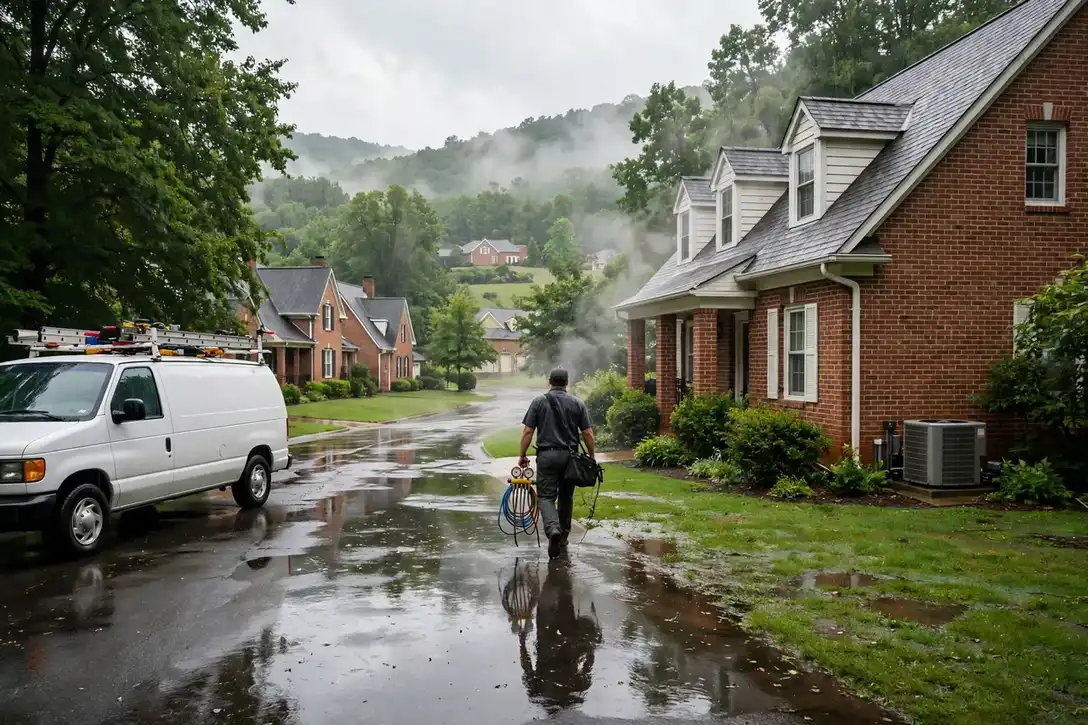


This is Huntsville's heating and cooling page, built from Huntsville's own numbers: Census housing figures, the metro's ZIP codes and its NOAA climate record. TempReach USA routes your call to an independent local HVAC technician; the homework below is here so you know your home's likely problems before you ever make it.
Call center hours: Mon-Fri 7:00 AM-10:00 PM ET | Sat 8:00 AM-10:00 PM ET | Sun 7:00 AM-9:00 PM ET
The median Huntsville home was built in 1992; 31.8% of the stock predates 1980, and the pattern this metro's own data ranks first is humidity burden on homes and cooling systems. TempReach USA is a referral service, not an HVAC company: one call connects you with an independent local HVAC technician serving your ZIP code.
Huntsville is a metro of 504,712 people and 202,490 households, and its heating and cooling is a portrait of its building history. The median home here was built in 1992; 31.8% of homes predate 1980 and 9.3% predate 1960, while 38.1% have arrived since 2000. Every one of those eras heated and cooled differently — different furnaces, different duct designs, different refrigerant generations — and they fail differently, which is why this page is organised around the patterns the data actually produces in Huntsville rather than HVAC in the abstract.
Ask how Huntsville's older homes have been kept comfortable and the honest answer is: in pieces. A furnace here, a condenser there, one room's ducts renewed while the rest of the system carries on — across 69,386 pre-1980 homes, the patchwork is the norm rather than the exception. That history is written in the attics of Limestone County and everywhere else the early stock stands: systems that are part original, part renewed, and entirely individual. It is also why the guidance on this page keeps returning to patterns rather than single faults — in a patchwork system, the pattern is the diagnosis.
Growth wrote this metro's newest HVAC chapter in matched equipment and planned ducts: systems sized as a single design, controls by the catalogue, outdoor units placed by the plat across the subdivisions near Madison and Athens. The chapter is young — its systems have decades in hand — but it is not exempt from the metro's arithmetic: 2,107 cooling degree days of demand work its condensers hard, and the winters test its heat pumps with the same cold that tests the oldest furnace in Limestone County.
The weather's part in this is written at HUNTSVILLE INTL AP, AL US, where an average year carries 54.29 inches of precipitation, 61.6 days at ninety degrees or more and 55.6 nights at freezing or below. Systems experience that year as workload and as stakes in roughly equal measure — the workload in the run hours, the stakes on the single coldest night and the single hottest week. The problem ranking further down is simply the housing profile above, read under this sky.
Housing eras and climate, joined — the two datasets every section of this page is built from.
The distribution, in one breath: of every hundred Huntsville homes, 9.3 were standing before 1960, 22.5 went up in the two decades after, 30.1 in the two after that, and 38.1 have arrived since 2000. Percentages flatten the picture, so hold the counts beside them — 20,292 oldest-era homes, 83,133 newest — and the metro's heating and cooling stops being an abstraction: it is that many systems, of those ages, failing in that order.
A metro that mostly built itself after 2000 has HVAC with a distinctive trait: uniformity. The same subdivisions, the same system designs, the same installation years — and therefore the same maintenance waves, arriving at the same streets in the same seasons. Huntsville's older pockets still produce the deepest individual jobs, but the volume lives in the new stock: condensers cycling together, thermostats ageing together, heat pump questions surfacing together. Reading those waves early is most of what local knowledge means here.
Second in the table, the 1980-1999 band: 65,677 homes, 30.1% of the metro. Its systems are mature rather than ancient — ducts still sound, first-generation efficiency equipment wearing toward its verdicts, controls reaching their wear points in waves — and its HVAC is the schedulable kind: work that rewards being booked before it becomes urgent.
A profile needs its climate column, and Huntsville's comes from HUNTSVILLE INTL AP, AL US: an average year of 62.9 degrees, built from extremes at both ends. The heating load (2,831 degree days) and the cooling load (2,107) together set the system's working life; the precipitation total (54.29 inches) sets the moisture the cooling half must remove; the freeze count (55.6 nights) sets the stakes of every heating failure. Four numbers — and most of the metro's HVAC behaviour follows from them.
Hold the two halves together and the rest of this page explains itself: the problems ranked highest here are the ones where Huntsville's dominant housing era and its climate record overlap. Change either dataset and the ranking changes — which is precisely why this profile is rebuilt from the records for every metro instead of carried over from the last one.
Ranked for this metro alone, from its Census housing profile and NOAA climate record.
Ask where a home's humidity actually comes from and the answers are a census of ordinary life: showers, cooking, laundry, breathing, houseplants, a damp crawl space exhaling through the floor, rain finding the grade against the foundation. In Huntsville the outdoor air itself joins the census for much of the year, entering through every leak in the envelope and every return-duct path that crosses a humid space. The air conditioner is expected to process the sum of it. That expectation is reasonable only when the system's drying capacity is matched to the load — and the load is a property of the house and its climate together, which is why two identical systems on the same street can leave one house crisp and another sticky: the houses are importing different amounts of water, and only one system's setup accounts for it.
Working a humidity complaint follows the water. The first measurements are indoor: relative humidity readings in several rooms, at several times, since a single reading at the thermostat flatters the story. The second look is at the equipment's drying setup — system size against the home's actual load, airflow across the coil, cycle length on a typical afternoon, and the condensate drain's condition and output. The third look is at the sources: crawl space or basement moisture, bathroom and kitchen exhausts that vent into attics instead of outdoors, plumbing weeping quietly somewhere, grade and gutters delivering rainwater to the foundation. Only then does the remedy conversation make sense, because each layer has its own remedy — equipment setup, dedicated dehumidification, ventilation correction, source control — and prescribing from one layer for a problem living in another is how humidity complaints survive multiple service visits.
Housing stacks the burden: Huntsville's 69,386 pre-1980 homes bring crawl spaces, older envelopes and duct runs through damp air to the contest. The moisture a system must remove is set by the house it serves — and much of this metro's housing imports generously.
There is a paperwork side to the transition that touches Huntsville homes quietly. Refrigerant work is regulated work: recovery, handling and record-keeping rules apply to whoever services a system, and the newest refrigerants — mildly flammable by classification — arrive with their own sensors, labeling and code provisions that installers must follow. For the homeowner the visible part is small: a nameplate with a different designation, a technician explaining why a charge is measured and documented as it is, an installation that includes leak-detection provisions the older system never had. The invisible part matters more over time: as the newest generation becomes the metro's standard, parts, training and service practice consolidate around it, and the older generations become the specialty work. Owning an older-generation system is not a fault — but its service ecosystem is, year by year, becoming a smaller room.
A transition-aware service visit has a recognizable order. First, identification: the nameplate's refrigerant, model and year, stated aloud so the household and technician share the fact. Second, the leak question, taken seriously — a system low on charge has a leak until proven otherwise, and recharging without finding it is buying the same refrigerant twice on an installment plan. Third, the condition audit around the failure: compressor health, coil condition, electrical wear, because the decision the household faces is about the whole machine, not the one part that stopped. Fourth, the comparison itself, presented as what it is — the repair path with its realistic horizon, the replacement path with its — so the choice is made on the machine's merits and the household's plans for the home. In Huntsville that conversation, held in a calm season, is unhurried and genuinely optional-feeling; held in a heat wave, the same facts arrive wearing a deadline.
The regulatory facts are the foundation: R-22 production and import ended in the United States in 2020, leaving reclaimed stock as the supply, while new equipment has moved through R-410A to the current lower-impact generation. In Huntsville every generation still stands in service — the transition is not coming to this metro; it is distributed across it, yard by yard.
One thermostat, one system, and a house that cannot agree on the temperature: the upstairs bakes while the downstairs needs a sweater, the addition never matches the original rooms, the far bedrooms run their own climate entirely. In Huntsville this is among the most common comfort complaints in larger and multi-storey homes, and among the most misdiagnosed, because the equipment is usually innocent. A single system delivers air according to its duct network's design and its thermostat's location — and the thermostat only reports its own room. Floors gain heat differently, sun loads rooms differently by the hour, and duct runs deliver unevenly by length and condition, so the house's rooms drift apart while the system reports success at the one point it measures. The answers live at three levels: airflow correction in the existing network, zoning that lets one system serve areas on separate calls, and ductless equipment that gives the problem rooms their own dedicated capacity. Which level fits depends on how far apart the rooms are, and why — a diagnosis question before it is an equipment question.
Airflow is the substrate everything else stands on, and its rules are unforgiving. A blower moves a volume of air against the network's resistance; lengthen a run, crush a section, close registers, or clog the path and the volume redistributes itself according to physics, not intention — favoring short, wide, open paths and starving long ones. Balancing is the craft of arranging that redistribution deliberately: damper positions, register adjustment, return paths sized for the supply they serve. In a Huntsville home the balance drifts over the years as filters load, furniture rearranges the rooms' air, renovations close paths that used to be open, and duct sections sag or separate. A system can therefore be out of balance without anything being broken — which is both the good news and the diagnostic difficulty, since the remedy is a methodical walk of the whole network rather than a replaced part.
The climate record sets the pattern's stakes in Huntsville: 2,107 cooling degree days load the upper floors through the summer while 2,831 heating degree days expose the far rooms all winter. A house with an unsorted delivery map is audited at both ends of the year — the pattern is not seasonal, it is structural, and the seasons merely take turns proving it.
A duct system is a delivery network, and in many Huntsville homes it leaks like one. Supply runs carry conditioned air through attics, crawl spaces and wall cavities on their way to the registers; return runs carry it back. Every joint, seam and connection along those paths is a chance for the air to leave early or for unconditioned air to be pulled in, and older installations — assembled with tape that has long since dried out, or sections that have sagged apart — leak at many of them at once. The system responds the only way it can: by running longer to deliver the same comfort, which is why duct loss so often disguises itself as an equipment problem. The furnace and air conditioner get blamed, serviced, sometimes replaced, while the network between them quietly spills a share of every run into the attic. In Huntsville's housing, where duct runs cross some of the hottest and coldest spaces in the home, a leak counts double: the air is lost, and the air that remains arrives changed by the space it traveled through.
Read a duct system the way a technician does and the examination has a shape: start at the air handler and work outward. At the plenum, connections are inspected where they are most stressed and most consequential. Along the runs, the checks are for the known failure family — separated joints, fallen insulation, sagging flex, crushed sections, takeoffs that were sealed with hope rather than mastic. At the registers, temperatures and airflow are compared room by room, and the map of strong and weak rooms is laid over the map of the runs themselves; the two maps explain each other with remarkable consistency. Returns get the same walk, with attention to panned cavities and any path that lets the system breathe from outside the envelope. Cleaning belongs in this picture where the inspection finds accumulation — but cleaning a leaking network without sealing it polishes the inside of a system that is losing its cargo through the walls.
Consider the delivery assumption: every system in Huntsville was sized on the expectation that its air would arrive. With 31.8% of homes built before 1980 — and their networks renovated, extended and re-sealed by turns ever since — that expectation's reliability varies house by house, which is why the measurement, not the assumption, has to govern.
Twice a year, Huntsville changes its mind. The shoulder seasons — the weeks when a house can need heating in the morning and cooling by afternoon, sometimes within the same day — ask more of a system and its household than either deep season does: both modes in working order at once, controls set for change rather than for a settled pattern, and equipment that may sit idle for stretches and then be called on without ceremony. The record at HUNTSVILLE INTL AP, AL US frames the workload honestly — 2,831 heating degree days against 2,107 cooling degree days, a genuinely two-season climate — and the shoulders are where the two halves meet and negotiate. The checks that matter are changeover checks: the season just ending reviewed for what it spent — the filter, the wear items, the symptoms it filed — and the season arriving proven before it is needed, with a full run in the new mode while the weather is still forgiving. The thermostat's program belongs in the same check; last season's schedule, carried forward unexamined, is how a house ends up heating against an open-window afternoon. Households that treat the shoulders as their maintenance seasons get two calm, well-timed looks at their system a year — which is exactly the rhythm the equipment's manufacturers had in mind.
The season loads Huntsville's systems the way its record at HUNTSVILLE INTL AP, AL US says it will: 2,831 heating degree days against 2,107 cooling degree days in an average year, against a housing stock whose median build year is 1992. The households that read the season early — filters, drains, a system run before the extreme weeks — are the ones whose calls stay schedulable.
Look deeper and the humidity story in Huntsville is partly a story about how houses changed. Older homes here breathed loosely and dried by accident; their moisture escaped through the same leaks that admitted it. Modern weatherization tightened the envelope — correctly, for energy — but a tight house keeps its moisture as faithfully as it keeps its conditioned air, and the drying that used to happen by leakage must now happen by design. Many Huntsville homes sit between the two eras: partly tightened, partly original, with cooling equipment asked to mediate. Their humidity complaints are era complaints — the house was changed faster than its moisture plan was. The resolution is not to loosen the house again but to finish the design: deliberate ventilation, deliberate dehumidification, and a cooling cycle set up to dry. The metro's housing stock, read closely, is a museum of this transition, and its sticky rooms are the exhibits still awaiting their captions.
Why here and not everywhere: Huntsville pairs 69,386 pre-1980 homes with 61.6 days a year at 90 degrees or more and 55.6 nights below freezing. Every metro pairs its housing with its weather somehow; this particular pairing is what puts the pattern where it sits on this page's list, ahead of problems that dominate metros built in other decades, under other skies.
The first visit follows a short, diagnostic list — each item ruling a branch of the problem in or out:
Listed in the order this metro's housing and climate data supports.
Source first, equipment second. A musty smell is moisture with an address; the professional finds the address, corrects it, and only then installs the filtration and ventilation that keep a corrected house corrected.
Air quality work in Huntsville also has a quiet economics of attention: the households that measure first — a hygrometer on the wall, the filter inspected monthly against the light — tend to need the least equipment, because they catch the simple causes early: the filter long past its season, the bath fan venting into an attic, the return pulling unconditioned air through a leaky duct in the pre-1980 districts. The assessment visit formalises that attention with instruments, and prescribes in proportion to what it finds. The 54.29 inches of rain in an average year here is part of the story too — humidity loads every cooling coil in the metro.
The local figures behind the service: 202,490 households, indoor humidity driven by 54.29 inches of yearly rain and long humid stretches, pollen seasons that load every return in Limestone County. The assessment measures a home against exactly that climate, not against a generic standard.
Refrigerant is never consumed, so a low charge in a Huntsville home means a leak to be found, not just a top-up to be sold; the repair addresses the cause or the symptom is already on its way back.
Cooling failure in Huntsville is rarely random. It bunches on the first serious heat wave, again in the late-summer grind, and it concentrates where the equipment is oldest — the pre-1980 districts, 31.8% of the metro's housing — and where the newest subdivisions' identical units reach the same wear points in the same seasons. The technician who works these streets stocks the van for both patterns: the ageing system's slow decline and the young fleet's shared failures. The HUNTSVILLE INTL AP, AL US record — 2,831 heating degree days, 2,107 cooling — is the backdrop Limestone County technicians plan around.
The local caseload behind this service is written in the climate figures: 2,107 cooling degree days a year and 61.6 days at 90 or above, pressing on a cooling fleet whose oldest members serve the 69,386 pre-1980 homes — in Meridianville (10,268 residents) as much as in the oldest districts.
Through TempReach USA, a Huntsville ductless installation is quoted as a complete design before work begins: units, positions, line routes, drainage and electrics, each room's reasoning shown.
The mini-split question in Huntsville is usually a room that the main system cannot reach or cannot satisfy — the upstairs bedroom under a hot roof, the addition beyond the duct run, the converted garage in Athens. The technology answers with zones: one outdoor unit, one or more indoor heads, each room on its own setting. Sizing still rules the outcome; an oversized head short-cycles and leaves the humidity behind, and Huntsville's humid stretches punish that error daily. With a median build year of 1992, most of the metro's 218,196 housing units are working through the same ageing curve.
The search territory for ductless is the metro's unducted stock: 20,292 pre-1960 homes built before central systems, plus the additions and conversions scattered through 202,490 households — in Moores Mill and the historic core alike, spaces the main system never reached.
Post-renovation is the clearest case in the trade. Drywall dust and sanding residue settle through every open register, and one thorough cleaning after the work ends removes in hours what the system would otherwise circulate for years.
What comes out of a Huntsville duct system tells the home's biography: drywall dust from the renovation, pet hair in proportion to the household, the fine grit that 54.29 inches of yearly rain and the dry seasons between them work into every return. Cleaning matters most where the biography is long — the pre-1980 homes, 31.8% of the stock — and where a household's breathing argues for it. A technician who shows the before and after, and says plainly when a system does not need the work, is the one whose advice holds up. Count it in homes if you prefer: 69,386 built before 1980, 83,133 since 2000, one shared system of streets and seasons.
Count the systems and the diary fills itself: 202,490 households breathing through ductwork daily, the oldest of it in homes from the 1990s and the newest in the subdivisions past New Hope. What the cleaning finds follows the biography — dust in proportion to years, debris in proportion to renovations.
With a median build year of 1992, many Huntsville systems are reaching replacement age together; the professional you are connected with inspects ducts and electrics across 32 ZIP codes before recommending equipment.
Furnace repair in Huntsville follows the sequence: the independent local professional covering Limestone, Madison watches your furnace attempt a start, tests the stage that failed, and quotes before work begins.
Heating installation in Huntsville starts with a heat-loss calculation across Limestone, Madison: the independent local professional measures the home's loss, inspects ducts and venting, and quotes the full scope before work begins.
Across 32 ZIP codes and housing from a median build year of 1992, Huntsville heat pumps are specified and serviced from heat-loss figures and low-temperature performance data, not nominal tonnage.
Across Limestone, Madison, one climate fact shapes the configuration: 2,831 heating degree days against 2,107 cooling degree days tells whether the control's year is mostly a heating story, mostly a cooling story, or a genuine heat pump balancing act.
From the oldest housing in Huntsville to the newest subdivisions in its 32 covered ZIP codes, the tune-up's question is identical and local at once: what do this system's measurements say, this season, before the weather asks it anything hard?
Across Limestone, Madison, the local professional who answers knows the stock — a median build year of 1992 across 218,196 homes means systems of every age failing in their characteristic ways, from Huntsville to the metro's newest subdivisions.
Across Limestone, Madison, one climate ledger drives the calendar: 2,831 heating degree days and 2,107 cooling degree days mean roof units work both seasons hard, so the spring and fall visits each carry a full checklist here.
There is a plainer way to say what this page's ranking means in practice: most calls in Huntsville are two calls. The first answers Humidity burden on homes and cooling systems; the second answers the refrigerant transition reaching older systems. Between them they account for the shape of a local technician's week here — the districts visited, the parts stocked, the diagnoses made fastest because they are made most often. The remaining services divide the rest of the diary among them, essential but episodic, the supporting work around two leading patterns.
PROBLEM SOLUTION
Population 218,814
Population 58,335
Population 27,474
Population 10,268
Population 6,624
Population 6,041
Population 3,765
Population 2,895
Population 2,678
Population 1,444
Population 1,296
Population 971
Also in the Huntsville metro: Gurley (population 543), Elkmont (population 327).
Read the grid as a building programme spread over a century. The oldest communities sit where the metro began; the youngest are still adding streets at its edge; and Madison and Athens, with 58,335 and 27,474 residents, stand for the rings in between. Each ring was fitted in its era's equipment, and each is now failing, wearing or holding in its era's characteristic order. The ZIP codes below draw the coverage boundary; the eras inside it draw everything else on this page — the problems ranked, the services ordered, the checks advised.
Also on the Huntsville map: Meridianville (10,268), Harvest (6,624), Moores Mill (6,041), Hazel Green (3,765), New Hope (2,895) — communities spread across Limestone, Madison, each with housing from its own growth years. A technician routed through TempReach USA to any of them is working from this same page: the metro data does not change at the city limit, but the housing on your street — its age, its equipment, its attic — is what the visit is really about.
The metro's weight is not evenly spread. Huntsville holds 218,814 of the 504,712 residents; Madison and Athens add 58,335 and 27,474; and the remainder scatters across the smaller places above, some no bigger than a few thousand people. HVAC follows the weight — most calls come from where most homes are — but era matters more than size: a small community of 1960s housing generates older-system work than a large new subdivision does.
Administratively the metro is drawn from Limestone, Madison — 2 in all — with Limestone County at its centre. County lines do not change how a system runs, but they do shape the paperwork around the work: permits, inspections and code details are county and city business, which is one reason the professional who serves your street is a local one.
Three neighbouring coverage areas begin where this one ends: Decatur, AL, some 27 miles off; Florence–Muscle Shoals, AL, 54 miles; and Birmingham, AL, 92 miles. Each keeps its own page because each keeps its own numbers — a different median build year, a different climate station, a different problem ranking. Boundary households should trust the ZIP list over the map: the code, not the compass, assigns the dataset.
The region around Huntsville is a set of variations on its theme: Decatur, AL, 27 miles off, runs a median build year of 1984 on a metro population of 160,326; Florence–Muscle Shoals, AL (54 miles) medians 1980 on 156,609; Birmingham, AL (92 miles) medians 1983 on 1,197,766. Nearness is not sameness — a few decades of median build year separate their heating and cooling as surely as the miles separate their maps.
Count the metro per unit of itself: 6,819 housing units per covered ZIP code; 101,245 households per county; 14 communities sharing 2 county governments. Then weigh the generations against each other — 0.8 older homes for each newer one — and the service pattern on this page stops being a list and becomes a proportion: that much of the diary written by ageing systems, the rest by young ones wearing in.
Huntsville by the derived numbers — median home age 34 years · owners in 142,755 homes, renters in 59,735 · each covered ZIP code carrying about 634 pre-1960 homes · a heating-to-cooling degree-day ratio of 1.34 · 1,379 mm average annual rainfall.
County pages carry the local detail — land area, climate normals and the heating and cooling pressures on the ground in each county.
More plain-language help: the TempReach USA heating & cooling guides
One call connects you with an independent local heating and cooling professional serving Huntsville and the surrounding metro.
Call center hours: Mon-Fri 7:00 AM-10:00 PM ET | Sat 8:00 AM-10:00 PM ET | Sun 7:00 AM-9:00 PM ET