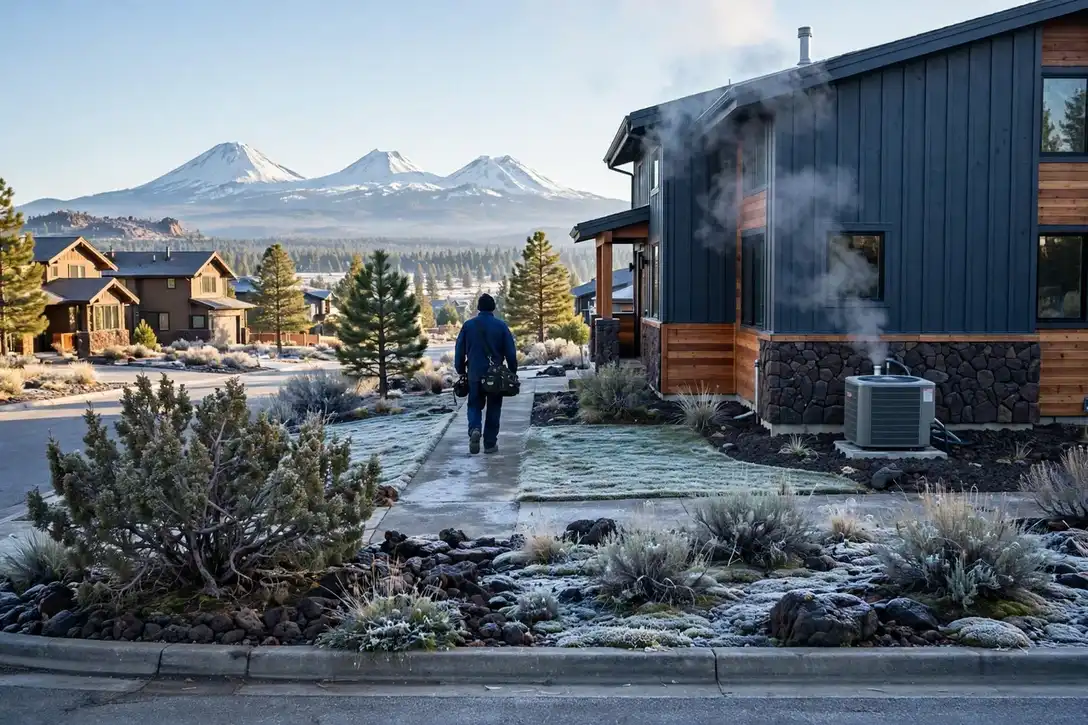


TempReach USA connects Bend homeowners with independent local HVAC technicians. This page is built from the metro's own Census housing data, ZIP codes and climate record — the heating and cooling problems described here are the ones Bend homes actually have.
Call center hours: Mon-Fri 7:00 AM-10:00 PM ET | Sat 8:00 AM-10:00 PM ET | Sun 7:00 AM-9:00 PM ET
The median Bend home was built in 1996; 26.4% of the stock predates 1980, and the pattern this metro's own data ranks first is heating failure risk when temperatures freeze. TempReach USA is a referral service, not an HVAC company: one call connects you with an independent local HVAC technician serving your ZIP code.
Two numbers frame everything that follows: 71.3% of Bend homes are owner-occupied, and the median one was built in 1996. Ownership matters to HVAC because owners inherit their systems whole — every equipment decision a builder made in the 1990s or earlier is still in the attic, the closet and the side yard, ageing on its original schedule. With 26.4% of homes predating 1980 and 42.4% arriving since 2000, the metro is really two housing stocks sharing one map, and they are taken separately below before the problems are ranked.
Ask how Bend's older homes have been kept comfortable and the honest answer is: in pieces. A furnace here, a condenser there, one room's ducts renewed while the rest of the system carries on — across 31,427 pre-1980 homes, the patchwork is the norm rather than the exception. That history is written in the attics of Crook County and everywhere else the early stock stands: systems that are part original, part renewed, and entirely individual. It is also why the guidance on this page keeps returning to patterns rather than single faults — in a patchwork system, the pattern is the diagnosis.
Growth wrote this metro's newest HVAC chapter in matched equipment and planned ducts: systems sized as a single design, controls by the catalogue, outdoor units placed by the plat across the subdivisions near Redmond and Prineville. The chapter is young — its systems have decades in hand — but it is not exempt from the metro's arithmetic: 317 cooling degree days of demand work its condensers hard, and the winters test its heat pumps with the same cold that tests the oldest furnace in Crook County.
The climate written over all of it comes from the NOAA station at REDMOND ROBERTS FLD, OR US: an average year brings 6,172 heating degree days, 317 cooling degree days and 8.46 inches of precipitation. Those are not abstractions to a furnace or a condenser — they set how many hours a heating system runs each winter, how hard a cooling system cycles in July, and how much moisture every coil has to pull out of the indoor air. The problem sections that follow are selected by exactly these numbers, combined with the housing-age profile above.
Housing eras and climate, joined — the two datasets every section of this page is built from.
Break the stock down by building era and the profile sharpens. Before 1960: 7.4% of homes, roughly 8,809 of them. From 1960 to 1979: 19.0%, about 22,618. From 1980 to 1999: 31.2%, about 37,141. Since 2000: 42.4%, about 50,474. Four eras, four equipment generations — and the balance among them is this metro's HVAC character in a single paragraph.
New-stock metros have their own signature, and Bend has it in full: most homes built since 2000, most systems young, most HVAC work a matter of waves — the condenser wave, the control-board wave, the first furnace questions — arriving street by street as identical subdivisions age in lockstep. The older pockets still produce the deepest single jobs, but the metro's HVAC centre of mass sits in its newest postcodes, and every year the waves get closer together.
Second in the table, the 1980-1999 band: 37,141 homes, 31.2% of the metro. Its systems are mature rather than ancient — ducts still sound, first-generation efficiency equipment wearing toward its verdicts, controls reaching their wear points in waves — and its HVAC is the schedulable kind: work that rewards being booked before it becomes urgent.
A profile needs its climate column, and Bend's comes from REDMOND ROBERTS FLD, OR US: an average year of 48.9 degrees, built from extremes at both ends. The heating load (6,172 degree days) and the cooling load (317) together set the system's working life; the precipitation total (8.46 inches) sets the moisture the cooling half must remove; the freeze count (181.2 nights) sets the stakes of every heating failure. Four numbers — and most of the metro's HVAC behaviour follows from them.
A profile is only useful if it predicts something, and this one predicts the shape of an HVAC diary in Bend: which streets will call about cooling, which about heating, which about airflow, and in which months. Everything after this section is that prediction written out as services, problems and answers — the numbers first, the narrative second, the way the evidence actually runs.
Ranked for this metro alone, from its Census housing profile and NOAA climate record.
The aftermath has a pattern too. Freeze heating failures in Bend are audited at the thaw — twice: once by the technician restoring the system, and once by the water, which reports every pipe the cold found while the heat was off. A burst discovered then is not a separate misfortune; it is the same event's second act, and preventing it is a matter of the first act's management: water shut down and drained where the exposure demanded it, exposed runs protected while the house was cold, the thaw watched rather than assumed. Households that have lived one freeze failure tend to emerge with a written household plan — valve locations, the order of actions, the number to call — because the event teaches what no mild season can: that in this climate, heating is not a comfort system with a plumbing neighbor, but a single system whose failure modes arrive together.
The physics of the risk run on a simple clock. A house loses heat through its envelope at a rate set by the temperature difference across it; in a hard freeze that difference is the widest of the year, so the indoor temperature of an unheated house falls fastest exactly when the consequences of falling are gravest. The fall is uneven: rooms over unheated spaces and against the wind cool first, wall cavities housing pipes cool faster than the rooms they serve, and a pipe can reach freezing beside a room that still feels merely chilly. That unevenness is the trap in a household's intuition — the thermostat's reading is the house's average story, while the pipes live in its coldest footnotes. In Bend the margin between a cold night and a damaging one is often a single night's depth of freeze against a house whose heat failed that morning, which is why the response sequence treats hours as the unit of value.
The timing evidence recurs every cold season: heating calls in Bend cluster in the deepest cold and at the thaw, the signature of marginal systems audited simultaneously by 31.7-degree summers' opposite number — the freeze weeks when REDMOND ROBERTS FLD, OR US's coldest readings arrive together.
Winter examines a furnace the way a long journey examines an older car: not with one dramatic test, but with sustained demand that finds every tired component in turn. In Bend, the examination runs for months — 6,172 heating degree days of it — and the components sit it in order of their wear. Igniters, which glow and cool with every cycle, are the classic first casualty of a long season. Motors follow, their bearings carrying the season's hours. What surprises households is the clustering: a furnace that needed nothing for years can ask for two repairs in one hard winter, not because the first repair failed, but because the cold is auditing the whole machine at once and reporting its findings in sequence.
Judge a furnace by its coldest week, not its kindest. In its coldest week a Bend furnace shows its true condition: whether it lights first time every time, whether it holds the house through the night without the temperature sagging, whether its sounds are the sounds it made when it was younger. REDMOND ROBERTS FLD, OR US's record — 181.2 freezing nights in an average year — makes the examination annual and unsparing. Households that come through it without drama have usually done one unglamorous thing: they treated the autumn symptoms as the season's advance copy. A furnace rarely fails without having filed its intentions first, in a slower start, a louder cycle, a room that stopped keeping up. The winter merely publishes what the furnace had already written.
Count the duty rather than the drama: a Bend furnace fires through 6,172 heating degree days a season, cycling its igniter and swinging its heat exchanger with every call. The wear that surfaces in January was purchased, cycle by cycle, in the seasons before it.
One thermostat, one system, and a house that cannot agree on the temperature: the upstairs bakes while the downstairs needs a sweater, the addition never matches the original rooms, the far bedrooms run their own climate entirely. In Bend this is among the most common comfort complaints in larger and multi-storey homes, and among the most misdiagnosed, because the equipment is usually innocent. A single system delivers air according to its duct network's design and its thermostat's location — and the thermostat only reports its own room. Floors gain heat differently, sun loads rooms differently by the hour, and duct runs deliver unevenly by length and condition, so the house's rooms drift apart while the system reports success at the one point it measures. The answers live at three levels: airflow correction in the existing network, zoning that lets one system serve areas on separate calls, and ductless equipment that gives the problem rooms their own dedicated capacity. Which level fits depends on how far apart the rooms are, and why — a diagnosis question before it is an equipment question.
Judge a multi-room home at its extremes, not at its thermostat. The thermostat sits, by convention, in the home's most average room, and it will report contentment while the nursery roasts and the end office freezes. The extremes are the system's true report card, and in Bend they follow the climate record honestly: 31.7 hot days audit the upstairs, 181.2 freezing nights audit the far rooms over unheated spaces, and the household learns its home's real climate map from the rooms it avoids in each season. Homes whose extremes are comfortable have been sorted — by design, by correction or by dedicated equipment — and homes whose extremes are endured are carrying an unsorted map. The sorting is a solvable problem in essentially every case; what it cannot survive is being mistaken for an equipment failure and treated with a bigger version of the same single answer.
The climate record sets the pattern's stakes in Bend: 317 cooling degree days load the upper floors through the summer while 6,172 heating degree days expose the far rooms all winter. A house with an unsorted delivery map is audited at both ends of the year — the pattern is not seasonal, it is structural, and the seasons merely take turns proving it.
This is the season the metro's housing is examined by the weather, and the examination is practical: heating plant against 6,172 heating degree days, envelopes against 181.2 freezing nights, condensate lines and vent terminations against snow and ice. The older districts sit the hardest paper — systems of advancing age serving the 31,427 pre-1980 homes across the metro — but no system is exempt; a new furnace with a frozen condensate run stops as completely as an old one with a spent igniter. Between cold snaps, the season's quieter work continues — filters loading, ducts breathing with the temperature swings — and the households that keep the small rhythm are the ones the big cold never gets a chance to interview.
The season loads Bend's systems the way its record at REDMOND ROBERTS FLD, OR US says it will: 6,172 heating degree days against 317 cooling degree days in an average year, against a housing stock whose median build year is 1996. The households that read the season early — filters, drains, a system run before the extreme weeks — are the ones whose calls stay schedulable.
There is a statistical shape to the freeze week that the individual household never sees but every local technician knows: the calls do not arrive evenly across the cold. They cluster at the thaw's approach and in the cold's second and third days, as marginal systems exhaust their ability to recover and houses exhaust their thermal patience. The cluster is the metro's deferred maintenance arriving on a single schedule — the 6,172 heating degree days having audited every system simultaneously and published the failures together. That is the deepest argument for the calm-season rhythm this pattern keeps recommending: the freeze queue is the one queue in the trade that forms for everyone at the same moment, and the only reliable way to be absent from it is to have been early, in the months when absence was still a choice.
Read the ranking backwards and it reads as a data summary: 253,650 residents in 119,043 housing units, 7.4% of the housing from before 1960, 8.46 inches of rain in an average year. The pattern leads because the exposure is broad — counted not in individual unlucky houses but in whole eras of the metro's building, stacked one on another.
Experienced local practice starts with the simple certainties — the observations that take minutes and decide the most:
Listed in the order this metro's housing and climate data supports.
Most emergency failures are ordinary parts at extraordinary hours, and those are restored on the visit. The major ones are stabilized, diagnosed and quoted from evidence, for a decision made in a safe house.
What counts as an emergency here is narrower than discomfort and wider than breakdown. No cooling with an infant or an elderly resident in the house during a Bend heat stretch is an emergency. No heat with pipes exposed to a freezing night is an emergency twice over. A burning smell, a tripped breaker that will not hold, water from a condensate overflow — each is the system asking for a same-day answer. The call center's questions sort the urgent from the schedulable, and local technicians already working these streets are the ones routed first. Ask in Madras and the answer rhymes with Bend: same eras, same equipment generations, same calendar of failures.
Scale the problem by the Census count: 102,503 households depending on systems that cannot be improvised around — no heat in a freeze, no cooling in a heat wave. The emergency visit exists for the hours when waiting until Monday is not a plan, in Redmond this month, somewhere else next.
Every furnace repair routed through TempReach USA ends with a full heating cycle run under observation in the Bend home — ignition to steady operation — because a repair is finished when it is proven.
A furnace in Bend rarely fails all at once; it files warnings first. Short cycling on cold mornings, a rumble at startup, one room that never reaches the thermostat's number while the rest of the house overshoots. The metro's climate makes those warnings worth reading early — a system that limps in October is being examined by 181.2 freezing nights all winter. The repair visit tests the safety chain before anything else: the exchanger's integrity, the venting, the carbon monoxide picture, then the parts that wear. The REDMOND ROBERTS FLD, OR US record — 6,172 heating degree days, 317 cooling — is the backdrop Crook County technicians plan around.
Heating demand in Bend concentrates where the cold does its work: 181.2 nights a year at or below freezing, against a housing stock whose median build year is 1996. Around Madras as in the old core, that combination is not an abstraction — it is the street's furnaces, house by house.
Multi-zone arithmetic matters in Bend: outdoor capacity is shared among indoor units, so the design is reasoned around the household's real hours, not around every room at full demand at once.
The mini-split question in Bend is usually a room that the main system cannot reach or cannot satisfy — the upstairs bedroom under a hot roof, the addition beyond the duct run, the converted garage in Prineville. The technology answers with zones: one outdoor unit, one or more indoor heads, each room on its own setting. Sizing still rules the outcome; an oversized head short-cycles and leaves the humidity behind, and Bend's humid stretches punish that error daily. The 8.46 inches of rain in an average year here is part of the story too — humidity loads every cooling coil in the metro.
Scale the question by the Census count and it stays concrete: 119,043 housing units, a share of them holding rooms — additions, conversions, finished spaces — that no duct serves. The mini-split visit exists to give one of those rooms its own climate, sized to its exposure and use.
AC repair in Bend starts with readings, not guesses: the independent local professional covering Crook, Deschutes, Jefferson tests your system at the unit, names the fault from the evidence, and quotes before any work begins.
Across Crook, Deschutes, Jefferson, the cleaning question is answered the same way — look inside first. From Bend out through the 17 ZIP codes covered, matted buildup and renovation debris make the case; a light film makes the case for waiting.
From Bend to Madras, Bend replacements routed through TempReach USA end in commissioning — measured charge and airflow — so the installed system matches the calculated one.
With 119,043 homes and a median build year of 1996, Bend heating stock spans every era of furnace and flue — each installation assessed on its own house, not on the outgoing unit's label.
From Bend to Madras, Bend heat pump calls through TempReach USA reach a local professional who explains findings plainly and quotes after assessing — in the heating season and the cooling season alike.
In Bend, air work follows the climate ledger: 6,172 heating degree days dry the indoor air out each winter while 317 cooling degree days load it with humidity each summer — most homes here need the humidity answer in both directions across the year.
From Bend to the metro's edge, Bend's 119,043 homes run every system type there is — single-stage furnaces, two-stage equipment, heat pumps with auxiliary heat — and each gets a control matched to its terminals, not a shelf guess.
From the oldest housing in Bend to the newest subdivisions in its 17 covered ZIP codes, the tune-up's question is identical and local at once: what do this system's measurements say, this season, before the weather asks it anything hard?
In Bend, commercial work follows the stock: 119,043 housing units' worth of mixed buildings — offices, retail and restaurants from Bend across the 17 covered ZIP codes — each with rooftop units whose service rhythm the local professional sets per building.
If this page's services were ranked by Bend's call patterns rather than listed in catalogue order, they would come out much as they do here — because the ranking behind them is data, not habit. Heating failure risk when temperatures freeze leads the metro's problem table and furnace wear in hard cold follows, so the services answering them lead the list. The long tail of a metro's HVAC life — thermostat calls, duct questions, the one room that never matches the rest — fills in the diary around them, here as everywhere.
PROBLEM SOLUTION
Population 101,472
Population 35,161
Population 11,187
Population 7,596
Population 5,755
Population 4,681
Population 3,966
Population 3,133
Population 3,018
Population 2,890
Population 2,510
Population 2,211
Also in the Bend metro: Prineville Lake Acres (population 1,589), Sunriver (population 1,429).
Beyond Bend itself, the metro takes in Redmond (35,161 residents), Prineville (11,187) and the rest of the communities in the grid above — each fitted with heating and cooling in its own building era, which is why two streets in the same metro can need entirely different HVAC conversations. The ZIP list below is the full coverage footprint: if your code is on it, this page was written about your housing stock.
The map continues: Madras (7,596), Deschutes River Woods (5,755), Crooked River Ranch (4,681), Three Rivers (3,966), Juniper Canyon (3,133). Different names, different decades — each community in Crook, Deschutes, Jefferson was fitted with heating and cooling in its own growth years, which is why two streets in the same metro can need entirely different HVAC conversations. The ZIP list below is the working definition of coverage; the housing behind each code is the working definition of the job.
Bend (101,472 residents) anchors the metro, and Redmond (35,161) is its second centre of gravity. Between them they hold the bulk of the 102,503 households — and, not coincidentally, the bulk of every housing era this page discusses, from the pre-1960 core to the newest subdivisions. Prineville (11,187) and the communities beyond it repeat the same eras at smaller scale.
The metro answers to 3 county governments (Crook, Deschutes, Jefferson), a patchwork that matters at permit time rather than at the thermostat. Crook County carries the centre; the others carry the growth rings and the older outlying towns. A technician routed through this page works inside that patchwork daily — the weather does not care about the boundaries, but the job's paperwork does.
Beyond the metro line, the nearest covered metros are Eugene, OR (100 miles away), Salem, OR (111 miles) and Portland, OR (127 miles) — separate pages, separate profiles, because their housing and weather records are their own. Homeowners near the boundary sit between two datasets; the ZIP list above, not the map's edge, decides which page was written about your stock.
The region around Bend is a set of variations on its theme: Eugene, OR, 100 miles off, runs a median build year of 1977 on a metro population of 381,584; Salem, OR (111 miles) medians 1980 on 445,814; Portland, OR (127 miles) medians 1983 on 2,542,282. Nearness is not sameness — a few decades of median build year separate their heating and cooling as surely as the miles separate their maps.
Ratios tell the metro's story compactly. Renters occupy 28.7% of homes; owners hold the rest. For every home built since 2000 there are 0.6 from before 1980. Spread the stock across the coverage map and each ZIP code carries about 7,003 housing units — the density at which era patterns repeat street after street instead of scattering, and at which a routed round of calls stays inside a few districts.
Bend by the derived numbers — median home age 30 years · owners in 73,085 homes, renters in 29,418 · each covered ZIP code carrying about 518 pre-1960 homes · a heating-to-cooling degree-day ratio of 19.46 · 215 mm average annual rainfall.
County pages carry the local detail — land area, climate normals and the heating and cooling pressures on the ground in each county.
More plain-language help: the TempReach USA heating & cooling guides
Describe the problem and the call center routes you to an independent local HVAC technician who works in the Bend metro.
Call center hours: Mon-Fri 7:00 AM-10:00 PM ET | Sat 8:00 AM-10:00 PM ET | Sun 7:00 AM-9:00 PM ET