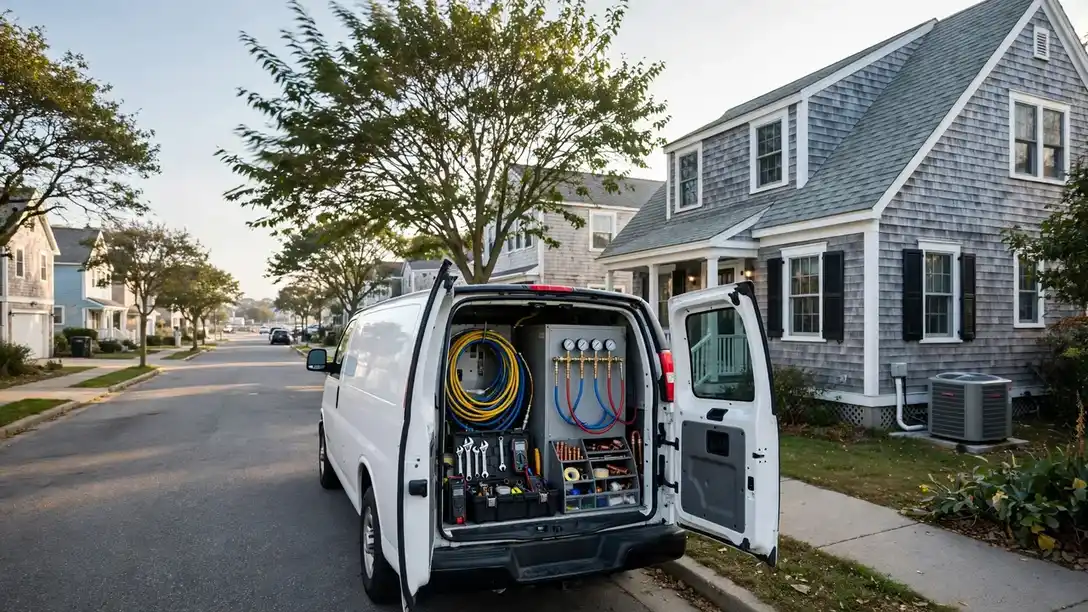


Everything on this page was computed for Atlantic City and nowhere else: the problem ranking from its Census housing profile, the seasonal risks from its NOAA station record, the coverage from its own ZIP codes. TempReach USA connects you to an independent local HVAC technician; the page itself is the homework, done in public, so the call you make is an informed one.
Call center hours: Mon-Fri 7:00 AM-10:00 PM ET | Sat 8:00 AM-10:00 PM ET | Sun 7:00 AM-9:00 PM ET
The median Atlantic City home was built in 1978; 52.3% of the stock predates 1980, and the pattern this metro's own data ranks first is the refrigerant transition reaching older systems. TempReach USA is a referral service, not an HVAC company: one call connects you with an independent local HVAC technician serving your ZIP code.
Read Atlantic City through its counties and the picture sharpens. Atlantic, Cape May were not built in the same decades or for the same households, and their heating and cooling carries those differences: an older core where 28.4% of the metro's homes predate 1960, growth corridors where the subdivisions arrived in waves, and edges still being built out. The metro-wide medians — a middle home built in 1978, 231,727 housing units in all — are the average of those local stories, and the sections below are organised by the patterns the combined record produces, from the oldest equipment generations to the newest failure modes.
Stand in one of Atlantic City's older neighbourhoods and you are standing in its HVAC's back catalogue. The homes there — part of the 121,193 built before 1980 across this metro — went up when a furnace was built to serve for a generation and central cooling was still spreading street by street. That generation has now elapsed several times over. What it leaves behind is not universal failure but universal exposure: every duct joint, igniter and condenser coil in those districts is operating past the horizon its makers planned for, in Atlantic County and beyond, and the failures arrive in the order the parts tire.
The newer side of Atlantic City — the 21.5% of homes built since 2000, concentrated around growing communities like Atlantic City — runs on matched modern systems that age more gracefully but fail in their own ways: heat pumps and condensers worked hard by 1,136 cooling degree days of hot-season demand, control boards and sensors wearing out in houses that all reach the same age at the same time. One metro, two equipment generations, and the sections below take them in the order this metro's data ranks them.
Over everything sits the weather, and here it is measured rather than described: NOAA's station at ATLANTIC CITY INTL AP, NJ US averages 55.1 degrees across the year, with 22.6 days reaching 90 or more and 101.3 nights at freezing or below. A furnace feels that record as a season of relentless cycling; a condenser feels it as a summer without a quiet week; a heat pump feels both. The problem ranking below is what those numbers, crossed with the housing profile, produce for Atlantic City specifically.
Housing eras and climate, joined — the two datasets every section of this page is built from.
Lay the eras side by side instead: 28.4% pre-1960 (65,810 homes), 23.9% from 1960-1979 (55,383), 26.2% from 1980-1999 (60,712), and 21.5% since 2000 (49,821). No single era tells the story — the proportions among them do, and those proportions are different in every metro this site covers.
The centre of gravity here is the deep stock: with pre-1960 homes the largest single band, Atlantic City's typical HVAC conversation starts with systems that have been renewed piecemeal for decades — furnaces on their third generation, duct layouts designed before central cooling was ordinary, condensers working on refrigerant the industry has retired. Newer work exists, out at the growth edge, but the metro's character — and most of its serious heating and cooling — sits in the old core and the streets that grew from it.
The runner-up era is 1980-1999, with 26.2% of homes. That stock has left its carefree decades and entered its maintenance decades, and it shows in the call pattern around Pleasantville and the other districts of those years: condensers on their second cycle, furnaces reaching their wear points together, ducts still young enough to reward attention over replacement.
The climate half of the profile, from ATLANTIC CITY INTL AP, NJ US: 4,701 heating degree days against 1,136 cooling degree days, 45.96 inches of precipitation, an average temperature of 55.1 degrees. Read together, those figures describe the loads: how many hours a furnace runs in a year, how relentlessly a condenser cycles through summer, how much moisture the cooling coil must pull from the air — 101.3 nights at or below freezing, against 22.6 days at 90 or above.
Hold the two halves together and the rest of this page explains itself: the problems ranked highest here are the ones where Atlantic City's dominant housing era and its climate record overlap. Change either dataset and the ranking changes — which is precisely why this profile is rebuilt from the records for every metro instead of carried over from the last one.
Selected and ranked from this metro's housing-age profile and climate record — not copied from another city's page.
A generation change is moving through Atlantic City's cooling equipment, and it arrives one repair decision at a time. For decades, residential systems ran on R-22; production and import of that refrigerant ended in the United States in 2020, so the supply that remains is reclaimed stock, and servicing a leaking R-22 system means weighing a scarce, aging refrigerant against the age of the machine it serves. Newer systems moved to R-410A, and equipment now arriving uses lower-impact refrigerants such as R-454B, with their own handling and code requirements. The transition matters to a homeowner at specific moments: when an older system needs a charge, when a coil or compressor fails on a machine whose refrigerant is effectively retired, when a repair quote must be compared honestly against replacement. Nothing about it is a reason for panic — R-22 systems are not banned from being serviced — but every significant repair on one is now also a planning conversation, and households in Atlantic City with equipment from the R-22 era benefit from having it before the hottest week, not during it.
Judge a refrigerant-era system by its leak history and its trend, not by a single charge reading. One low reading after many tight years is an event; a pattern of small losses is a biography, and the biography is what the economics should be based on. Atlantic City's climate record loads the question at both ends — a leaking system underperforms exactly when ATLANTIC CITY INTL AP, NJ US's 22.6 hot days demand its full capacity, and its owner pays for refrigerant and lost performance simultaneously. The households that navigate this transition well keep one habit: they can state their system's age, refrigerant and last three repairs without looking them up. That small command of the facts converts an industry-wide generational change into a single household's managed decision, which is the scale at which it was always going to be decided anyway.
Count the generations the way a technician's route does: a single Atlantic City street can hold an R-22 veteran, two R-410A systems and a current-generation installation within a few doors. The service records of one metro contain the whole transition — which is why identification, not assumption, opens every diagnosis here.
Renovation writes its own chapter in this pattern. Homes in Atlantic City have been extended, finished and re-divided for decades — a garage converted, a basement finished, an addition tied into ductwork sized for the original house. Each alteration borrows air from the existing network, and the borrowing is rarely repaid with new capacity or rebalanced runs. The result is a duct system whose map no longer matches the house it serves: original rooms over-supplied, added rooms fed by a hopeful tap into a trunk that was never asked to carry them. Add the slow leaks of age on top of the redesigns of renovation, and the far rooms' complaints stop being mysterious. The remedy starts with honesty about the map — what was designed, what was improvised, and what each run can actually deliver — before any cleaning, sealing or resizing is worth doing.
The construction details explain the timeline. Duct joints are mechanical connections, and the sealants asked to make them permanent have finite lives: cloth-backed tape dries and releases, foil tape lifts at edges, and even mastic can crack where runs move with the building. Flex duct, common in the metro's later building decades, fails at its connections and where its inner liner is pierced or crushed — and a crushed section quietly throttles every room downstream of it. Meanwhile the spaces the ducts cross work against them: attic temperatures in a Atlantic City summer turn an uninsulated or leaking run into a heat exchanger pointed the wrong way, and winter reverses the argument in the crawl space. A duct system is therefore not a fixed asset but a slowly changing one, and its delivered performance in any given year is an empirical question, not a memory of its installation day.
The housing numbers frame the exposure: 231,727 housing units in Atlantic City, a median build year of 1978, and duct networks installed era by era in attics, crawl spaces and wall cavities. Every one of those networks is a set of joints ageing in the dark — the loss pool is the size of the metro itself.
There is a stage in every system's life when maintenance stops being a formality and becomes the main event. In Atlantic City, with 121,193 pre-1980 homes and the equipment generations stacked inside them, a large part of the metro lives in that stage permanently. The tune-up of an older system is diagnostic work: pressures and temperatures that reveal a thinning refrigerant charge, electrical readings that show a motor working harder than its nameplate allows, a heat exchanger that deserves eyes rather than assumptions. Done yearly, it converts ageing from a surprise generator into a managed slope — the household learns each year what the system spent and what it has left. Skipped for years, the same visit becomes an archaeology dig, and the findings arrive all at once, usually in the season the household could least use them.
A serious look at an ageing system follows a short order. First, identity: the nameplate's age, model and refrigerant, because those three facts set the realistic horizon. Second, the electrical profile: starting components, motor draws, the condition of connections and the disconnect. Third, the air side: filter, coil cleanliness, blower condition and the temperatures across the system, which together say whether the machine is moving its rated air. Fourth, the combustion side on heating equipment: ignition condition, flame quality, exchanger inspection and venting. Last, the conversation those readings support — what is sound, what is spent, what to watch, and what the household should plan for in which season. In Atlantic City's older housing that order matters more, not less, because the findings compound: an old system behind dirty coils and a drifting charge is three small problems impersonating one large one.
The arithmetic is straightforward: 231,727 housing units in Atlantic City, a median build year of 1978, and equipment that turns over far more slowly than it ages. At any given moment, a large share of the metro's systems are in the second half of their working lives — being maintained there, or being discovered there.
What the shoulders reward is a habit of finishing seasons properly. The last cold week is the time to note the heating system's report card while it is still legible; the last hot week, the cooling system's. Between them sits a window — mild days, an unhurried diary for local technicians, a system that can be opened and tested without the household depending on it that night — that neither deep season gives. In Atlantic City that window opens twice a year on a climate of 22.6 hot days and 101.3 freezing nights, and the households that use it convert the two most failure-prone transitions of the year into the two calmest appointments on their calendar.
The season loads Atlantic City's systems the way its record at ATLANTIC CITY INTL AP, NJ US says it will: 4,701 heating degree days against 1,136 cooling degree days in an average year, against a housing stock whose median build year is 1978. The households that read the season early — filters, drains, a system run before the extreme weeks — are the ones whose calls stay schedulable.
In Atlantic City the transition's map is the housing map, lagged by one equipment generation. The districts built around Atlantic City and the the 1970s streets hold the metro's R-22 veterans, in homes that have already seen one full cycle of this story when the equipment before them was young. The middle suburbs hold the R-410A majority. The 49,821 homes built since 2000 carry early current-generation systems now reaching the age where their first major repairs will be quoted — into a market whose standard has already moved on again. Read as a whole, the metro's 231,727 housing units contain the refrigerant industry's last several decades standing in rows, and the service economy of the metro is, in part, the business of keeping all those decades running at once. The deep pattern for a homeowner is simple to state and slow to change: your system's generation is a property of your street's building era, and its implications were installed with the house.
Read the ranking backwards and it reads as a data summary: 369,940 residents in 231,727 housing units, 28.4% of the housing from before 1960, 45.96 inches of rain in an average year. The pattern leads because the exposure is broad — counted not in individual unlucky houses but in whole eras of the metro's building, stacked one on another.
The first visit follows a short, diagnostic list — each item ruling a branch of the problem in or out:
Listed in the order this metro's housing and climate data supports.
Refrigerant is never consumed, so a low charge in a Atlantic City home means a leak to be found, not just a top-up to be sold; the repair addresses the cause or the symptom is already on its way back.
Ask what fills an AC repair diary in Atlantic City and the answer is written in its housing. The median home was built in 1978, and a good share of the metro's cooling equipment is older than the homes' current owners realise — units sized for a different era of insulation, charged with refrigerant generations that have since been phased down. A system in Atlantic County that cools a little less each summer is telling a story in instalments, and the repair visit reads the whole story: pressures, airflow, the coil's condition, the duct losses behind the walls. The ATLANTIC CITY INTL AP, NJ US record — 4,701 heating degree days, 1,136 cooling — is the backdrop Atlantic County technicians plan around.
Count the exposure from the Census side: a median build year of 1978 across 231,727 housing units means half the metro's air conditioners are older than the systems in the growth suburbs around Pleasantville, and summer runtime is the statistic that matters — the repair calls follow it street by street.
Method separates cleaning from stirring. Negative pressure on the whole network, agitation in every run, registers off and washed, the blower compartment cleared — anything less moves the dust from one room's duct to another's.
Duct cleaning in Atlantic City is booked in waves that follow the housing: after the renovation seasons in the older districts, at move-in across the subdivisions, alongside system replacements everywhere. The work pairs naturally with the inspection that surrounds it — leaking joints found and sealed, a disconnected run in an attic discovered, insulation fallen where it should not be. The cleaning is the appointment; the findings are often the value. Ask in Ocean City and the answer rhymes with Atlantic City: same eras, same equipment generations, same calendar of failures.
Duct demand concentrates in the metro's long-biography homes: 121,193 pre-1980 systems that have carried decades of household air, and the renovated homes around Ocean City (11,260 residents) whose construction dust is still in the runs.
The failures maintenance interrupts are unglamorous and specific — a condensate drain weeks from flooding, a capacitor drifting out of range, charge seeping from a joint. Each is a small job in spring and a breakdown in July.
Ask what a tune-up prevents in Atlantic City and the answer is the peak-season failure: the capacitor that gives out on the first 100-degree afternoon, the condensate switch that floods a closet in the humid weeks, the igniter that chooses the coldest night of January. Those parts announce themselves in advance to anyone measuring — weakening values, slow drains, dirty flame sensors — and the maintenance visit exists to hear the announcements in spring and autumn instead of in the emergency weeks. Locally the workload concentrates where the stock is oldest — the districts built around the 1970s first.
Tune-up demand follows the fleet's waves: the subdivisions' matched systems reaching service points together, the pre-1980 districts' individual units on individual schedules. Somers Point sits inside one of those patterns; the readings taken there this season predict its systems' next one.
Across Atlantic, Cape May, the housing split decides the starting point: older, leakier homes around Atlantic City usually need filtration and moisture work first, while tighter newer builds in the 41 covered ZIP codes usually need deliberate ventilation most.
Across 41 ZIP codes, Atlantic City heating stock reflects a median build year of 1978 — furnaces at every age, each diagnosed on its own sequence and condition rather than its birthday.
Replacement in Atlantic City begins with a load calculation across Atlantic, Cape May: the independent local professional measures the home — not the old unit's label — and quotes the full scope before work begins.
Heating installation in Atlantic City starts with a heat-loss calculation across Atlantic, Cape May: the independent local professional measures the home's loss, inspects ducts and venting, and quotes the full scope before work begins.
Heat pump services in Atlantic City test the whole year-round system: the independent local professional covering Atlantic, Cape May reads charge and airflow in both modes, proves defrost, and checks auxiliary heat logic before quoting any work.
From period homes near Atlantic City to newer builds toward Ocean City, Atlantic City's ductless projects serve the rooms central systems miss — additions, conversions and homes built without ductwork.
Across Atlantic, Cape May, one climate fact shapes the configuration: 4,701 heating degree days against 1,136 cooling degree days tells whether the control's year is mostly a heating story, mostly a cooling story, or a genuine heat pump balancing act.
Across Atlantic, Cape May, the local professional who answers knows the stock — a median build year of 1978 across 231,727 homes means systems of every age failing in their characteristic ways, from Atlantic City to the metro's newest subdivisions.
Atlantic City's commercial buildings span every era around a median build year of 1978 — and with the era goes the equipment, from aging single units over old storefronts to multi-zone systems in new developments, all serviced from a per-unit record.
If this page's services were ranked by Atlantic City's call patterns rather than listed in catalogue order, they would come out much as they do here — because the ranking behind them is data, not habit. The refrigerant transition reaching older systems leads the metro's problem table and leaky ducts losing air and energy follows, so the services answering them lead the list. The long tail of a metro's HVAC life — thermostat calls, duct questions, the one room that never matches the rest — fills in the diary around them, here as everywhere.
PROBLEM SOLUTION
Population 38,486
Population 20,604
Population 14,746
Population 11,260
Population 10,843
Population 10,461
Population 9,897
Population 9,260
Population 9,220
Population 9,099
Population 8,427
Population 8,141
Also in the Atlantic City metro: Brigantine (population 7,702), Linwood (population 6,954).
Beyond Atlantic City itself, the metro takes in Pleasantville (20,604 residents), Hammonton (14,746) and the rest of the communities in the grid above — each fitted with heating and cooling in its own building era, which is why two streets in the same metro can need entirely different HVAC conversations. The ZIP list below is the full coverage footprint: if your code is on it, this page was written about your housing stock.
Also on the Atlantic City map: Ocean City (11,260), McKee City (10,843), Somers Point (10,461), Villas (9,897), Smithville (9,260) — communities spread across Atlantic, Cape May, each with housing from its own growth years. A technician routed through TempReach USA to any of them is working from this same page: the metro data does not change at the city limit, but the housing on your street — its age, its equipment, its attic — is what the visit is really about.
Atlantic City (38,486 residents) anchors the metro, and Pleasantville (20,604) is its second centre of gravity. Between them they hold the bulk of the 153,081 households — and, not coincidentally, the bulk of every housing era this page discusses, from the pre-1960 core to the newest subdivisions. Hammonton (14,746) and the communities beyond it repeat the same eras at smaller scale.
The metro answers to 2 county governments (Atlantic, Cape May), a patchwork that matters at permit time rather than at the thermostat. Atlantic County carries the centre; the others carry the growth rings and the older outlying towns. A technician routed through this page works inside that patchwork daily — the weather does not care about the boundaries, but the job's paperwork does.
Beyond the metro line, the nearest covered metros are Vineland, NJ (21 miles away), Trenton, NJ (69 miles) and Dover, DE (43 miles) — separate pages, separate profiles, because their housing and weather records are their own. Homeowners near the boundary sit between two datasets; the ZIP list above, not the map's edge, decides which page was written about your stock.
The region around Atlantic City is a set of variations on its theme: Vineland, NJ, 21 miles off, runs a median build year of 1968 on a metro population of 157,148; Trenton, NJ (69 miles) medians 1967 on 399,289; Dover, DE (43 miles) medians 1993 on 194,786. Nearness is not sameness — a few decades of median build year separate their heating and cooling as surely as the miles separate their maps.
Count the metro per unit of itself: 5,652 housing units per covered ZIP code; 76,540 households per county; 14 communities sharing 2 county governments. Then weigh the generations against each other — 2.4 older homes for each newer one — and the service pattern on this page stops being a list and becomes a proportion: that much of the diary written by ageing systems, the rest by young ones wearing in.
One line of Atlantic City arithmetic — a median home 48 years old · 108,994 owner-occupied homes against 44,087 renter-occupied · 1,605 pre-1960 homes for every covered ZIP code · a heating-to-cooling degree-day ratio of 4.14 · 1,167 mm of rain in an average year.
County pages carry the local detail — land area, climate normals and the heating and cooling pressures on the ground in each county.
More plain-language help: the TempReach USA heating & cooling guides
One call connects you with an independent local heating and cooling professional serving Atlantic City and the surrounding metro.
Call center hours: Mon-Fri 7:00 AM-10:00 PM ET | Sat 8:00 AM-10:00 PM ET | Sun 7:00 AM-9:00 PM ET