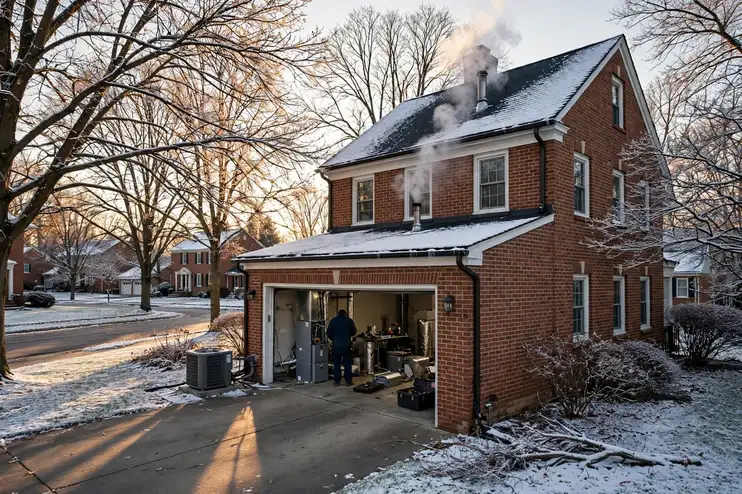


Everything on this page was computed for Racine and nowhere else: the problem ranking from its Census housing profile, the seasonal risks from its NOAA station record, the coverage from its own ZIP codes. TempReach USA connects you to an independent local HVAC technician; the page itself is the homework, done in public, so the call you make is an informed one.
Call center hours: Mon-Fri 7:00 AM-10:00 PM ET | Sat 8:00 AM-10:00 PM ET | Sun 7:00 AM-9:00 PM ET
The median Racine home was built in 1968; 67.0% of the stock predates 1980, and the pattern this metro's own data ranks first is the refrigerant transition reaching older systems. TempReach USA is a referral service, not an HVAC company: one call connects you with an independent local HVAC technician serving your ZIP code.
Racine is a metro of 196,888 people and 79,109 households, and its heating and cooling is a portrait of its building history. The median home here was built in 1968; 67.0% of homes predate 1980 and 40.1% predate 1960, while 12.9% have arrived since 2000. Every one of those eras heated and cooled differently — different furnaces, different duct designs, different refrigerant generations — and they fail differently, which is why this page is organised around the patterns the data actually produces in Racine rather than HVAC in the abstract.
Stand in one of Racine's older neighbourhoods and you are standing in its HVAC's back catalogue. The homes there — part of the 56,654 built before 1980 across this metro — went up when a furnace was built to serve for a generation and central cooling was still spreading street by street. That generation has now elapsed several times over. What it leaves behind is not universal failure but universal exposure: every duct joint, igniter and condenser coil in those districts is operating past the horizon its makers planned for, in Racine County and beyond, and the failures arrive in the order the parts tire.
Growth wrote this metro's newest HVAC chapter in matched equipment and planned ducts: systems sized as a single design, controls by the catalogue, outdoor units placed by the plat across the subdivisions near Mount Pleasant and Caledonia. The chapter is young — its systems have decades in hand — but it is not exempt from the metro's arithmetic: 654 cooling degree days of demand work its condensers hard, and the winters test its heat pumps with the same cold that tests the oldest furnace in Racine County.
Over everything sits the weather, and here it is measured rather than described: NOAA's station at RACINE BATTEN AP, WI US averages 48.4 degrees across the year, with 7.2 days reaching 90 or more and 125.5 nights at freezing or below. A furnace feels that record as a season of relentless cycling; a condenser feels it as a summer without a quiet week; a heat pump feels both. The problem ranking below is what those numbers, crossed with the housing profile, produce for Racine specifically.
Housing eras and climate, joined — the two datasets every section of this page is built from.
Lay the eras side by side instead: 40.1% pre-1960 (33,908 homes), 26.9% from 1960-1979 (22,746), 20.1% from 1980-1999 (16,996), and 12.9% since 2000 (10,908). No single era tells the story — the proportions among them do, and those proportions are different in every metro this site covers.
The centre of gravity here is the deep stock: with pre-1960 homes the largest single band, Racine's typical HVAC conversation starts with systems that have been renewed piecemeal for decades — furnaces on their third generation, duct layouts designed before central cooling was ordinary, condensers working on refrigerant the industry has retired. Newer work exists, out at the growth edge, but the metro's character — and most of its serious heating and cooling — sits in the old core and the streets that grew from it.
The second band in the table is the 1960-1979 stock: 22,746 homes, 26.9% of the metro. It is the transition generation — cooling arriving, heating generations overlapping, ducts mixed street by street — and it supplies Racine with its most diagnostic HVAC: two homes of the same year needing opposite answers, decided by what the builder happened to specify.
Racine's weather, reduced to what a system experiences: 7.2 hot days a year loading the cooling, 125.5 freezing nights loading the heating, and 31.77 inches of rain feeding the humidity both seasons complain about. NOAA's normals at RACINE BATTEN AP, WI US — 6,682 heating degree days, 654 cooling degree days — are the long average of that experience, and they are why this metro's problem list is not interchangeable with a milder or harsher metro's.
That is the whole method of this page in one section: era shares from the Census, loads from NOAA, and a problem list that is simply where the two overlap most in Racine. The services and guidance that follow are ordered by the same profile — local first, generic last.
Ranked for this metro alone, from its Census housing profile and NOAA climate record.
It is worth saying plainly what the transition is not. It is not a mandate to replace working equipment, not a deadline after which older systems become unusable, and not a verdict on the many R-22 and early R-410A systems still cooling Racine homes adequately. Systems are retired by economics and condition, not by calendar. What the transition changes is the slope of those economics: each year, the older generation's refrigerant and parts grow scarcer while the machine itself grows older, so the repair-versus-replace crossing arrives a little earlier than the same failure would have suggested a decade ago. Honest service practice in this metro states that slope openly and lets the household's own numbers — the unit's age, its condition, its history — make the call. The refrigerant in the pipes has become a fact of the house, like its roof's age: not urgent every day, and unwise to leave unexamined.
A transition-aware service visit has a recognizable order. First, identification: the nameplate's refrigerant, model and year, stated aloud so the household and technician share the fact. Second, the leak question, taken seriously — a system low on charge has a leak until proven otherwise, and recharging without finding it is buying the same refrigerant twice on an installment plan. Third, the condition audit around the failure: compressor health, coil condition, electrical wear, because the decision the household faces is about the whole machine, not the one part that stopped. Fourth, the comparison itself, presented as what it is — the repair path with its realistic horizon, the replacement path with its — so the choice is made on the machine's merits and the household's plans for the home. In Racine that conversation, held in a calm season, is unhurried and genuinely optional-feeling; held in a heat wave, the same facts arrive wearing a deadline.
The climate loads the stakes: a leaking system in Racine underperforms through 7.2 days a year at 90 degrees or more at RACINE BATTEN AP, WI US, so the household pays the transition's toll twice — in refrigerant and in lost cooling — until the underlying decision is made.
Duct loss hides inside other complaints. It presents as an air conditioner that cannot keep up in July — because the supply run through the attic is delivering air that picked up heat the whole way there. It presents as dust that returns days after cleaning, drawn in through return leaks in the crawl space. It presents as a furnace that heats the basement ceiling handsomely and the bedrooms modestly. In Racine, where many homes route their ducts outside the conditioned envelope by design of their era, these presentations are common enough to have a standing place in a technician's first questions. Separating duct loss from equipment weakness takes measurement rather than opinion — pressures and temperatures at the registers compared with those at the unit — and the separation matters, because the remedies are entirely different and only one of them touches the actual loss.
Read a duct system the way a technician does and the examination has a shape: start at the air handler and work outward. At the plenum, connections are inspected where they are most stressed and most consequential. Along the runs, the checks are for the known failure family — separated joints, fallen insulation, sagging flex, crushed sections, takeoffs that were sealed with hope rather than mastic. At the registers, temperatures and airflow are compared room by room, and the map of strong and weak rooms is laid over the map of the runs themselves; the two maps explain each other with remarkable consistency. Returns get the same walk, with attention to panned cavities and any path that lets the system breathe from outside the envelope. Cleaning belongs in this picture where the inspection finds accumulation — but cleaning a leaking network without sealing it polishes the inside of a system that is losing its cargo through the walls.
The load figures complete the case: 654 cooling degree days and 6,682 heating degree days at RACINE BATTEN AP, WI US mean the network is in service in earnest at both ends of the year. Duct loss here is not a summer inefficiency or a winter one; it is a twelve-month tax on a system that works both seasons.
There is a stage in every system's life when maintenance stops being a formality and becomes the main event. In Racine, with 56,654 pre-1980 homes and the equipment generations stacked inside them, a large part of the metro lives in that stage permanently. The tune-up of an older system is diagnostic work: pressures and temperatures that reveal a thinning refrigerant charge, electrical readings that show a motor working harder than its nameplate allows, a heat exchanger that deserves eyes rather than assumptions. Done yearly, it converts ageing from a surprise generator into a managed slope — the household learns each year what the system spent and what it has left. Skipped for years, the same visit becomes an archaeology dig, and the findings arrive all at once, usually in the season the household could least use them.
A serious look at an ageing system follows a short order. First, identity: the nameplate's age, model and refrigerant, because those three facts set the realistic horizon. Second, the electrical profile: starting components, motor draws, the condition of connections and the disconnect. Third, the air side: filter, coil cleanliness, blower condition and the temperatures across the system, which together say whether the machine is moving its rated air. Fourth, the combustion side on heating equipment: ignition condition, flame quality, exchanger inspection and venting. Last, the conversation those readings support — what is sound, what is spent, what to watch, and what the household should plan for in which season. In Racine's older housing that order matters more, not less, because the findings compound: an old system behind dirty coils and a drifting charge is three small problems impersonating one large one.
The arithmetic is straightforward: 84,558 housing units in Racine, a median build year of 1968, and equipment that turns over far more slowly than it ages. At any given moment, a large share of the metro's systems are in the second half of their working lives — being maintained there, or being discovered there.
Living with a real winter, as Racine does, means the season has a shape: the first hard freeze finds the unprepared systems, mid-winter tests endurance — igniters, motors and sensors carrying months of cycles — and the late thaws reveal what the cold quietly damaged. Households that prove their heating in autumn and treat mid-season symptoms as scheduling information get through most winters with nothing dramatic to report; the drama concentrates, year after year, in the systems nobody ran until the night they were needed at full load.
The season loads Racine's systems the way its record at RACINE BATTEN AP, WI US says it will: 6,682 heating degree days against 654 cooling degree days in an average year, against a housing stock whose median build year is 1968. The households that read the season early — filters, drains, a system run before the extreme weeks — are the ones whose calls stay schedulable.
The closer look reveals an irony at the transition's core. The systems most exposed to it — the oldest refrigerant generation — are concentrated in the homes least able to treat replacement casually: Racine's older housing, whose owners inherited their equipment's generation along with its era's ductwork and electrical service. For those households the repair-versus-replace decision carries more weight per dollar, and the quality of the conversation matters accordingly. Good local practice in this metro recognizes the stakes explicitly: present the leak, the machine's full condition, and both paths with their honest horizons, and let the decision be the household's, made with the nameplate fact on the table. The transition will complete itself across this metro one household decision at a time; the households served well are the ones whose decisions were informed rather than hurried.
The numbers underneath it, for Racine: 84,558 housing units, a median build year of 1968, and a climate record at RACINE BATTEN AP, WI US of 6,682 heating degree days against 654 cooling degree days. Cross the housing record with the weather record and this pattern is what falls out at the top — rarely the most dramatic problem in heating and cooling, but the one this metro's stock and climate manufacture most steadily.
Experienced local practice starts with the simple certainties — the observations that take minutes and decide the most:
Listed in the order this metro's housing and climate data supports.
Ice on the line, a tripping breaker, run times that lengthen week by week — in Racine these are the early chapters of a cooling failure, and a diagnosis caught at that stage is usually a component, not a system.
Ask what fills an AC repair diary in Racine and the answer is written in its housing. The median home was built in 1968, and a good share of the metro's cooling equipment is older than the homes' current owners realise — units sized for a different era of insulation, charged with refrigerant generations that have since been phased down. A system in Racine County that cools a little less each summer is telling a story in instalments, and the repair visit reads the whole story: pressures, airflow, the coil's condition, the duct losses behind the walls. Locally the workload concentrates where the stock is oldest — the districts built around the 1960s first.
The local caseload behind this service is written in the climate figures: 654 cooling degree days a year and 7.2 days at 90 or above, pressing on a cooling fleet whose oldest members serve the 56,654 pre-1980 homes — in Mount Pleasant (27,694 residents) as much as in the oldest districts.
A duct system remembers everything the house has done: the remodel, the shedding dog, the winter the filter went unchanged. Cleaning reads that memory out under vacuum pressure and leaves the airways themselves — not just the grilles — clean.
Duct cleaning in Racine is booked in waves that follow the housing: after the renovation seasons in the older districts, at move-in across the subdivisions, alongside system replacements everywhere. The work pairs naturally with the inspection that surrounds it — leaking joints found and sealed, a disconnected run in an attic discovered, insulation fallen where it should not be. The cleaning is the appointment; the findings are often the value. In Racine that holds across 13 ZIP codes, from Racine out to Caledonia.
Count the systems and the diary fills itself: 79,109 households breathing through ductwork daily, the oldest of it in homes from the 1960s and the newest in the subdivisions past Burlington. What the cleaning finds follows the biography — dust in proportion to years, debris in proportion to renovations.
Heating visits carry a safety core the cooling visit does not: burners, ignition, heat exchanger and venting inspected while the household is not depending on them nightly. Comfort is the other half of the visit, not the whole of it.
The tune-up diary in Racine follows the installed base: the pre-1980 districts' ageing systems, kept in service by attention; the middle ring's equipment in its second decade, where maintenance decides whether it sees a third; the subdivisions' matched fleets, all reaching the same service points in the same seasons. A maintenance visit is measurement more than ritual — temperatures, pressures, electrical readings, airflow — recorded against last year's figures, so the system's direction is known rather than guessed. That is the daily reality for the 79,109 households spread across Racine.
Tune-up demand follows the fleet's waves: the subdivisions' matched systems reaching service points together, the pre-1980 districts' individual units on individual schedules. Waterford sits inside one of those patterns; the readings taken there this season predict its systems' next one.
Furnace repair in Racine follows the sequence: the independent local professional covering Racine watches your furnace attempt a start, tests the stage that failed, and quotes before work begins.
Across Racine, the local professional who answers knows the stock — a median build year of 1968 across 84,558 homes means systems of every age failing in their characteristic ways, from Racine to the metro's newest subdivisions.
From Racine to Burlington, Racine replacements routed through TempReach USA end in commissioning — measured charge and airflow — so the installed system matches the calculated one.
From Racine to Burlington, Racine installations routed through TempReach USA finish with commissioning — combustion, temperature rise and airflow verified — so the fitted system is the specified system.
Heat pump services in Racine test the whole year-round system: the independent local professional covering Racine reads charge and airflow in both modes, proves defrost, and checks auxiliary heat logic before quoting any work.
Across 13 ZIP codes, Racine mini-split systems installed through local professionals are commissioned zone by zone in heating and cooling, with the filter and drain routine handed over in person.
With a median build year of 1968 across 84,558 homes, Racine holds both air problems at once — envelopes that leak air freely and envelopes sealed tight — and the local professional assesses which house yours is before recommending equipment.
From Racine to the metro's edge, Racine's 84,558 homes run every system type there is — single-stage furnaces, two-stage equipment, heat pumps with auxiliary heat — and each gets a control matched to its terminals, not a shelf guess.
Racine's commercial buildings span every era around a median build year of 1968 — and with the era goes the equipment, from aging single units over old storefronts to multi-zone systems in new developments, all serviced from a per-unit record.
Two patterns generate most of the bookings behind the services above: The refrigerant transition reaching older systems and leaky ducts losing air and energy. That is why the order of this page's service list is what it is — the services answering those patterns come early, and the rest follow in the order the metro's data supports. A homeowner whose home matches the local profile — built in the metro's big decades, in one of its older districts — is, statistically, reading their own shortlist.
PROBLEM SOLUTION
Population 77,155
Population 27,694
Population 25,292
Population 11,021
Population 6,787
Population 5,627
Population 5,173
Population 5,028
Population 4,968
Population 3,928
Population 3,780
Population 3,237
Also in the Racine metro: Bohners Lake (population 2,138), Browns Lake (population 1,766).
Beyond Racine itself, the metro takes in Mount Pleasant (27,694 residents), Caledonia (25,292) and the rest of the communities in the grid above — each fitted with heating and cooling in its own building era, which is why two streets in the same metro can need entirely different HVAC conversations. The ZIP list below is the full coverage footprint: if your code is on it, this page was written about your housing stock.
Beyond the largest communities sit Burlington (11,021), Sturtevant (6,787), Waterford (5,627), Tichigan (5,173), Wind Lake (5,028) — smaller places across Racine, covered on the same terms. Their housing tends to be older on average than the big suburbs', and their calls follow the older patterns on this page. One routing covers them all: find your ZIP code below and the rest is a phone call.
The metro's weight is not evenly spread. Racine holds 77,155 of the 196,888 residents; Mount Pleasant and Caledonia add 27,694 and 25,292; and the remainder scatters across the smaller places above, some no bigger than a few thousand people. HVAC follows the weight — most calls come from where most homes are — but era matters more than size: a small community of 1960s housing generates older-system work than a large new subdivision does.
The metro answers to 1 county governments (Racine), a patchwork that matters at permit time rather than at the thermostat. Racine County carries the centre; the others carry the growth rings and the older outlying towns. A technician routed through this page works inside that patchwork daily — the weather does not care about the boundaries, but the job's paperwork does.
Beyond the metro line, the nearest covered metros are Kenosha, WI (14 miles away), Milwaukee, WI (33 miles) and Janesville, WI (67 miles) — separate pages, separate profiles, because their housing and weather records are their own. Homeowners near the boundary sit between two datasets; the ZIP list above, not the map's edge, decides which page was written about your stock.
The region around Racine is a set of variations on its theme: Kenosha, WI, 14 miles off, runs a median build year of 1975 on a metro population of 168,448; Milwaukee, WI (33 miles) medians 1966 on 1,575,010; Janesville, WI (67 miles) medians 1970 on 166,472. Nearness is not sameness — a few decades of median build year separate their heating and cooling as surely as the miles separate their maps.
Count the metro per unit of itself: 6,504 housing units per covered ZIP code; 79,109 households per county; 14 communities sharing 1 county governments. Then weigh the generations against each other — 5.2 older homes for each newer one — and the service pattern on this page stops being a list and becomes a proportion: that much of the diary written by ageing systems, the rest by young ones wearing in.
The Racine record in one line — median home age: 58 years · owner-occupied homes: 56,246 · renter-occupied homes: 22,863 · pre-1960 homes per covered ZIP code: 2,608 · heating-to-cooling degree-day ratio: 10.22 · average rainfall: 807 mm a year.
County pages carry the local detail — land area, climate normals and the heating and cooling pressures on the ground in each county.
More plain-language help: the TempReach USA heating & cooling guides
One call connects you with an independent local heating and cooling professional serving Racine and the surrounding metro.
Call center hours: Mon-Fri 7:00 AM-10:00 PM ET | Sat 8:00 AM-10:00 PM ET | Sun 7:00 AM-9:00 PM ET