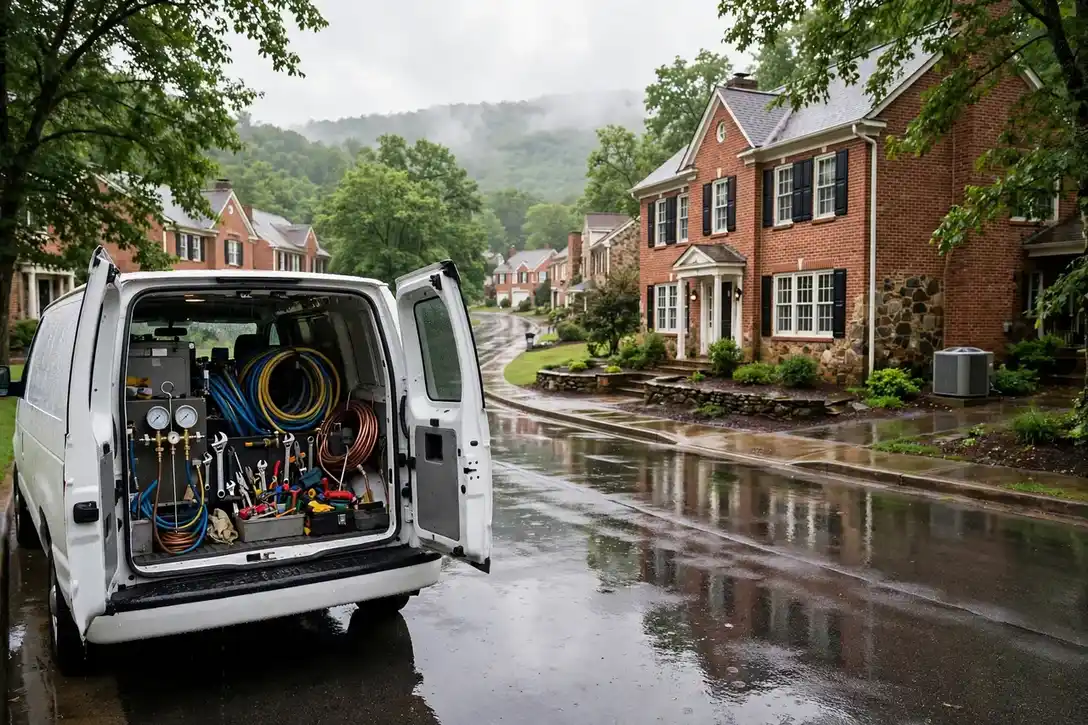


Start with the stock, and the rest of the page follows: Fayetteville–Springdale–Rogers's housing eras, its climate record at FAYETTEVILLE DRAKE FLD, AR US, and the failure patterns those two manufacture together — ranked, evidenced and answered below. When the pattern matches your home, one call routes you to an independent local HVAC technician who works these streets.
Call center hours: Mon-Fri 7:00 AM-10:00 PM ET | Sat 8:00 AM-10:00 PM ET | Sun 7:00 AM-9:00 PM ET
The median Fayetteville–Springdale–Rogers home was built in 1997; 23.4% of the stock predates 1980, and the pattern this metro's own data ranks first is uneven temperatures and airflow across the house. TempReach USA is a referral service, not an HVAC company: one call connects you with an independent local HVAC technician serving your ZIP code.
Fayetteville–Springdale–Rogers is a metro of 563,436 people and 209,515 households, and its heating and cooling is a portrait of its building history. The median home here was built in 1997; 23.4% of homes predate 1980 and 6.9% predate 1960, while 43.5% have arrived since 2000. Every one of those eras heated and cooled differently — different furnaces, different duct designs, different refrigerant generations — and they fail differently, which is why this page is organised around the patterns the data actually produces in Fayetteville–Springdale–Rogers rather than HVAC in the abstract.
Stand in one of Fayetteville–Springdale–Rogers's older neighbourhoods and you are standing in its HVAC's back catalogue. The homes there — part of the 53,672 built before 1980 across this metro — went up when a furnace was built to serve for a generation and central cooling was still spreading street by street. That generation has now elapsed several times over. What it leaves behind is not universal failure but universal exposure: every duct joint, igniter and condenser coil in those districts is operating past the horizon its makers planned for, in Benton County and beyond, and the failures arrive in the order the parts tire.
The growth side of the metro tells the opposite story in the same language. Springdale, Rogers and the subdivisions still filling in account for much of the 99,776 homes built since 2000 — matched systems, planned ductwork, heat pumps where the lots suit them. Their HVAC is not old; it is uniform, which creates its own calendar: everything installed in the same boom reaches each wear point in the same years, from the first condenser replacements to the first control-board failures, while 1,352 cooling degree days of annual heat keep demand on the system high.
The climate written over all of it comes from the NOAA station at FAYETTEVILLE DRAKE FLD, AR US: an average year brings 4,080 heating degree days, 1,352 cooling degree days and 46.96 inches of precipitation. Those are not abstractions to a furnace or a condenser — they set how many hours a heating system runs each winter, how hard a cooling system cycles in July, and how much moisture every coil has to pull out of the indoor air. The problem sections that follow are selected by exactly these numbers, combined with the housing-age profile above.
The metro's building eras on one side, its weather record on the other — and its heating and cooling where the two meet.
Lay the eras side by side instead: 6.9% pre-1960 (15,826 homes), 16.5% from 1960-1979 (37,846), 33.1% from 1980-1999 (75,921), and 43.5% since 2000 (99,776). No single era tells the story — the proportions among them do, and those proportions are different in every metro this site covers.
Growth is the headline in Fayetteville–Springdale–Rogers: the post-2000 band is the largest, much of it subdivisions fitted with matched modern systems and ductwork designed as a single plan. The work here is young-stock work — first replacements arriving in waves as whole streets age together, heat pumps standard where their neighbours have furnaces, controls and sensors failing in preference to iron. The metro's older pockets still generate the deep problems, but the volume of its HVAC future is being written in the new subdivisions.
The runner-up era is 1980-1999, with 33.1% of homes. That stock has left its carefree decades and entered its maintenance decades, and it shows in the call pattern around Springdale and the other districts of those years: condensers on their second cycle, furnaces reaching their wear points together, ducts still young enough to reward attention over replacement.
Translate the climate record into HVAC terms and it comes out as three working conditions. Condition one, the freeze count — 93.5 nights a year when a heating failure stops being a comfort issue and becomes a household one. Condition two, the heat count — 40.5 days that load condensers, ducts and tempers simultaneously. Condition three, the moisture: 46.96 inches of precipitation arriving as humidity the cooling coil must remove. Fayetteville–Springdale–Rogers's systems are engineered, installed and aged inside those three conditions, and their failures carry the conditions' fingerprints.
That is the whole method of this page in one section: era shares from the Census, loads from NOAA, and a problem list that is simply where the two overlap most in Fayetteville–Springdale–Rogers. The services and guidance that follow are ordered by the same profile — local first, generic last.
Chosen by this metro's own housing and weather data — the same two records this whole page is built from.
Before any equipment enters the conversation, the existing network deserves its audit, because a share of uneven-temperature complaints in Fayetteville–Springdale–Rogers are delivery failures wearing a zoning costume. A crushed flex run to the upstairs, a takeoff never opened, returns missing where doors close rooms off from the air's path back — these produce room-to-room differences that no thermostat arrangement can fix, and they correct with duct repairs rather than equipment replacement. The honest sequence is measurement first: temperatures and airflow room by room, the duct map compared against the complaint map, register behavior with doors open and closed. Where the two maps diverge for design reasons, zoning or ductless capacity is the answer; where they diverge for defects, repair is. Households served well get the measurement before the recommendation, because the two answers differ so much in scope that confusing them is the expensive error in either direction.
Airflow is the substrate everything else stands on, and its rules are unforgiving. A blower moves a volume of air against the network's resistance; lengthen a run, crush a section, close registers, or clog the path and the volume redistributes itself according to physics, not intention — favoring short, wide, open paths and starving long ones. Balancing is the craft of arranging that redistribution deliberately: damper positions, register adjustment, return paths sized for the supply they serve. In a Fayetteville–Springdale–Rogers home the balance drifts over the years as filters load, furniture rearranges the rooms' air, renovations close paths that used to be open, and duct sections sag or separate. A system can therefore be out of balance without anything being broken — which is both the good news and the diagnostic difficulty, since the remedy is a methodical walk of the whole network rather than a replaced part.
Look at the adaptation evidence in any affected Fayetteville–Springdale–Rogers home: the portable heater in the end room, the fan that lives in the upstairs hall, the bedroom doors propped for airflow. Households instrument this pattern with their own purchases long before anyone measures it — the adaptations are the data, waiting for a diagnosis.
Leaks are where the transition stops being abstract. A slow leak on a current-generation system is an ordinary repair story: find it, fix it, recharge. The same leak on an R-22 system in Fayetteville–Springdale–Rogers opens a ledger. The refrigerant itself is drawn from a shrinking reclaimed supply; the system is, by definition, of an age where the leak may not be its last; and the money spent returning it to service buys time on a machine whose other components have aged alongside it. None of that decides the answer by itself — plenty of R-22 systems justify a repair and serve well afterward — but it changes the questions: how old is the unit, where is the leak, what else is worn, and what would the same money mean applied to a current-generation replacement? Households that ask those four questions with the numbers in front of them make the decision once; households that skip them often make it repeatedly, one hot season at a time.
A transition-aware service visit has a recognizable order. First, identification: the nameplate's refrigerant, model and year, stated aloud so the household and technician share the fact. Second, the leak question, taken seriously — a system low on charge has a leak until proven otherwise, and recharging without finding it is buying the same refrigerant twice on an installment plan. Third, the condition audit around the failure: compressor health, coil condition, electrical wear, because the decision the household faces is about the whole machine, not the one part that stopped. Fourth, the comparison itself, presented as what it is — the repair path with its realistic horizon, the replacement path with its — so the choice is made on the machine's merits and the household's plans for the home. In Fayetteville–Springdale–Rogers that conversation, held in a calm season, is unhurried and genuinely optional-feeling; held in a heat wave, the same facts arrive wearing a deadline.
The regulatory facts are the foundation: R-22 production and import ended in the United States in 2020, leaving reclaimed stock as the supply, while new equipment has moved through R-410A to the current lower-impact generation. In Fayetteville–Springdale–Rogers every generation still stands in service — the transition is not coming to this metro; it is distributed across it, yard by yard.
Cooling and drying are two jobs wearing one name, and in Fayetteville–Springdale–Rogers the second job is the heavier one for much of the season. The climate record at FAYETTEVILLE DRAKE FLD, AR US pairs the heat with 46.96 inches of precipitation in an average year, and the air that comes with that moisture asks every air conditioner to do double duty: lower the temperature and wring out the water. A system dries air only while it runs, and only when its coil is cold and its airflow is right — so a unit that satisfies the thermostat quickly and shuts off can leave a house cool and clammy at the same time. The burden shows in the house as much as in the equipment: rooms that feel sticky at a normal setting, a musty note in closets and low corners, condensation on registers and windows, and indoor air that never quite feels finished. Households often answer by turning the thermostat down, which buys dryness with overcooling and longer bills of runtime. The underlying question is a moisture question — where the water is entering, how the system is set up to remove it, and whether the house needs dedicated dehumidification help beyond its cooling cycle.
The physics of the burden are worth stating plainly. Air holds water as vapor; the amount it can hold rises with temperature, which is why warm air arriving in a Fayetteville–Springdale–Rogers summer carries so much of it indoors. A cooling coil removes moisture by passing air across a surface cold enough for water to condense on it — the same physics that beads a cold glass. Two conditions govern how much condenses: how long the air stays against the cold coil, and how cold the coil runs. Short cycles starve the first; high airflow can starve the second. Meanwhile the house keeps adding vapor from living and from its own damp places, and the envelope keeps trading air with the outdoors. Indoor humidity is the running balance of that account — removal by the coil against addition by everything else — and a house that feels damp is simply a house whose account is out of balance in the wet direction.
Count the load the way the coil experiences it: through the humid months, each pass of indoor air delivers moisture that must condense and drain before the air can feel finished. In Fayetteville–Springdale–Rogers, where cooling degree days reach 1,352 a year, that invisible water work rivals the temperature work the system was named for.
The freeze changes the meaning of symptoms. A furnace that lockouts and recovers in October is a nuisance; the same behavior with the temperature falling through the twenties outside is a system announcing that it may not be present for the coldest hours. In Fayetteville–Springdale–Rogers, experienced households read winter heating symptoms against the forecast rather than the calendar: intermittent operation ahead of a cold snap is a reason to act that day, because the snap will test the system at exactly the load where its weakness lives, and it will do so at the hour when every other weak system in the metro is being tested too. The queue forms in the cold, all at once, for reasons that were visible in the mild weather before it. The freeze-risk pattern is therefore partly a story about timing — the gap between when a system files its intentions and when the weather collects on them.
The physics of the risk run on a simple clock. A house loses heat through its envelope at a rate set by the temperature difference across it; in a hard freeze that difference is the widest of the year, so the indoor temperature of an unheated house falls fastest exactly when the consequences of falling are gravest. The fall is uneven: rooms over unheated spaces and against the wind cool first, wall cavities housing pipes cool faster than the rooms they serve, and a pipe can reach freezing beside a room that still feels merely chilly. That unevenness is the trap in a household's intuition — the thermostat's reading is the house's average story, while the pipes live in its coldest footnotes. In Fayetteville–Springdale–Rogers the margin between a cold night and a damaging one is often a single night's depth of freeze against a house whose heat failed that morning, which is why the response sequence treats hours as the unit of value.
The timing evidence recurs every cold season: heating calls in Fayetteville–Springdale–Rogers cluster in the deepest cold and at the thaw, the signature of marginal systems audited simultaneously by 40.5-degree summers' opposite number — the freeze weeks when FAYETTEVILLE DRAKE FLD, AR US's coldest readings arrive together.
The shoulder season is the system's handover, and like any handover it exposes what the outgoing shift left undone. In Fayetteville–Springdale–Rogers, the spring shoulder inherits winter's account — a filter loaded with the heating season, an igniter that has fired its thousands, heating symptoms nobody acted on once the weather softened — while the autumn shoulder inherits summer's: a coil washed by months of condensate, a drain carrying the season's growth, starting parts worn by the hot months' work. Clearing each inheritance before the next season draws on the account is the whole craft here, and it is light work precisely because the weather, for these few weeks, is not in a hurry.
The season loads Fayetteville–Springdale–Rogers's systems the way its record at FAYETTEVILLE DRAKE FLD, AR US says it will: 4,080 heating degree days against 1,352 cooling degree days in an average year, against a housing stock whose median build year is 1997. The households that read the season early — filters, drains, a system run before the extreme weeks — are the ones whose calls stay schedulable.
The penalties for leaving the pattern unsorted are easy to miss because they are paid in behavior. The family that overheats its whole house to warm one suite, cools empty bedrooms to serve one nursery, sleeps downstairs in the hot weeks and abandons the end office in the cold ones is paying — in runtime, in comfort, in rooms of the home effectively lost for parts of the year. In Fayetteville–Springdale–Rogers, where the climate record at FAYETTEVILLE DRAKE FLD, AR US presses both ends of the year — 1,352 cooling degree days against 4,080 heating degree days — the lost-room tax is collected twice annually. Read that way, sorting the house is not a luxury project. It is the recovery of floor space the household already owns, from a delivery problem that measurement can name precisely and that three distinct remedies stand ready to answer at three distinct scales.
Strip the pattern down to its inputs and the ranking stops being mysterious: 209,515 households depending on systems installed across a median build year of 1997, in a climate that swings between 40.5 days of serious heat and 93.5 freezing nights. Whatever pattern a metro with those inputs manufactures most, it manufactures here — the lead position is less a title than a consequence, recalculated from the same public records any sceptic can check.
On a first visit for this pattern, a local technician's checks run in a practised order:
Ordered by what this metro's data says its homes need most.
Ductless comfort in Fayetteville–Springdale–Rogers is designed room by room: a unit sized from the room's own load modulates quietly and evenly, while one guessed at short-cycles or strains, zone by zone.
Ductless work in Fayetteville–Springdale–Rogers also follows the housing nobody else can easily serve: the historic core around Fayetteville, where walls were never built for ducts, and the accessory dwellings and in-law spaces appearing across Benton, Madison, Washington. Each installation is a small design project — line-set routes, condensate paths, the outdoor unit's placement — fitted to a building that predates the very idea of central air. Done well, the result is the quietest heating and cooling in the house. The FAYETTEVILLE DRAKE FLD, AR US record — 4,080 heating degree days, 1,352 cooling — is the backdrop Benton County technicians plan around.
The search territory for ductless is the metro's unducted stock: 15,826 pre-1960 homes built before central systems, plus the additions and conversions scattered through 209,515 households — in Springdale and the historic core alike, spaces the main system never reached.
Ice on the line, a tripping breaker, run times that lengthen week by week — in Fayetteville–Springdale–Rogers these are the early chapters of a cooling failure, and a diagnosis caught at that stage is usually a component, not a system.
One more pattern belongs in the Fayetteville–Springdale–Rogers picture: repair calls here are also a refrigerant story. Systems fitted in the older decades run on refrigerant generations the industry has been retiring, and every repair on those units weighs the charge's scarcity against the system's remaining life. The technician who explains that arithmetic plainly — what the repair restores, what it cannot assure anyone about next summer — is giving the household the real choice, and in the 53,672 pre-1980 homes it is a conversation held weekly. Ask in Bentonville and the answer rhymes with Fayetteville: same eras, same equipment generations, same calendar of failures.
The local caseload behind this service is written in the climate figures: 1,352 cooling degree days a year and 40.5 days at 90 or above, pressing on a cooling fleet whose oldest members serve the 53,672 pre-1980 homes — in Bentonville (56,326 residents) as much as in the oldest districts.
Three parts, one system: filtration captures what the air carries, humidity control keeps moisture where the building tolerates it, and ventilation replaces stale air on schedule. Equipment chosen for one part cannot do the others' work.
The air quality conversation in Fayetteville–Springdale–Rogers starts with humidity more often than with gadgets. A home whose summer indoor humidity rides high grows musty at the coil and uncomfortable at the thermostat, and a home dried out by 4,080 heating degree days of winter runtime irritates skin, wood and sinuses in the opposite direction. The assessment measures before it prescribes: humidity in both seasons, the filter's actual condition and fit, the duct leakage that pulls attic or crawl-space air into the supply stream in the metro's older districts. That is the daily reality for the 209,515 households spread across Benton, Madison, Washington.
The local figures behind the service: 209,515 households, indoor humidity driven by 46.96 inches of yearly rain and long humid stretches, pollen seasons that load every return in Benton County. The assessment measures a home against exactly that climate, not against a generic standard.
An emergency is a trajectory, not a discomfort: temperatures heading somewhere unsafe, water in motion, an electrical fault worsening. Those failures cannot wait for a routine slot, and the response is sequenced accordingly.
What counts as an emergency here is narrower than discomfort and wider than breakdown. No cooling with an infant or an elderly resident in the house during a Fayetteville–Springdale–Rogers heat stretch is an emergency. No heat with pipes exposed to a freezing night is an emergency twice over. A burning smell, a tripped breaker that will not hold, water from a condensate overflow — each is the system asking for a same-day answer. The call center's questions sort the urgent from the schedulable, and local technicians already working these streets are the ones routed first. Count it in homes if you prefer: 53,672 built before 1980, 99,776 since 2000, one shared system of streets and seasons.
Scale the problem by the Census count: 209,515 households depending on systems that cannot be improvised around — no heat in a freeze, no cooling in a heat wave. The emergency visit exists for the hours when waiting until Monday is not a plan, in Lowell this month, somewhere else next.
From Fayetteville to Bentonville, a no-heat call through TempReach USA reaches a local professional whose visit includes the exchanger and venting checks that furnace work owes a Fayetteville–Springdale–Rogers household.
From Fayetteville to Bentonville, Fayetteville–Springdale–Rogers replacements routed through TempReach USA end in commissioning — measured charge and airflow — so the installed system matches the calculated one.
From Fayetteville to Bentonville, Fayetteville–Springdale–Rogers installations routed through TempReach USA finish with commissioning — combustion, temperature rise and airflow verified — so the fitted system is the specified system.
Heat pump services in Fayetteville–Springdale–Rogers test the whole year-round system: the independent local professional covering Benton, Madison, Washington reads charge and airflow in both modes, proves defrost, and checks auxiliary heat logic before quoting any work.
Across Benton, Madison, Washington, the cleaning question is answered the same way — look inside first. From Fayetteville out through the 41 ZIP codes covered, matted buildup and renovation debris make the case; a light film makes the case for waiting.
From Fayetteville to the metro's edge, Fayetteville–Springdale–Rogers's 229,369 homes run every system type there is — single-stage furnaces, two-stage equipment, heat pumps with auxiliary heat — and each gets a control matched to its terminals, not a shelf guess.
In Fayetteville–Springdale–Rogers, the maintenance calendar writes itself from the climate: 4,080 heating degree days and 1,352 cooling degree days mean both systems work a real season, so the fall and spring visits each have genuine work to inspect.
In Fayetteville–Springdale–Rogers, commercial work follows the stock: 229,369 housing units' worth of mixed buildings — offices, retail and restaurants from Fayetteville across the 41 covered ZIP codes — each with rooftop units whose service rhythm the local professional sets per building.
Ask where this metro's HVAC diary fills up and the answer is a short story: Uneven temperatures and airflow across the house first, the refrigerant transition reaching older systems close behind, and the services that answer them doing the bulk of the booked work. Everything else on the list above is the supporting cast — necessary, frequent enough, but not what Fayetteville–Springdale–Rogers's housing stock, at its age and in its climate, principally demands. Read the service list as a weather report for the metro's systems and it stops looking like a catalogue.
PROBLEM SOLUTION
Population 97,227
Population 87,388
Population 71,411
Population 56,326
Population 30,935
Population 20,212
Population 18,096
Population 10,438
Population 8,469
Population 7,445
Population 7,348
Population 5,778
Also in the Fayetteville–Springdale–Rogers metro: Tontitown (population 5,739), Gentry (population 4,069).
The communities in the grid are not suburbs of the page; they are its subject as much as Fayetteville is. Springdale (87,388 residents) and Rogers (71,411) carry their own building decades, their own equipment generations and their own positions in the problem ranking's logic — a system under a Springdale roof answers to the same data as one in the centre, but to a different era of it. Coverage here is defined by the ZIP list below; understanding is defined street by street, and this page's figures are the metro-wide version of a story each community tells in its own numbers.
Also on the Fayetteville–Springdale–Rogers map: Bentonville (56,326), Bella Vista (30,935), Centerton (20,212), Siloam Springs (18,096), Lowell (10,438) — communities spread across Benton, Madison, Washington, each with housing from its own growth years. A technician routed through TempReach USA to any of them is working from this same page: the metro data does not change at the city limit, but the housing on your street — its age, its equipment, its attic — is what the visit is really about.
The metro's weight is not evenly spread. Fayetteville holds 97,227 of the 563,436 residents; Springdale and Rogers add 87,388 and 71,411; and the remainder scatters across the smaller places above, some no bigger than a few thousand people. HVAC follows the weight — most calls come from where most homes are — but era matters more than size: a small community of 1960s housing generates older-system work than a large new subdivision does.
One metro, 3 county lines drawn through it: Benton, Madison, Washington. The lines are invisible to the weather, but they structure everything administrative around an HVAC job — which office permits it, which inspector signs it, which code edition applies. Benton County, at the centre, carries the oldest housing and the heaviest share of the work this page describes; its neighbours carry the growth. A routed local technician navigates the patchwork so the homeowner does not have to.
This page ends at the metro boundary, but the region does not: Fort Smith, AR, Little Rock, AR and Joplin, MO continue the coverage in their own directions, each with a profile built from its own Census and NOAA figures. If your home sits near the line between metros, go by your ZIP code — it places you in the dataset that describes your housing.
The region around Fayetteville–Springdale–Rogers is a set of variations on its theme: Fort Smith, AR, 51 miles off, runs a median build year of 1983 on a metro population of 234,140; Little Rock, AR (131 miles) medians 1988 on 777,607; Joplin, MO (72 miles) medians 1982 on 208,796. Nearness is not sameness — a few decades of median build year separate their heating and cooling as surely as the miles separate their maps.
The stock has a shape as well as a size. Owners hold 62.3% of it and renters 37.7%, a split that decides who notices a comfort problem first and who arranges the repair. The generations split 0.5-to-one in favour of the pre-1980 homes. And the map divides into 14 named communities across Benton, Madison, Washington, each carrying its era's share of the 229,369 housing units the Census counts here.
One line of Fayetteville–Springdale–Rogers arithmetic — a median home 29 years old · 130,528 owner-occupied homes against 78,987 renter-occupied · 386 pre-1960 homes for every covered ZIP code · a heating-to-cooling degree-day ratio of 3.02 · 1,193 mm of rain in an average year.
County pages carry the local detail — land area, climate normals and the heating and cooling pressures on the ground in each county.
More plain-language help: the TempReach USA heating & cooling guides
Describe the problem and the call center routes you to an independent local HVAC technician who works in the Fayetteville–Springdale–Rogers metro.
Call center hours: Mon-Fri 7:00 AM-10:00 PM ET | Sat 8:00 AM-10:00 PM ET | Sun 7:00 AM-9:00 PM ET