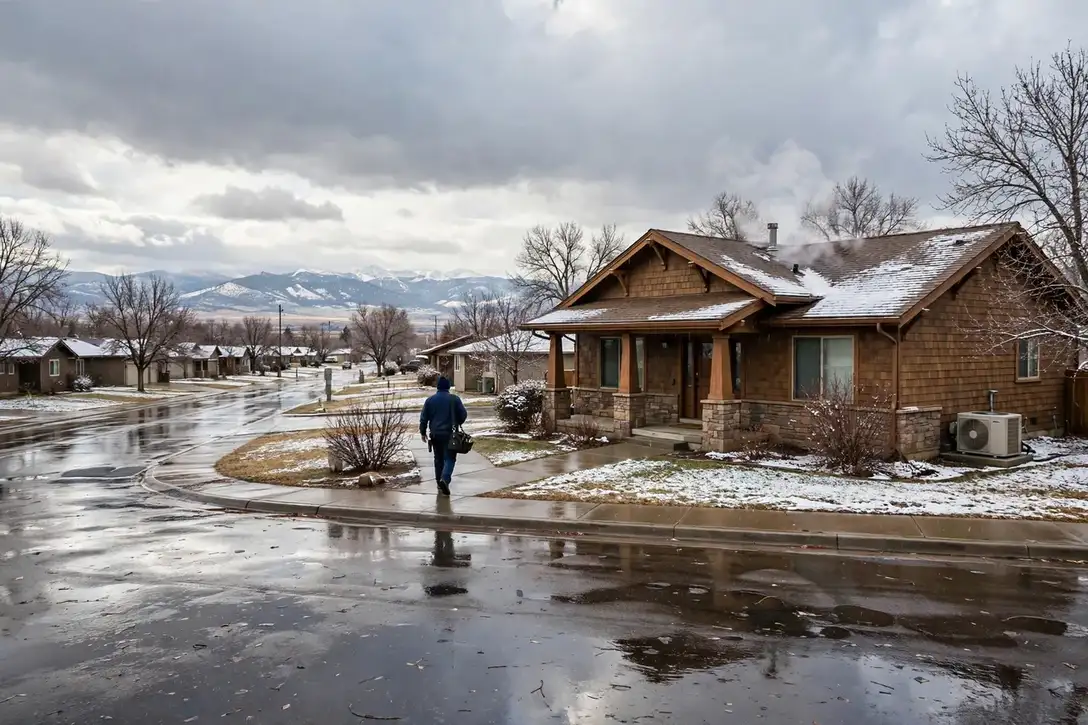

This is Greeley's heating and cooling page, built from Greeley's own numbers: Census housing figures, the metro's ZIP codes and its NOAA climate record. TempReach USA routes your call to an independent local HVAC technician; the homework below is here so you know your home's likely problems before you ever make it.
Call center hours: Mon-Fri 7:00 AM-10:00 PM ET | Sat 8:00 AM-10:00 PM ET | Sun 7:00 AM-9:00 PM ET
The median Greeley home was built in 2000; 30.8% of the stock predates 1980, and the pattern this metro's own data ranks first is uneven temperatures and airflow across the house. TempReach USA is a referral service, not an HVAC company: one call connects you with an independent local HVAC technician serving your ZIP code.
Two numbers frame everything that follows: 75.5% of Greeley homes are owner-occupied, and the median one was built in 2000. Ownership matters to HVAC because owners inherit their systems whole — every equipment decision a builder made in the 2000s or earlier is still in the attic, the closet and the side yard, ageing on its original schedule. With 30.8% of homes predating 1980 and 49.4% arriving since 2000, the metro is really two housing stocks sharing one map, and they are taken separately below before the problems are ranked.
Ask how Greeley's older homes have been kept comfortable and the honest answer is: in pieces. A furnace here, a condenser there, one room's ducts renewed while the rest of the system carries on — across 38,510 pre-1980 homes, the patchwork is the norm rather than the exception. That history is written in the attics of Weld County and everywhere else the early stock stands: systems that are part original, part renewed, and entirely individual. It is also why the guidance on this page keeps returning to patterns rather than single faults — in a patchwork system, the pattern is the diagnosis.
The newer side of Greeley — the 49.4% of homes built since 2000, concentrated around growing communities like Greeley — runs on matched modern systems that age more gracefully but fail in their own ways: heat pumps and condensers worked hard by 434 cooling degree days of hot-season demand, control boards and sensors wearing out in houses that all reach the same age at the same time. One metro, two equipment generations, and the sections below take them in the order this metro's data ranks them.
The weather's part in this is written at NUNN 7 NNE, CO US, where an average year carries 13.4 inches of precipitation, 34.2 days at ninety degrees or more and 183.1 nights at freezing or below. Systems experience that year as workload and as stakes in roughly equal measure — the workload in the run hours, the stakes on the single coldest night and the single hottest week. The problem ranking further down is simply the housing profile above, read under this sky.
Two public records, one metro: what was built here, and what the sky does to it.
Break the stock down by building era and the profile sharpens. Before 1960: 12.0% of homes, roughly 15,004 of them. From 1960 to 1979: 18.8%, about 23,506. From 1980 to 1999: 19.8%, about 24,757. Since 2000: 49.4%, about 61,766. Four eras, four equipment generations — and the balance among them is this metro's HVAC character in a single paragraph.
Read this metro's profile as a before-and-after photograph with the after still developing: the post-2000 band leads, the older bands trail, and every year the balance tips further toward young systems with young problems. Greeley's HVAC volume already lives in the new stock — its condenser waves, its sensor waves, its heat pump questions — while its deepest single jobs still come from the old core. Both facts are in the numbers above; a local technician's week is simply where they meet.
The runner-up era is 1980-1999, with 19.8% of homes. That stock has left its carefree decades and entered its maintenance decades, and it shows in the call pattern around Windsor and the other districts of those years: condensers on their second cycle, furnaces reaching their wear points together, ducts still young enough to reward attention over replacement.
Start the climate half where the system starts: at the thermostat's two seasons. Greeley's cooling answers 434 cooling degree days of load and its heating answers 6,845 heating degree days of cold at NUNN 7 NNE, CO US — an average temperature of 47.3 degrees that no individual week actually delivers. A heating and cooling system here is never in neutral; the record keeps it working at one end or the other all year.
That is the whole method of this page in one section: era shares from the Census, loads from NOAA, and a problem list that is simply where the two overlap most in Greeley. The services and guidance that follow are ordered by the same profile — local first, generic last.
Sequenced by this metro's own problem ranking, not by a national catalogue order.
Ductless comfort in Greeley is designed room by room: a unit sized from the room's own load modulates quietly and evenly, while one guessed at short-cycles or strains, zone by zone.
The mini-split question in Greeley is usually a room that the main system cannot reach or cannot satisfy — the upstairs bedroom under a hot roof, the addition beyond the duct run, the converted garage in Erie. The technology answers with zones: one outdoor unit, one or more indoor heads, each room on its own setting. Sizing still rules the outcome; an oversized head short-cycles and leaves the humidity behind, and Greeley's humid stretches punish that error daily. That is the daily reality for the 120,019 households spread across Weld.
The search territory for ductless is the metro's unducted stock: 15,004 pre-1960 homes built before central systems, plus the additions and conversions scattered through 120,019 households — in Windsor and the historic core alike, spaces the main system never reached.
Stabilization precedes diagnosis. The fault isolated, the water contained, the dangerous component out of service — a repair decided in a worsening house is rarely the right one, so the worsening stops first.
HVAC emergencies in Greeley keep the climate's hours: the cooling failure on the third day of a heat wave, the furnace that stops on the coldest night of the year. The metro's record at NUNN 7 NNE, CO US — 34.2 days of serious heat, 183.1 freezing nights — sets the stakes at both ends, and the housing sets the vulnerability: a well-insulated new build coasts for a day without its system, while an older home in the the 2000s districts follows the outdoor temperature indoors within hours. The emergency visit triages in order: safety first, then the fault, then the honest question of repair against replacement. The 13.4 inches of rain in an average year here is part of the story too — humidity loads every cooling coil in the metro.
The emergency caseload is written in the extremes: 34.2 days of serious heat and 183.1 freezing nights a year, against systems whose median home was built in 2000. In Evans as across the metro, the urgent calls arrive when the weather and the equipment's age meet.
The lights-then-dies pattern in a Greeley home is most often a flame sensor whose signal has weakened with oxidisation; measured in minutes by a professional, misdiagnosed for weeks by guesswork.
A furnace in Greeley rarely fails all at once; it files warnings first. Short cycling on cold mornings, a rumble at startup, one room that never reaches the thermostat's number while the rest of the house overshoots. The metro's climate makes those warnings worth reading early — a system that limps in October is being examined by 183.1 freezing nights all winter. The repair visit tests the safety chain before anything else: the exchanger's integrity, the venting, the carbon monoxide picture, then the parts that wear. In Greeley that holds across 35 ZIP codes, from Greeley out to Erie.
Under Greeley's winters lie 6,845 heating degree days a year, and the furnaces answering them include the ageing units of the 38,510 pre-1980 homes alongside the electronic systems of the new subdivisions. The repair diary in Firestone reads both ends of that stock in a single week.
Refrigerant is never consumed, so a low charge in a Greeley home means a leak to be found, not just a top-up to be sold; the repair addresses the cause or the symptom is already on its way back.
Air conditioning in Greeley works against the local calendar: 434 cooling degree days a year at NUNN 7 NNE, CO US, with 34.2 days at 90 degrees or more. The failures follow that load — capacitors and contactors worn by relentless summer cycling, refrigerant charges drifting low on systems that have served a decade of heat, condensate drains clogging in the humid weeks. The older districts run the oldest condensers; the subdivisions around Greeley run matched fleets installed in the same seasons, and both sides of the metro meet the repair call on the hottest week of the year. It is why two Greeley homes of the same age, on different streets, so often need the same visit in the same year.
The local caseload behind this service is written in the climate figures: 434 cooling degree days a year and 34.2 days at 90 or above, pressing on a cooling fleet whose oldest members serve the 38,510 pre-1980 homes — in Berthoud (11,684 residents) as much as in the oldest districts.
Across Weld, the cleaning question is answered the same way — look inside first. From Greeley out through the 35 ZIP codes covered, matted buildup and renovation debris make the case; a light film makes the case for waiting.
With a median build year of 2000, many Greeley systems are reaching replacement age together; the professional you are connected with inspects ducts and electrics across 35 ZIP codes before recommending equipment.
Heating installation in Greeley starts with a heat-loss calculation across Weld: the independent local professional measures the home's loss, inspects ducts and venting, and quotes the full scope before work begins.
Across 35 ZIP codes and housing from a median build year of 2000, Greeley heat pumps are specified and serviced from heat-loss figures and low-temperature performance data, not nominal tonnage.
With a median build year of 2000 across 125,033 homes, Greeley holds both air problems at once — envelopes that leak air freely and envelopes sealed tight — and the local professional assesses which house yours is before recommending equipment.
In Greeley, the thermostat question splits by housing era: homes from around the median build year of 2000 often lack a common wire in the wall, while newer builds across the 35 covered ZIP codes usually carry one — the local professional checks the cable before choosing the control.
Across Weld, the service record is the scarcest asset: with a median build year of 2000 across 125,033 homes, many systems around Greeley have no documented history — and a first tune-up's baseline is what every later decision stands on.
Greeley's commercial buildings span every era around a median build year of 2000 — and with the era goes the equipment, from aging single units over old storefronts to multi-zone systems in new developments, all serviced from a per-unit record.
There is a plainer way to say what this page's ranking means in practice: most calls in Greeley are two calls. The first answers Uneven temperatures and airflow across the house; the second answers heating failure risk when temperatures freeze. Between them they account for the shape of a local technician's week here — the districts visited, the parts stocked, the diagnoses made fastest because they are made most often. The remaining services divide the rest of the diary among them, essential but episodic, the supporting work around two leading patterns.
Selected and ranked from this metro's housing-age profile and climate record — not copied from another city's page.
Some rooms should never have been asked to share. The converted garage, the sunroom, the addition over the back, the finished attic in a Greeley home — these spaces have different walls, different exposure and different loads from the original house, and tying them into the original duct network asked a system sized for one building to serve two. Ductless mini-split equipment answers precisely there: a dedicated indoor unit for the problem space, its own thermostat, capacity matched to that room's actual load, and no dependence on a trunk line that was never designed to reach it. The original system is relieved of its most unreasonable duty at the same moment the room gains honest service. That is why the ductless conversation so often begins with a single room's complaint rather than a whole-house plan — the room was the problem, and the room is what gets its own equipment.
Judge a multi-room home at its extremes, not at its thermostat. The thermostat sits, by convention, in the home's most average room, and it will report contentment while the nursery roasts and the end office freezes. The extremes are the system's true report card, and in Greeley they follow the climate record honestly: 34.2 hot days audit the upstairs, 183.1 freezing nights audit the far rooms over unheated spaces, and the household learns its home's real climate map from the rooms it avoids in each season. Homes whose extremes are comfortable have been sorted — by design, by correction or by dedicated equipment — and homes whose extremes are endured are carrying an unsorted map. The sorting is a solvable problem in essentially every case; what it cannot survive is being mistaken for an equipment failure and treated with a bigger version of the same single answer.
The climate record sets the pattern's stakes in Greeley: 434 cooling degree days load the upper floors through the summer while 6,845 heating degree days expose the far rooms all winter. A house with an unsorted delivery map is audited at both ends of the year — the pattern is not seasonal, it is structural, and the seasons merely take turns proving it.
A heating failure in mild weather is an appointment. The same failure in a hard freeze is a countdown, because a house without heat in Greeley's coldest weather is losing temperature toward the point where its plumbing becomes the next casualty. The record at NUNN 7 NNE, CO US — 183.1 nights a year at or below freezing and 6,845 heating degree days across the season — says the exposure is not hypothetical here. As indoor temperature falls, the spaces that go first are the ones the heat reached last: pipes in exterior walls, runs through crawl spaces and garages, the plumbing of additions and rooms over unheated ground. A burst pipe discovered at the thaw converts one breakdown into two trades' worth of damage, which is why freeze-season heating calls run on different logic from every other call of the year: restore heat or protect the house, in that order, with no step treated as routine. Knowing the sequence before the night it is needed — how to keep a house safer while help travels, when to drip taps, when to shut water down — is part of owning a heated home in this climate.
Judge a heating system's freeze readiness in the autumn, by evidence, not in January by outcome. The evidence is a short list: ignition proven under a real call for heat, the safety chain and fault history read rather than assumed, condensate and venting paths walked where the cold can reach them, backup heat exercised on a heat pump, and a household that knows its own water main and its own first hour by heart. NUNN 7 NNE, CO US's record — 183.1 freezing nights in an average year — is the examination date, published in advance. The homes that pass it without drama share the profile of having treated that date as real. A freeze does not grade on effort or intention; it grades the house and its heating plant exactly as it finds them, in the coldest hours, once a year, with the plumbing as the second paper. Preparation is simply the decision to sit the exam rehearsed.
Count the coupling: Greeley's 125,033 housing units hold their plumbing inside the envelope their heating maintains. Every unit's freeze risk is therefore a joint property of its heating plant's condition and its pipes' placement — and both properties were set, house by house, by the era that built it.
A furnace earns its keep in the weeks a Greeley winter stops being polite. The record at NUNN 7 NNE, CO US counts 183.1 nights a year at or below freezing and 6,845 heating degree days across the season, and in the coldest stretches a furnace that idled through autumn runs nearly without pause. That duty wears the parts that move and the parts that ignite: inducer and blower motors accumulate hours, igniters cycle thousands of times, flame sensors foul a little with every firing, and heat exchangers expand and contract through temperature swings that test their metal daily. The failures that follow have a rhythm homeowners recognize — a furnace that lights and quits, one that runs but heats unevenly, one that was fine in November and silent in the coldest week of January. Cold does not usually break a sound furnace; it collects the wear the furnace had been carrying quietly, and it collects at the moment the household can least spare the heat.
A technician reading a tired furnace works from the safety chain outward. Modern furnaces report themselves through lockouts and fault codes, and the pattern of the lockout is the first text: ignition failures point one way, overheating shutdowns another, pressure-switch faults toward venting and condensate. In cold weather the venting branch matters more than households expect — snow, ice and wind can obstruct terminations, and a furnace that will not prove its draft will not fire, by design. The heat exchanger inspection belongs in the same visit whenever age or overheating symptoms suggest it, because a cracked exchanger is the one finding that changes the conversation from repair to replacement on safety grounds. What looks from the hallway like 'the furnace stopped' resolves, under a practiced sequence, into one worn branch of a short list.
The timing testifies. Furnace failures in Greeley concentrate in the coldest stretches of the 183.1 freezing nights NUNN 7 NNE, CO US records — the failures follow the load curve, which is the signature of wear meeting demand rather than chance meeting a machine.
It is worth saying plainly what the transition is not. It is not a mandate to replace working equipment, not a deadline after which older systems become unusable, and not a verdict on the many R-22 and early R-410A systems still cooling Greeley homes adequately. Systems are retired by economics and condition, not by calendar. What the transition changes is the slope of those economics: each year, the older generation's refrigerant and parts grow scarcer while the machine itself grows older, so the repair-versus-replace crossing arrives a little earlier than the same failure would have suggested a decade ago. Honest service practice in this metro states that slope openly and lets the household's own numbers — the unit's age, its condition, its history — make the call. The refrigerant in the pipes has become a fact of the house, like its roof's age: not urgent every day, and unwise to leave unexamined.
The mechanics underneath the policy are simple. A refrigerant is the working fluid of the cooling cycle: it evaporates indoors to absorb heat and condenses outdoors to release it, thousands of times a season. Each generation of fluid was engineered to improve on the last one's environmental profile and operating pressures, and each required its own hardware — compressors built for different pressures, oils that mix with one fluid and not another, metering set for one fluid's characteristics. That is why the generations cannot be swapped like brands of the same product, and why 'topping up' an older system always means its own fluid, sourced from whatever supply its generation still commands. In Greeley, where systems from all three generations stand in neighboring yards, the diversity is a service reality: diagnosis begins with identification, because the same symptom — a system low on charge — carries three different expense structures depending on the nameplate.
Housing arithmetic shows the exposure: with 30.8% of Greeley's homes built before 1980 and equipment replaced in long cycles ever since, a substantial share of the metro's systems belong to refrigerant generations the market has already succeeded. The nameplates say so, one address at a time.
Living with a real winter, as Greeley does, means the season has a shape: the first hard freeze finds the unprepared systems, mid-winter tests endurance — igniters, motors and sensors carrying months of cycles — and the late thaws reveal what the cold quietly damaged. Households that prove their heating in autumn and treat mid-season symptoms as scheduling information get through most winters with nothing dramatic to report; the drama concentrates, year after year, in the systems nobody ran until the night they were needed at full load.
The season loads Greeley's systems the way its record at NUNN 7 NNE, CO US says it will: 6,845 heating degree days against 434 cooling degree days in an average year, against a housing stock whose median build year is 2000. The households that read the season early — filters, drains, a system run before the extreme weeks — are the ones whose calls stay schedulable.
The pattern's map in Greeley is the map of its floor plans across the decades. The compact homes of the the 2000s core — fewer rooms, shorter runs — complain least; the growth that followed built the complaint in: two-storey plans in the subdivisions, long ranch wings, and later the large multi-level homes among the 61,766 built since 2000, whose sheer volume asks one system to referee several climates at once. Layer on the renovations — additions and conversions in the older districts around Greeley, finished upper floors and basements everywhere — and the metro's housing becomes a catalogue of the pattern's causes, one per plan type. A technician who knows the catalogue reads an address the way a doctor reads an age: the likely geometry, the likely duct compromises, and the questions to ask first are all implied by the plan the era built.
Why here and not everywhere: Greeley pairs 38,510 pre-1980 homes with 34.2 days a year at 90 degrees or more and 183.1 nights below freezing. Every metro pairs its housing with its weather somehow; this particular pairing is what puts the pattern where it sits on this page's list, ahead of problems that dominate metros built in other decades, under other skies.
On a first visit for this pattern, a local technician's checks run in a practised order:
PROBLEM SOLUTION
Population 109,421
Population 35,918
Population 31,927
Population 22,265
Population 18,075
Population 17,353
Population 15,893
Population 11,684
Population 9,302
Population 8,695
Population 8,494
Population 6,419
Also in the Greeley metro: Eaton (population 5,832), Mead (population 5,503).
The communities in the grid are not suburbs of the page; they are its subject as much as Greeley is. Windsor (35,918 residents) and Erie (31,927) carry their own building decades, their own equipment generations and their own positions in the problem ranking's logic — a system under a Windsor roof answers to the same data as one in the centre, but to a different era of it. Coverage here is defined by the ZIP list below; understanding is defined street by street, and this page's figures are the metro-wide version of a story each community tells in its own numbers.
Also on the Greeley map: Evans (22,265), Johnstown (18,075), Firestone (17,353), Frederick (15,893), Berthoud (11,684) — communities spread across Weld, each with housing from its own growth years. A technician routed through TempReach USA to any of them is working from this same page: the metro data does not change at the city limit, but the housing on your street — its age, its equipment, its attic — is what the visit is really about.
The metro's weight is not evenly spread. Greeley holds 109,421 of the 340,711 residents; Windsor and Erie add 35,918 and 31,927; and the remainder scatters across the smaller places above, some no bigger than a few thousand people. HVAC follows the weight — most calls come from where most homes are — but era matters more than size: a small community of 1960s housing generates older-system work than a large new subdivision does.
Administratively the metro is drawn from Weld — 1 in all — with Weld County at its centre. County lines do not change how a system runs, but they do shape the paperwork around the work: permits, inspections and code details are county and city business, which is one reason the professional who serves your street is a local one.
Beyond the metro line, the nearest covered metros are Fort Collins, CO (58 miles away), Boulder, CO (62 miles) and Denver, CO (72 miles) — separate pages, separate profiles, because their housing and weather records are their own. Homeowners near the boundary sit between two datasets; the ZIP list above, not the map's edge, decides which page was written about your stock.
Set Greeley among its neighbours and the contrasts sharpen the profile: Fort Collins, CO — metro population 377,292, median build year 1993 — sits 58 miles away; Boulder, CO (328,560, median 1986) 62 miles; Denver, CO (3,092,037, median 1986) 72 miles. Three different housing stocks under three nearby skies, which is why each keeps its own page and its own problem ranking rather than borrowing this one.
Ratios tell the metro's story compactly. Renters occupy 24.5% of homes; owners hold the rest. For every home built since 2000 there are 0.6 from before 1980. Spread the stock across the coverage map and each ZIP code carries about 3,572 housing units — the density at which era patterns repeat street after street instead of scattering, and at which a routed round of calls stays inside a few districts.
The Greeley record in one line — median home age: 26 years · owner-occupied homes: 90,614 · renter-occupied homes: 29,405 · pre-1960 homes per covered ZIP code: 429 · heating-to-cooling degree-day ratio: 15.79 · average rainfall: 340 mm a year.
County pages carry the local detail — land area, climate normals and the heating and cooling pressures on the ground in each county.
More plain-language help: the TempReach USA heating & cooling guides
One call connects you with an independent local heating and cooling professional serving Greeley and the surrounding metro.
Call center hours: Mon-Fri 7:00 AM-10:00 PM ET | Sat 8:00 AM-10:00 PM ET | Sun 7:00 AM-9:00 PM ET