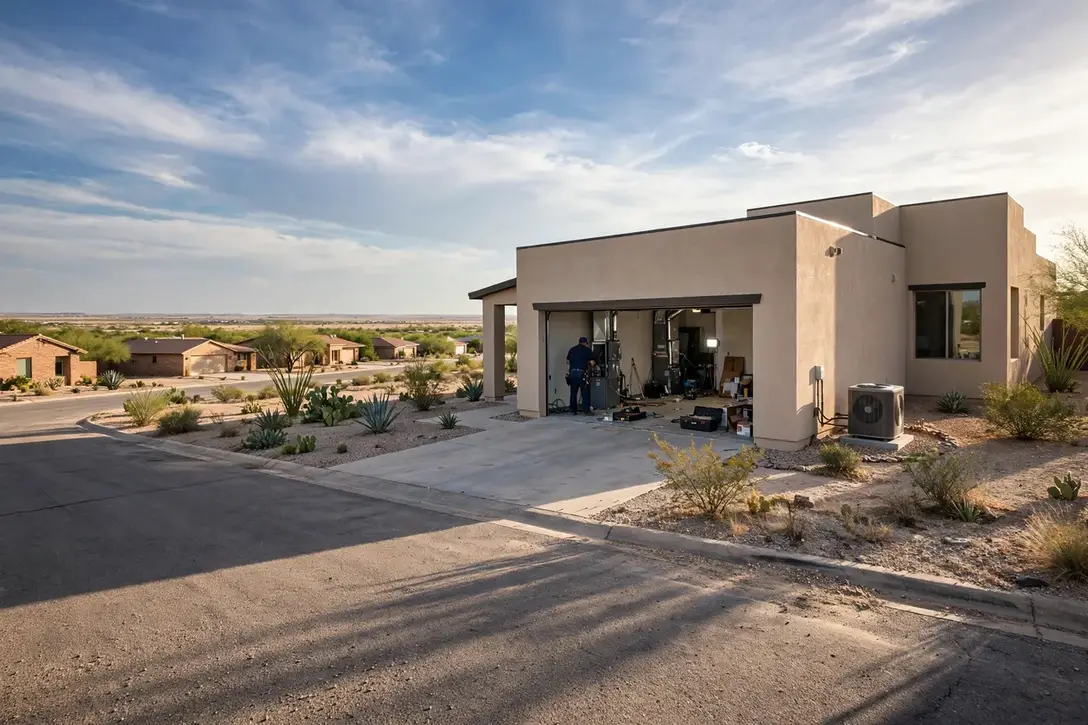


This is Odessa's heating and cooling page, built from Odessa's own numbers: Census housing figures, the metro's ZIP codes and its NOAA climate record. TempReach USA routes your call to an independent local HVAC technician; the homework below is here so you know your home's likely problems before you ever make it.
Call center hours: Mon-Fri 7:00 AM-10:00 PM ET | Sat 8:00 AM-10:00 PM ET | Sun 7:00 AM-9:00 PM ET
The median Odessa home was built in 1981; 48.4% of the stock predates 1980, and the pattern this metro's own data ranks first is the refrigerant transition reaching older systems. TempReach USA is a referral service, not an HVAC company: one call connects you with an independent local HVAC technician serving your ZIP code.
Odessa is a metro of 163,206 people and 62,422 households, and its heating and cooling is a portrait of its building history. The median home here was built in 1981; 48.4% of homes predate 1980 and 22.5% predate 1960, while 26.3% have arrived since 2000. Every one of those eras heated and cooled differently — different furnaces, different duct designs, different refrigerant generations — and they fail differently, which is why this page is organised around the patterns the data actually produces in Odessa rather than HVAC in the abstract.
Ask how Odessa's older homes have been kept comfortable and the honest answer is: in pieces. A furnace here, a condenser there, one room's ducts renewed while the rest of the system carries on — across 32,690 pre-1980 homes, the patchwork is the norm rather than the exception. That history is written in the attics of Ector County and everywhere else the early stock stands: systems that are part original, part renewed, and entirely individual. It is also why the guidance on this page keeps returning to patterns rather than single faults — in a patchwork system, the pattern is the diagnosis.
The growth side of the metro tells the opposite story in the same language. Odessa, West Odessa and the subdivisions still filling in account for much of the 17,764 homes built since 2000 — matched systems, planned ductwork, heat pumps where the lots suit them. Their HVAC is not old; it is uniform, which creates its own calendar: everything installed in the same boom reaches each wear point in the same years, from the first condenser replacements to the first control-board failures, while 2,478 cooling degree days of annual heat keep demand on the system high.
One more record sits over the whole metro, and it is the one the equipment itself keeps: the weather's. ODESSA SCHLEMEYER FLD, TX US logs 12.93 inches of precipitation in an average year and swings between 114.9 days at 90 degrees or more and 49.4 nights at or below freezing. Heating systems ride that swing in their run hours; cooling systems ride it in their cycle counts; ducts ride it in the attics, expanding and contracting between the seasons. Cross the swing with the housing ages above and the selection of problems further down this page stops looking like a list and starts looking like an arithmetic result.
Two public records, one metro: what was built here, and what the sky does to it.
Break the stock down by building era and the profile sharpens. Before 1960: 22.5% of homes, roughly 15,197 of them. From 1960 to 1979: 25.9%, about 17,493. From 1980 to 1999: 25.4%, about 17,156. Since 2000: 26.3%, about 17,764. Four eras, four equipment generations — and the balance among them is this metro's HVAC character in a single paragraph.
Read this metro's profile as a before-and-after photograph with the after still developing: the post-2000 band leads, the older bands trail, and every year the balance tips further toward young systems with young problems. Odessa's HVAC volume already lives in the new stock — its condenser waves, its sensor waves, its heat pump questions — while its deepest single jobs still come from the old core. Both facts are in the numbers above; a local technician's week is simply where they meet.
Close behind the leader come the 1960-1979 homes, 25.9% of the stock. Their systems are mid-change by construction — the decades when cooling spread mid-stream — so this band is where a Odessa technician earns the diagnostic fee: airflow readings and pressure tests that say which side of the transition a given house was built on.
Translate the climate record into HVAC terms and it comes out as three working conditions. Condition one, the freeze count — 49.4 nights a year when a heating failure stops being a comfort issue and becomes a household one. Condition two, the heat count — 114.9 days that load condensers, ducts and tempers simultaneously. Condition three, the moisture: 12.93 inches of precipitation arriving as humidity the cooling coil must remove. Odessa's systems are engineered, installed and aged inside those three conditions, and their failures carry the conditions' fingerprints.
Hold the two halves together and the rest of this page explains itself: the problems ranked highest here are the ones where Odessa's dominant housing era and its climate record overlap. Change either dataset and the ranking changes — which is precisely why this profile is rebuilt from the records for every metro instead of carried over from the last one.
Ranked for this metro alone, from its Census housing profile and NOAA climate record.
A generation change is moving through Odessa's cooling equipment, and it arrives one repair decision at a time. For decades, residential systems ran on R-22; production and import of that refrigerant ended in the United States in 2020, so the supply that remains is reclaimed stock, and servicing a leaking R-22 system means weighing a scarce, aging refrigerant against the age of the machine it serves. Newer systems moved to R-410A, and equipment now arriving uses lower-impact refrigerants such as R-454B, with their own handling and code requirements. The transition matters to a homeowner at specific moments: when an older system needs a charge, when a coil or compressor fails on a machine whose refrigerant is effectively retired, when a repair quote must be compared honestly against replacement. Nothing about it is a reason for panic — R-22 systems are not banned from being serviced — but every significant repair on one is now also a planning conversation, and households in Odessa with equipment from the R-22 era benefit from having it before the hottest week, not during it.
The mechanics underneath the policy are simple. A refrigerant is the working fluid of the cooling cycle: it evaporates indoors to absorb heat and condenses outdoors to release it, thousands of times a season. Each generation of fluid was engineered to improve on the last one's environmental profile and operating pressures, and each required its own hardware — compressors built for different pressures, oils that mix with one fluid and not another, metering set for one fluid's characteristics. That is why the generations cannot be swapped like brands of the same product, and why 'topping up' an older system always means its own fluid, sourced from whatever supply its generation still commands. In Odessa, where systems from all three generations stand in neighboring yards, the diversity is a service reality: diagnosis begins with identification, because the same symptom — a system low on charge — carries three different expense structures depending on the nameplate.
The climate loads the stakes: a leaking system in Odessa underperforms through 114.9 days a year at 90 degrees or more at ODESSA SCHLEMEYER FLD, TX US, so the household pays the transition's toll twice — in refrigerant and in lost cooling — until the underlying decision is made.
There is also a quieter loss running underneath the comfort loss: what leaks out was paid to condition. Every run of the system heats or cools a volume of air; the share that escapes into the attic or crawl space is work done for no room, repeated cycle after cycle, season after season. In a Odessa home the arithmetic is worst exactly when the load is highest — the 114.9 hot days push the longest runs through the hottest attics — so the loss curve and the demand curve rise together. Sealing is unglamorous work: mastic on joints, connections re-made and supported, insulation restored where it has fallen. But it is one of the few interventions whose benefit the household can feel at the register on the first run afterward, in air that arrives at the temperature and volume the system produced.
Households judge their heating and cooling at the thermostat, but the thermostat only reports the room it sits in. Judge the system at its furthest register instead: the air arriving there, its temperature against the supply at the unit, its volume against the room's need. In Odessa that furthest room is the honest auditor of the duct network — it inherits every leak, every sag and every degree of attic heat between it and the air handler. The homes whose far rooms match their near rooms have networks that were sealed when they were built and checked as they aged. The homes whose far rooms lag are not necessarily homes with weak equipment; they are homes whose delivery network has been quietly resigning, joint by joint, while the equipment took the blame and the service calls. The register, not the nameplate, is where the resignation is announced.
The housing numbers frame the exposure: 67,542 housing units in Odessa, a median build year of 1981, and duct networks installed era by era in attics, crawl spaces and wall cavities. Every one of those networks is a set of joints ageing in the dark — the loss pool is the size of the metro itself.
Heat is a workload before it is a weather report. Every degree above the design range asks the outdoor unit in a Odessa home to reject heat into air that is already hot, which is the hardest version of its job, and it asks for that work for the longest hours of the year. The parts that answer — compressor, fan motor, capacitor, contactor — are wear items, and sustained heat spends them faster than mild weather ever does. That is why the metro's cooling calls cluster in the hottest stretches rather than spreading across the summer: the systems were not broken in June, they were being used up by July, and August collects the difference. A system that has cooled adequately for years can still be the one that stops in a heat wave, not because it suddenly aged, but because the heat finally asked for more than its remaining margin.
Households tend to judge a cooling system by its mildest day. On a mild day an overworked system still copes, still reaches the setting, still argues for another season. Judge it by its hottest week instead: the hours it ran without pausing, the afternoons the house drifted upward, the nights it needed to recover. In Odessa, ODESSA SCHLEMEYER FLD, TX US keeps the honest record of that week — 114.9 days a year over 90 degrees is the examination the system actually sits. The homes that fare well in it are rarely the ones with the newest equipment; they are the ones whose owners believed the early chapters of the strain story — the lengthening runs, the fading afternoons — and had the wear items checked while the system was still arguing its case.
The evidence is in the calendar as much as the equipment. Heat failures in Odessa cluster in the season's hottest stretches — the same weeks ODESSA SCHLEMEYER FLD, TX US records its highest readings — because the load, not luck, is what finishes weakened components.
Heat is not an event in Odessa; it is a season, and a long one. The record at ODESSA SCHLEMEYER FLD, TX US counts 114.9 days a year at 90 degrees or more and 2,478 cooling degree days, which means the metro's air conditioners work their longest shifts exactly when the air they must reject heat into is at its hottest. The households that come through the season smoothly treat it as a campaign with a beginning: before the first serious heat, the outdoor coil is washed clear of the spring's debris, the filter is fresh, the condensate drain is proven clear, and the system is run long enough on a warm day to show how it behaves under load — startup, sound, the temperature it delivers at the registers. During the season, the checks are small and regular: the outdoor unit kept clear of growth and stored items, the filter watched monthly because a loaded filter in peak season throttles a system already at full stretch, and indoor temperatures read honestly — a house drifting upward through a hot afternoon is the system filing an early report, and answering it in June is a different errand from answering it in the season's hottest week.
The season loads Odessa's systems the way its record at ODESSA SCHLEMEYER FLD, TX US says it will: 2,512 heating degree days against 2,478 cooling degree days in an average year, against a housing stock whose median build year is 1981. The households that read the season early — filters, drains, a system run before the extreme weeks — are the ones whose calls stay schedulable.
There is a supply-side depth as well. A shrinking refrigerant does not vanish; it circulates — recovered from retired systems, reclaimed to specification, and returned to service at an expense that reflects the shrinking pool. In Odessa that means the R-22 in a system serviced this year may have cooled three other homes before it, and may cool another after this system retires, provided it is recovered rather than vented. The chain gives older equipment a managed twilight rather than a cliff: service remains possible, performed by technicians qualified for the work, for as long as the economics hold for the household. Understanding that chain replaces two common errors — that old systems are already unserviceable, and that they can be serviced forever as cheaply as ever — with the true picture: a gradually tightening supply, a gradually aging fleet, and a decision that improves with information and worsens with delay.
Read the ranking backwards and it reads as a data summary: 163,206 residents in 67,542 housing units, 22.5% of the housing from before 1960, 12.93 inches of rain in an average year. The pattern leads because the exposure is broad — counted not in individual unlucky houses but in whole eras of the metro's building, stacked one on another.
The first visit follows a short, diagnostic list — each item ruling a branch of the problem in or out:
Ordered by what this metro's data says its homes need most.
Warm air from the vents is a symptom with several authors — capacitor, charge, airflow, controls — and AC repair in Odessa separates them by measurement at your unit, not by parts swapped on hope.
Ask what fills an AC repair diary in Odessa and the answer is written in its housing. The median home was built in 1981, and a good share of the metro's cooling equipment is older than the homes' current owners realise — units sized for a different era of insulation, charged with refrigerant generations that have since been phased down. A system in Ector County that cools a little less each summer is telling a story in instalments, and the repair visit reads the whole story: pressures, airflow, the coil's condition, the duct losses behind the walls. That is the daily reality for the 62,422 households spread across Ector.
Count the exposure from the Census side: a median build year of 1981 across 67,542 housing units means half the metro's air conditioners are older than the systems in the growth suburbs around Odessa, and summer runtime is the statistic that matters — the repair calls follow it street by street.
The evidence lives in the returns. Matted dust, debris from construction, hair woven into the load: that is the case for cleaning, made by the ductwork itself. A light film in a tidy system is the case for waiting, and an honest visit says so.
Ducts in Odessa collect what the metro's life sends through them: construction dust in the growth subdivisions, decades of household dust in the older districts, pollen riding the return air through long pollen seasons. The honest framing for cleaning is the system's condition, not a calendar — a duct system in a the 1980s home that has been remodelled twice carries a different load from one in a new build near Odessa. The cleaning visit itself is agitation and extraction under negative pressure, register by register, with the blower compartment and coil inspected while access is open. With a median build year of 1981, most of the metro's 67,542 housing units are working through the same ageing curve.
Count the systems and the diary fills itself: 62,422 households breathing through ductwork daily, the oldest of it in homes from the 1980s and the newest in the subdivisions past Andrews. What the cleaning finds follows the biography — dust in proportion to years, debris in proportion to renovations.
In Odessa, the maintenance calendar writes itself from the climate: 2,512 heating degree days and 2,478 cooling degree days mean both systems work a real season, so the fall and spring visits each have genuine work to inspect.
With a median build year of 1981 across 67,542 homes, Odessa holds both air problems at once — envelopes that leak air freely and envelopes sealed tight — and the local professional assesses which house yours is before recommending equipment.
From Midland to Andrews, Odessa replacements routed through TempReach USA end in commissioning — measured charge and airflow — so the installed system matches the calculated one.
Furnace repair in Odessa follows the sequence: the independent local professional covering Ector watches your furnace attempt a start, tests the stage that failed, and quotes before work begins.
From Midland to Andrews, Odessa installations routed through TempReach USA finish with commissioning — combustion, temperature rise and airflow verified — so the fitted system is the specified system.
Across 10 ZIP codes and housing from a median build year of 1981, Odessa heat pumps are specified and serviced from heat-loss figures and low-temperature performance data, not nominal tonnage.
Ductless installation in Odessa is surveyed room by room across Ector: the independent local professional calculates each space's load, plans line and drain routes, and quotes the complete design before work begins.
In Odessa, the thermostat question splits by housing era: homes from around the median build year of 1981 often lack a common wire in the wall, while newer builds across the 10 covered ZIP codes usually carry one — the local professional checks the cable before choosing the control.
Across Ector, the local professional who answers knows the stock — a median build year of 1981 across 67,542 homes means systems of every age failing in their characteristic ways, from Midland to the metro's newest subdivisions.
Across Ector, one climate ledger drives the calendar: 2,512 heating degree days and 2,478 cooling degree days mean roof units work both seasons hard, so the spring and fall visits each carry a full checklist here.
If this page's services were ranked by Odessa's call patterns rather than listed in catalogue order, they would come out much as they do here — because the ranking behind them is data, not habit. The refrigerant transition reaching older systems leads the metro's problem table and leaky ducts losing air and energy follows, so the services answering them lead the list. The long tail of a metro's HVAC life — thermostat calls, duct questions, the one room that never matches the rest — fills in the diary around them, here as everywhere.
PROBLEM SOLUTION
Population 133,998
Population 114,080
Population 31,985
Population 13,416
Population 7,536
Population 5,681
Population 3,304
Population 1,520
Population 1,328
Population 1,174
Population 678
Population 644
Also in the Odessa metro: McKinney Acres (population 605), Grandfalls town (population 322).
Beyond Midland itself, the metro takes in Odessa (114,080 residents), West Odessa (31,985) and the rest of the communities in the grid above — each fitted with heating and cooling in its own building era, which is why two streets in the same metro can need entirely different HVAC conversations. The ZIP list below is the full coverage footprint: if your code is on it, this page was written about your housing stock.
Beyond the largest communities sit Andrews (13,416), Monahans (7,536), Kermit (5,681), Crane (3,304), Gardendale (1,520) — smaller places across Ector, covered on the same terms. Their housing tends to be older on average than the big suburbs', and their calls follow the older patterns on this page. One routing covers them all: find your ZIP code below and the rest is a phone call.
The metro's weight is not evenly spread. Midland holds 133,998 of the 163,206 residents; Odessa and West Odessa add 114,080 and 31,985; and the remainder scatters across the smaller places above, some no bigger than a few thousand people. HVAC follows the weight — most calls come from where most homes are — but era matters more than size: a small community of 1960s housing generates older-system work than a large new subdivision does.
One metro, 1 county lines drawn through it: Ector. The lines are invisible to the weather, but they structure everything administrative around an HVAC job — which office permits it, which inspector signs it, which code edition applies. Ector County, at the centre, carries the oldest housing and the heaviest share of the work this page describes; its neighbours carry the growth. A routed local technician navigates the patchwork so the homeowner does not have to.
This page ends at the metro boundary, but the region does not: Midland, TX, Lubbock, TX and Abilene, TX continue the coverage in their own directions, each with a profile built from its own Census and NOAA figures. If your home sits near the line between metros, go by your ZIP code — it places you in the dataset that describes your housing.
The region around Odessa is a set of variations on its theme: Midland, TX, 36 miles off, runs a median build year of 1989 on a metro population of 193,139; Lubbock, TX (117 miles) medians 1982 on 368,431; Abilene, TX (170 miles) medians 1976 on 185,429. Nearness is not sameness — a few decades of median build year separate their heating and cooling as surely as the miles separate their maps.
Count the metro per unit of itself: 6,754 housing units per covered ZIP code; 62,422 households per county; 14 communities sharing 1 county governments. Then weigh the generations against each other — 1.8 older homes for each newer one — and the service pattern on this page stops being a list and becomes a proportion: that much of the diary written by ageing systems, the rest by young ones wearing in.
One line of Odessa arithmetic — a median home 45 years old · 40,200 owner-occupied homes against 22,222 renter-occupied · 1,520 pre-1960 homes for every covered ZIP code · a heating-to-cooling degree-day ratio of 1.01 · 328 mm of rain in an average year.
County pages carry the local detail — land area, climate normals and the heating and cooling pressures on the ground in each county.
More plain-language help: the TempReach USA heating & cooling guides
One call connects you with an independent local heating and cooling professional serving Odessa and the surrounding metro.
Call center hours: Mon-Fri 7:00 AM-10:00 PM ET | Sat 8:00 AM-10:00 PM ET | Sun 7:00 AM-9:00 PM ET