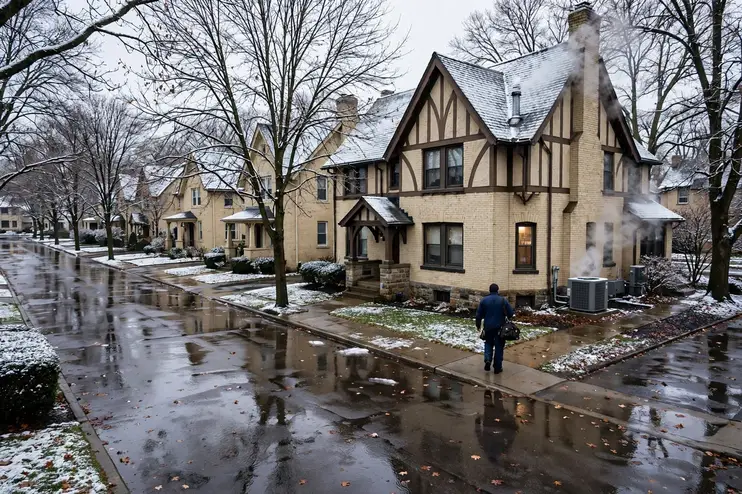


Everything on this page was computed for Milwaukee and nowhere else: the problem ranking from its Census housing profile, the seasonal risks from its NOAA station record, the coverage from its own ZIP codes. TempReach USA connects you to an independent local HVAC technician; the page itself is the homework, done in public, so the call you make is an informed one.
Call center hours: Mon-Fri 7:00 AM-10:00 PM ET | Sat 8:00 AM-10:00 PM ET | Sun 7:00 AM-9:00 PM ET
The median Milwaukee home was built in 1966; 67.7% of the stock predates 1980, and the pattern this metro's own data ranks first is leaky ducts losing air and energy. TempReach USA is a referral service, not an HVAC company: one call connects you with an independent local HVAC technician serving your ZIP code.
Two numbers frame everything that follows: 60.4% of Milwaukee homes are owner-occupied, and the median one was built in 1966. Ownership matters to HVAC because owners inherit their systems whole — every equipment decision a builder made in the 1960s or earlier is still in the attic, the closet and the side yard, ageing on its original schedule. With 67.7% of homes predating 1980 and 14.3% arriving since 2000, the metro is really two housing stocks sharing one map, and they are taken separately below before the problems are ranked.
Stand in one of Milwaukee's older neighbourhoods and you are standing in its HVAC's back catalogue. The homes there — part of the 470,912 built before 1980 across this metro — went up when a furnace was built to serve for a generation and central cooling was still spreading street by street. That generation has now elapsed several times over. What it leaves behind is not universal failure but universal exposure: every duct joint, igniter and condenser coil in those districts is operating past the horizon its makers planned for, in Milwaukee County and beyond, and the failures arrive in the order the parts tire.
The growth side of the metro tells the opposite story in the same language. Waukesha, West Allis and the subdivisions still filling in account for much of the 99,469 homes built since 2000 — matched systems, planned ductwork, heat pumps where the lots suit them. Their HVAC is not old; it is uniform, which creates its own calendar: everything installed in the same boom reaches each wear point in the same years, from the first condenser replacements to the first control-board failures, while 780 cooling degree days of annual heat keep demand on the system high.
Over everything sits the weather, and here it is measured rather than described: NOAA's station at MILWAUKEE MITCHELL AP, WI US averages 49.3 degrees across the year, with 9.1 days reaching 90 or more and 122.8 nights at freezing or below. A furnace feels that record as a season of relentless cycling; a condenser feels it as a summer without a quiet week; a heat pump feels both. The problem ranking below is what those numbers, crossed with the housing profile, produce for Milwaukee specifically.
Housing eras and climate, joined — the two datasets every section of this page is built from.
The distribution, in one breath: of every hundred Milwaukee homes, 43.0 were standing before 1960, 24.7 went up in the two decades after, 18.0 in the two after that, and 14.3 have arrived since 2000. Percentages flatten the picture, so hold the counts beside them — 299,102 oldest-era homes, 99,469 newest — and the metro's heating and cooling stops being an abstraction: it is that many systems, of those ages, failing in that order.
Some metros are defined by their growth; this one is defined by its inheritance. The largest share of Milwaukee's homes was built before 1960, and inheritance in HVAC means system designs from another era serving households who did not choose them. The work that follows from that fact is the metro's staple: furnaces renewed, condensers renewed, ducts sealed and rebalanced — the patient, house-by-house modernisation of a founding stock. Newer districts exist and matter, but they are not where this metro's HVAC character was decided.
Close behind the leader come the 1960-1979 homes, 24.7% of the stock. Their systems are mid-change by construction — the decades when cooling spread mid-stream — so this band is where a Milwaukee technician earns the diagnostic fee: airflow readings and pressure tests that say which side of the transition a given house was built on.
Milwaukee's weather, reduced to what a system experiences: 9.1 hot days a year loading the cooling, 122.8 freezing nights loading the heating, and 34.57 inches of rain feeding the humidity both seasons complain about. NOAA's normals at MILWAUKEE MITCHELL AP, WI US — 6,450 heating degree days, 780 cooling degree days — are the long average of that experience, and they are why this metro's problem list is not interchangeable with a milder or harsher metro's.
A profile is only useful if it predicts something, and this one predicts the shape of an HVAC diary in Milwaukee: which streets will call about cooling, which about heating, which about airflow, and in which months. Everything after this section is that prediction written out as services, problems and answers — the numbers first, the narrative second, the way the evidence actually runs.
Listed in the order this metro's housing and climate data supports.
The evidence lives in the returns. Matted dust, debris from construction, hair woven into the load: that is the case for cleaning, made by the ductwork itself. A light film in a tidy system is the case for waiting, and an honest visit says so.
What comes out of a Milwaukee duct system tells the home's biography: drywall dust from the renovation, pet hair in proportion to the household, the fine grit that 34.57 inches of yearly rain and the dry seasons between them work into every return. Cleaning matters most where the biography is long — the pre-1980 homes, 67.7% of the stock — and where a household's breathing argues for it. A technician who shows the before and after, and says plainly when a system does not need the work, is the one whose advice holds up. It is why two Milwaukee homes of the same age, on different streets, so often need the same visit in the same year.
Duct demand concentrates in the metro's long-biography homes: 470,912 pre-1980 systems that have carried decades of household air, and the renovated homes around Waukesha (70,779 residents) whose construction dust is still in the runs.
Where this service gets booked in Milwaukee follows the map on this page: the older districts generate the deep-end work, the post-2000 subdivisions the wear-and-tear work, and the 125,205 homes in between split the difference. Telling the call center your home's build decade — most Milwaukee owners know it within a few years — puts the right kit on the van the first time.
Warm air from the vents is a symptom with several authors — capacitor, charge, airflow, controls — and AC repair in Milwaukee separates them by measurement at your unit, not by parts swapped on hope.
Ask what fills an AC repair diary in Milwaukee and the answer is written in its housing. The median home was built in 1966, and a good share of the metro's cooling equipment is older than the homes' current owners realise — units sized for a different era of insulation, charged with refrigerant generations that have since been phased down. A system in Milwaukee County that cools a little less each summer is telling a story in instalments, and the repair visit reads the whole story: pressures, airflow, the coil's condition, the duct losses behind the walls. Count it in homes if you prefer: 470,912 built before 1980, 99,469 since 2000, one shared system of streets and seasons.
Count the exposure from the Census side: a median build year of 1966 across 695,586 housing units means half the metro's air conditioners are older than the systems in the growth suburbs around Wauwatosa, and summer runtime is the statistic that matters — the repair calls follow it street by street.
One local habit worth copying: Milwaukee homeowners who mention their street's building era when they book get a better-matched visit, because a technician heading to a the 1960s home in Milwaukee County loads different parts than one heading to a new-build subdivision in Waukesha. The service is the same; the preparation is local.
The failures maintenance interrupts are unglamorous and specific — a condensate drain weeks from flooding, a capacitor drifting out of range, charge seeping from a joint. Each is a small job in spring and a breakdown in July.
Ask what a tune-up prevents in Milwaukee and the answer is the peak-season failure: the capacitor that gives out on the first 100-degree afternoon, the condensate switch that floods a closet in the humid weeks, the igniter that chooses the coldest night of January. Those parts announce themselves in advance to anyone measuring — weakening values, slow drains, dirty flame sensors — and the maintenance visit exists to hear the announcements in spring and autumn instead of in the emergency weeks. That is the daily reality for the 650,084 households spread across Milwaukee, Ozaukee, Washington, Waukesha.
The maintenance caseload is the installed base itself: 695,586 housing units whose systems each face 9.1 hot days and 122.8 freezing nights a year. Around New Berlin (40,384 residents) as in the old core, the twice-yearly visit is what stands between that calendar and the emergency diary.
In Milwaukee this service is booked most often through the problem patterns at the top of this page — the metro's housing data, not habit, sets the order. If your home is in the 67.7% built before 1980, mention its age on the call: it changes the parts the technician loads before heading to Milwaukee and the rest of the metro.
Furnaces rehearse their failures: second-attempt ignition, shortening cycles, a louder blower. In Milwaukee those early signs are the cheapest version of the repair, caught while the house is still warm.
Read Milwaukee's furnace calls as a census and they mirror the housing: the the 1960s districts produce the exchanger and ignition work on equipment in its second or third decade; the growth subdivisions produce the control-board and sensor faults of newer, more electronic systems. Both are furnace repair, but they are different trades inside one name — which is why the technician's first questions here are about the home's age and the unit's, before a single panel comes off. The MILWAUKEE MITCHELL AP, WI US record — 6,450 heating degree days, 780 cooling — is the backdrop Milwaukee County technicians plan around.
Heating demand in Milwaukee concentrates where the cold does its work: 122.8 nights a year at or below freezing, against a housing stock whose median build year is 1966. Around Greenfield as in the old core, that combination is not an abstraction — it is the street's furnaces, house by house.
In Milwaukee this service is booked most often through the problem patterns at the top of this page — the metro's housing data, not habit, sets the order. If your home is in the 67.7% built before 1980, mention its age on the call: it changes the parts the technician loads before heading to Milwaukee and the rest of the metro.
The call center's questions are triage, not script: what failed, what the weather is doing, who is in the house. Your answers order the dispatch and shape the advice that protects the house before anyone arrives.
HVAC emergencies in Milwaukee keep the climate's hours: the cooling failure on the third day of a heat wave, the furnace that stops on the coldest night of the year. The metro's record at MILWAUKEE MITCHELL AP, WI US — 9.1 days of serious heat, 122.8 freezing nights — sets the stakes at both ends, and the housing sets the vulnerability: a well-insulated new build coasts for a day without its system, while an older home in the the 1960s districts follows the outdoor temperature indoors within hours. The emergency visit triages in order: safety first, then the fault, then the honest question of repair against replacement. In Milwaukee that holds across 81 ZIP codes, from Milwaukee out to West Allis.
The emergency caseload is written in the extremes: 9.1 days of serious heat and 122.8 freezing nights a year, against systems whose median home was built in 1966. In Franklin as across the metro, the urgent calls arrive when the weather and the equipment's age meet.
One local habit worth copying: Milwaukee homeowners who mention their street's building era when they book get a better-matched visit, because a technician heading to a the 1960s home in Milwaukee County loads different parts than one heading to a new-build subdivision in Waukesha. The service is the same; the preparation is local.
With a median build year of 1966, many Milwaukee systems are reaching replacement age together; the professional you are connected with inspects ducts and electrics across 81 ZIP codes before recommending equipment.
Heating installation in Milwaukee starts with a heat-loss calculation across Milwaukee, Ozaukee, Washington, Waukesha: the independent local professional measures the home's loss, inspects ducts and venting, and quotes the full scope before work begins.
From Milwaukee to Wauwatosa, Milwaukee heat pump calls through TempReach USA reach a local professional who explains findings plainly and quotes after assessing — in the heating season and the cooling season alike.
From period homes near Milwaukee to newer builds toward Wauwatosa, Milwaukee's ductless projects serve the rooms central systems miss — additions, conversions and homes built without ductwork.
In Milwaukee, air work follows the climate ledger: 6,450 heating degree days dry the indoor air out each winter while 780 cooling degree days load it with humidity each summer — most homes here need the humidity answer in both directions across the year.
In Milwaukee, the thermostat question splits by housing era: homes from around the median build year of 1966 often lack a common wire in the wall, while newer builds across the 81 covered ZIP codes usually carry one — the local professional checks the cable before choosing the control.
In Milwaukee, commercial work follows the stock: 695,586 housing units' worth of mixed buildings — offices, retail and restaurants from Milwaukee across the 81 covered ZIP codes — each with rooftop units whose service rhythm the local professional sets per building.
There is a plainer way to say what this page's ranking means in practice: most calls in Milwaukee are two calls. The first answers Leaky ducts losing air and energy; the second answers the refrigerant transition reaching older systems. Between them they account for the shape of a local technician's week here — the districts visited, the parts stocked, the diagnoses made fastest because they are made most often. The remaining services divide the rest of the diary among them, essential but episodic, the supporting work around two leading patterns.
Selected and ranked from this metro's housing-age profile and climate record — not copied from another city's page.
A duct system is a delivery network, and in many Milwaukee homes it leaks like one. Supply runs carry conditioned air through attics, crawl spaces and wall cavities on their way to the registers; return runs carry it back. Every joint, seam and connection along those paths is a chance for the air to leave early or for unconditioned air to be pulled in, and older installations — assembled with tape that has long since dried out, or sections that have sagged apart — leak at many of them at once. The system responds the only way it can: by running longer to deliver the same comfort, which is why duct loss so often disguises itself as an equipment problem. The furnace and air conditioner get blamed, serviced, sometimes replaced, while the network between them quietly spills a share of every run into the attic. In Milwaukee's housing, where duct runs cross some of the hottest and coldest spaces in the home, a leak counts double: the air is lost, and the air that remains arrives changed by the space it traveled through.
Households judge their heating and cooling at the thermostat, but the thermostat only reports the room it sits in. Judge the system at its furthest register instead: the air arriving there, its temperature against the supply at the unit, its volume against the room's need. In Milwaukee that furthest room is the honest auditor of the duct network — it inherits every leak, every sag and every degree of attic heat between it and the air handler. The homes whose far rooms match their near rooms have networks that were sealed when they were built and checked as they aged. The homes whose far rooms lag are not necessarily homes with weak equipment; they are homes whose delivery network has been quietly resigning, joint by joint, while the equipment took the blame and the service calls. The register, not the nameplate, is where the resignation is announced.
The load figures complete the case: 780 cooling degree days and 6,450 heating degree days at MILWAUKEE MITCHELL AP, WI US mean the network is in service in earnest at both ends of the year. Duct loss here is not a summer inefficiency or a winter one; it is a twelve-month tax on a system that works both seasons.
A generation change is moving through Milwaukee's cooling equipment, and it arrives one repair decision at a time. For decades, residential systems ran on R-22; production and import of that refrigerant ended in the United States in 2020, so the supply that remains is reclaimed stock, and servicing a leaking R-22 system means weighing a scarce, aging refrigerant against the age of the machine it serves. Newer systems moved to R-410A, and equipment now arriving uses lower-impact refrigerants such as R-454B, with their own handling and code requirements. The transition matters to a homeowner at specific moments: when an older system needs a charge, when a coil or compressor fails on a machine whose refrigerant is effectively retired, when a repair quote must be compared honestly against replacement. Nothing about it is a reason for panic — R-22 systems are not banned from being serviced — but every significant repair on one is now also a planning conversation, and households in Milwaukee with equipment from the R-22 era benefit from having it before the hottest week, not during it.
Judge a refrigerant-era system by its leak history and its trend, not by a single charge reading. One low reading after many tight years is an event; a pattern of small losses is a biography, and the biography is what the economics should be based on. Milwaukee's climate record loads the question at both ends — a leaking system underperforms exactly when MILWAUKEE MITCHELL AP, WI US's 9.1 hot days demand its full capacity, and its owner pays for refrigerant and lost performance simultaneously. The households that navigate this transition well keep one habit: they can state their system's age, refrigerant and last three repairs without looking them up. That small command of the facts converts an industry-wide generational change into a single household's managed decision, which is the scale at which it was always going to be decided anyway.
Count the generations the way a technician's route does: a single Milwaukee street can hold an R-22 veteran, two R-410A systems and a current-generation installation within a few doors. The service records of one metro contain the whole transition — which is why identification, not assumption, opens every diagnosis here.
Ageing also changes what a repair means. On a young system, a failed part is an interruption; on an old one, it is information — a data point about the machine's remaining life and about whether the next failure is already loading. In the older districts of Milwaukee, around Milwaukee and the streets that grew with it, technicians read repairs that way and say so: this motor can be replaced, and here is what its failure tells us about the compressor behind it. The household's decision — maintain, repair, or plan a replacement on a calm schedule — is only as good as that reading. Systems do not owe anyone a warning before their last season, but in practice they file their intentions in a language of rising run times and narrowing margins, for those who have the readings taken.
Judge an ageing system by its trend line, never by its kindest day. On its kindest day — mild weather, light load — almost any system in Milwaukee can still argue for itself. The trend line is written elsewhere: in run times lengthening season over season, in the setting creeping to hold the same comfort, in the rooms that quietly dropped out of the system's reach. MILWAUKEE MITCHELL AP, WI US's climate record ensures the trend will be tested at both ends of the year — 9.1 hot days and 122.8 freezing nights in an average year. The households that read their trend early choose the terms of the ending, whether that ending is a renewed component, a planned replacement in a shoulder season, or a few more good years bought with honest maintenance. The households that wait for the system's verdict receive it in the weather least suited to hearing it.
Look at the replacement echoes: the 99,469 homes built since 2000 are now carrying first-generation equipment deep into its service life, joining the older cohorts. In Milwaukee, ageing is not a niche condition of old houses; it is the metro's standard equipment profile.
Winter examines a furnace the way a long journey examines an older car: not with one dramatic test, but with sustained demand that finds every tired component in turn. In Milwaukee, the examination runs for months — 6,450 heating degree days of it — and the components sit it in order of their wear. Igniters, which glow and cool with every cycle, are the classic first casualty of a long season. Motors follow, their bearings carrying the season's hours. What surprises households is the clustering: a furnace that needed nothing for years can ask for two repairs in one hard winter, not because the first repair failed, but because the cold is auditing the whole machine at once and reporting its findings in sequence.
A technician reading a tired furnace works from the safety chain outward. Modern furnaces report themselves through lockouts and fault codes, and the pattern of the lockout is the first text: ignition failures point one way, overheating shutdowns another, pressure-switch faults toward venting and condensate. In cold weather the venting branch matters more than households expect — snow, ice and wind can obstruct terminations, and a furnace that will not prove its draft will not fire, by design. The heat exchanger inspection belongs in the same visit whenever age or overheating symptoms suggest it, because a cracked exchanger is the one finding that changes the conversation from repair to replacement on safety grounds. What looks from the hallway like 'the furnace stopped' resolves, under a practiced sequence, into one worn branch of a short list.
Count the duty rather than the drama: a Milwaukee furnace fires through 6,450 heating degree days a season, cycling its igniter and swinging its heat exchanger with every call. The wear that surfaces in January was purchased, cycle by cycle, in the seasons before it.
Some heating systems carry the freeze risk inside their own design. High-efficiency furnaces drain condensate that can freeze in an unheated run and stop the furnace to protect it — the safety doing its job, in the weather least suited to hearing about it. Heat pumps hand their load to auxiliary heat in deep cold, and a system whose backup was never proven discovers the fact at the freeze's worst hour. Equipment installed in attics and garages — common in parts of Milwaukee's housing — works surrounded by the cold it defends against, its own components and drains exposed to the temperatures the house is being protected from. None of these are flaws; they are designs with freeze chapters, and the households that fare well with them are the ones whose installations and maintenance accounted for the chapter: drains run and protected correctly, backup heat tested before the season, the equipment's cold-space vulnerabilities known rather than discovered.
A freeze-call diagnosis runs triage first and depth second. The first questions sort the stop into its great families: no power or no call for heat; a safety lockout reporting itself through the board's codes; a fuel or ignition failure; a condensate or venting stop on high-efficiency equipment; a heat pump standing on failed auxiliary heat. Each family has a different restoration path and a different implication for how long the house will be cold. In the same visit, the freeze-specific checks ride along: the condensate drain's exposed run, the intake and exhaust terminations against snow and ice, the state of the spaces the pipes cross. Where restoration will take time, the professional's advice turns to the house itself — which water to shut, which taps to open, which rooms to close off and consolidate warmth in — because in a freeze the building is the second patient, and its treatment window is shorter than the equipment's.
Count the coupling: Milwaukee's 695,586 housing units hold their plumbing inside the envelope their heating maintains. Every unit's freeze risk is therefore a joint property of its heating plant's condition and its pipes' placement — and both properties were set, house by house, by the era that built it.
Living with a real winter, as Milwaukee does, means the season has a shape: the first hard freeze finds the unprepared systems, mid-winter tests endurance — igniters, motors and sensors carrying months of cycles — and the late thaws reveal what the cold quietly damaged. Households that prove their heating in autumn and treat mid-season symptoms as scheduling information get through most winters with nothing dramatic to report; the drama concentrates, year after year, in the systems nobody ran until the night they were needed at full load.
The season loads Milwaukee's systems the way its record at MILWAUKEE MITCHELL AP, WI US says it will: 6,450 heating degree days against 780 cooling degree days in an average year, against a housing stock whose median build year is 1966. The households that read the season early — filters, drains, a system run before the extreme weeks — are the ones whose calls stay schedulable.
Follow the air and the argument completes itself. A Milwaukee system in a hard week moves an enormous volume of air — every room's volume, many times a day, through a network of sheet metal and flex assembled decades ago in the dark. The wonder is not that such networks leak; it is that they leak as little as they do. But the margin matters, because the system was sized assuming delivery: the equipment's capacity was matched to the house on the understanding that the conditioned air would arrive. Every joint that opens moves that understanding further from true, and the household pays the difference in the only currency available — runtime. Sealing, supporting and insulating the network is therefore not cosmetic work on an old installation. It is the restoration of the assumption the whole system was sized on, and in the metro's older housing it is routinely the intervention that makes the existing equipment sufficient again.
Why here and not everywhere: Milwaukee pairs 470,912 pre-1980 homes with 9.1 days a year at 90 degrees or more and 122.8 nights below freezing. Every metro pairs its housing with its weather somehow; this particular pairing is what puts the pattern where it sits on this page's list, ahead of problems that dominate metros built in other decades, under other skies.
On a first visit for this pattern, a local technician's checks run in a practised order:
PROBLEM SOLUTION
Population 569,756
Population 70,779
Population 59,588
Population 47,718
Population 41,592
Population 40,384
Population 38,963
Population 37,361
Population 36,473
Population 35,751
Population 31,722
Population 25,259
Also in the Milwaukee metro: Muskego (population 25,156), Germantown (population 20,940).
Read the grid as a building programme spread over a century. The oldest communities sit where the metro began; the youngest are still adding streets at its edge; and Waukesha and West Allis, with 70,779 and 59,588 residents, stand for the rings in between. Each ring was fitted in its era's equipment, and each is now failing, wearing or holding in its era's characteristic order. The ZIP codes below draw the coverage boundary; the eras inside it draw everything else on this page — the problems ranked, the services ordered, the checks advised.
Also on the Milwaukee map: Wauwatosa (47,718), Brookfield (41,592), New Berlin (40,384), Menomonee Falls (38,963), Greenfield (37,361) — communities spread across Milwaukee, Ozaukee, Washington, Waukesha, each with housing from its own growth years. A technician routed through TempReach USA to any of them is working from this same page: the metro data does not change at the city limit, but the housing on your street — its age, its equipment, its attic — is what the visit is really about.
Milwaukee (569,756 residents) anchors the metro, and Waukesha (70,779) is its second centre of gravity. Between them they hold the bulk of the 650,084 households — and, not coincidentally, the bulk of every housing era this page discusses, from the pre-1960 core to the newest subdivisions. West Allis (59,588) and the communities beyond it repeat the same eras at smaller scale.
The metro answers to 4 county governments (Milwaukee, Ozaukee, Washington, Waukesha), a patchwork that matters at permit time rather than at the thermostat. Milwaukee County carries the centre; the others carry the growth rings and the older outlying towns. A technician routed through this page works inside that patchwork daily — the weather does not care about the boundaries, but the job's paperwork does.
This page ends at the metro boundary, but the region does not: Racine, WI, Kenosha, WI and Janesville, WI continue the coverage in their own directions, each with a profile built from its own Census and NOAA figures. If your home sits near the line between metros, go by your ZIP code — it places you in the dataset that describes your housing.
Set Milwaukee among its neighbours and the contrasts sharpen the profile: Racine, WI — metro population 198,919, median build year 1968 — sits 33 miles away; Kenosha, WI (168,448, median 1975) 44 miles; Janesville, WI (166,472, median 1970) 63 miles. Three different housing stocks under three nearby skies, which is why each keeps its own page and its own problem ranking rather than borrowing this one.
Divide the stock by the map and the densities appear: roughly 8,587 housing units for every covered ZIP code, 162,521 households to a county, 14 named communities in the grid. The balance between the generations reads 4.7 pre-1980 homes for every home built since 2000 — a single ratio that quietly predicts whether a metro's HVAC week leans toward renewal work in the old districts or first-generation upkeep in the new ones.
One line of Milwaukee arithmetic — a median home 60 years old · 392,651 owner-occupied homes against 257,433 renter-occupied · 3,693 pre-1960 homes for every covered ZIP code · a heating-to-cooling degree-day ratio of 8.27 · 878 mm of rain in an average year.
County pages carry the local detail — land area, climate normals and the heating and cooling pressures on the ground in each county.
More plain-language help: the TempReach USA heating & cooling guides
TempReach USA routes your call to an independent local heating and cooling professional serving Milwaukee — the assessment and the work are theirs.
Call center hours: Mon-Fri 7:00 AM-10:00 PM ET | Sat 8:00 AM-10:00 PM ET | Sun 7:00 AM-9:00 PM ET