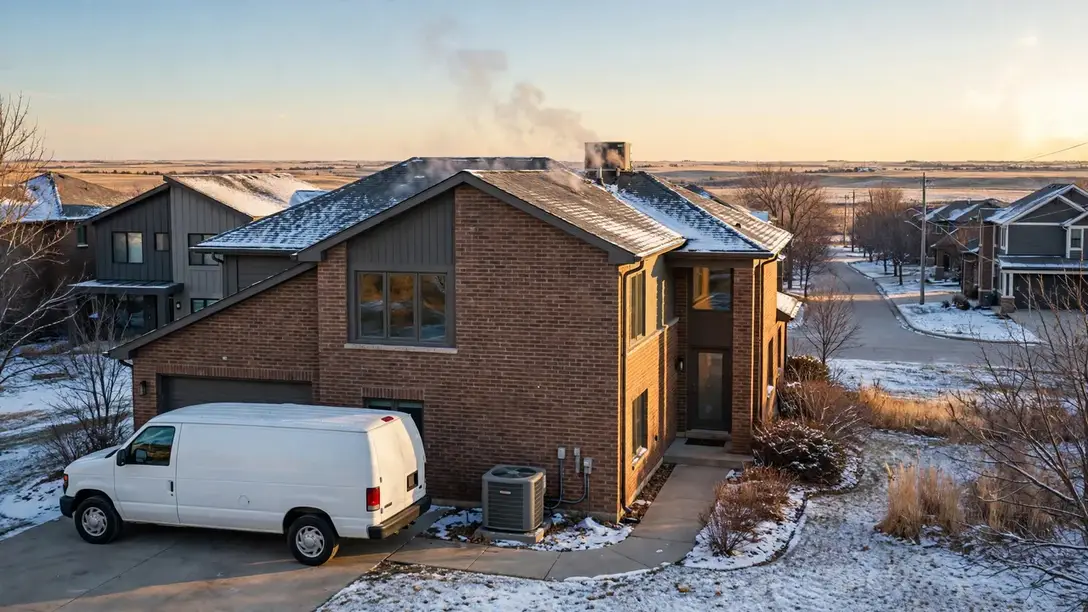


Everything on this page was computed for Sioux Falls and nowhere else: the problem ranking from its Census housing profile, the seasonal risks from its NOAA station record, the coverage from its own ZIP codes. TempReach USA connects you to an independent local HVAC technician; the page itself is the homework, done in public, so the call you make is an informed one.
Call center hours: Mon-Fri 7:00 AM-10:00 PM ET | Sat 8:00 AM-10:00 PM ET | Sun 7:00 AM-9:00 PM ET
The median Sioux Falls home was built in 1990; 40.2% of the stock predates 1980, and the pattern this metro's own data ranks first is furnace wear in hard cold. TempReach USA is a referral service, not an HVAC company: one call connects you with an independent local HVAC technician serving your ZIP code.
Two numbers frame everything that follows: 66.6% of Sioux Falls homes are owner-occupied, and the median one was built in 1990. Ownership matters to HVAC because owners inherit their systems whole — every equipment decision a builder made in the 1990s or earlier is still in the attic, the closet and the side yard, ageing on its original schedule. With 40.2% of homes predating 1980 and 37.1% arriving since 2000, the metro is really two housing stocks sharing one map, and they are taken separately below before the problems are ranked.
The pre-1980 stock is where most of the metro's HVAC character lives. Homes from those decades in Rock County and across Rock, Lincoln, McCook, Minnehaha, Turner were built with duct layouts from the first age of central systems, furnaces and condensers that have since been renewed piecemeal, and insulation standards from another era, and each of those choices is now at or beyond the age its makers expected of it. Owner-occupiers hold 66.6% of the metro's homes, so most of the people reading this page are reading about a system they own outright — one whose failures arrive as surprises only if nobody has looked at the pattern: cooling fading a little each summer, a furnace recovering a little more slowly, one room drifting a little further from the thermostat.
Uniformity is the newer stock's defining trait. A subdivision in Brandon or Harrisburg went up in a handful of years, fitted with one generation of equipment, one duct design, one thermostat class. That uniformity writes a calendar the whole street shares: the first heating wave, the first cooling wave, the first questions about refrigerant and charge arrive together, years before the same streets need anything structural. With 37.1% of the metro built since 2000, that calendar governs a large and growing share of Sioux Falls's HVAC work — predictable work, if a household reads the calendar early.
Over everything sits the weather, and here it is measured rather than described: NOAA's station at SIOUX FALLS, SD US averages 47.3 degrees across the year, with 15.0 days reaching 90 or more and 162.0 nights at freezing or below. A furnace feels that record as a season of relentless cycling; a condenser feels it as a summer without a quiet week; a heat pump feels both. The problem ranking below is what those numbers, crossed with the housing profile, produce for Sioux Falls specifically.
The metro's building eras on one side, its weather record on the other — and its heating and cooling where the two meet.
The distribution, in one breath: of every hundred Sioux Falls homes, 22.6 were standing before 1960, 17.6 went up in the two decades after, 22.8 in the two after that, and 37.1 have arrived since 2000. Percentages flatten the picture, so hold the counts beside them — 28,295 oldest-era homes, 46,448 newest — and the metro's heating and cooling stops being an abstraction: it is that many systems, of those ages, failing in that order.
Read this metro's profile as a before-and-after photograph with the after still developing: the post-2000 band leads, the older bands trail, and every year the balance tips further toward young systems with young problems. Sioux Falls's HVAC volume already lives in the new stock — its condenser waves, its sensor waves, its heat pump questions — while its deepest single jobs still come from the old core. Both facts are in the numbers above; a local technician's week is simply where they meet.
The runner-up era is 1980-1999, with 22.8% of homes. That stock has left its carefree decades and entered its maintenance decades, and it shows in the call pattern around Brandon and the other districts of those years: condensers on their second cycle, furnaces reaching their wear points together, ducts still young enough to reward attention over replacement.
Start the climate half where the system starts: at the thermostat's two seasons. Sioux Falls's cooling answers 847 cooling degree days of load and its heating answers 7,248 heating degree days of cold at SIOUX FALLS, SD US — an average temperature of 47.3 degrees that no individual week actually delivers. A heating and cooling system here is never in neutral; the record keeps it working at one end or the other all year.
A profile is only useful if it predicts something, and this one predicts the shape of an HVAC diary in Sioux Falls: which streets will call about cooling, which about heating, which about airflow, and in which months. Everything after this section is that prediction written out as services, problems and answers — the numbers first, the narrative second, the way the evidence actually runs.
Ordered by what this metro's data says its homes need most.
Heat exchanger condition is the line in furnace work: sound, and most faults are repairs; cracked or corroded, and the conversation in any Sioux Falls home becomes safety and replacement, plainly explained.
Read Sioux Falls's furnace calls as a census and they mirror the housing: the the 1990s districts produce the exchanger and ignition work on equipment in its second or third decade; the growth subdivisions produce the control-board and sensor faults of newer, more electronic systems. Both are furnace repair, but they are different trades inside one name — which is why the technician's first questions here are about the home's age and the unit's, before a single panel comes off. Ask in Tea and the answer rhymes with Sioux Falls: same eras, same equipment generations, same calendar of failures.
Under Sioux Falls's winters lie 7,248 heating degree days a year, and the furnaces answering them include the ageing units of the 50,329 pre-1980 homes alongside the electronic systems of the new subdivisions. The repair diary in Brandon reads both ends of that stock in a single week.
Safety outranks repair, always. A gas smell or a carbon monoxide alarm means leaving the house and calling the utility or emergency services first — the repair visit comes after the house is safe to be in.
Emergency demand in Sioux Falls bunches, and the bunching is predictable from this page's data: heat waves load the ageing condensers of the pre-1980 districts, cold snaps find the tired igniters and cracked exchangers, storm weeks test every system the power surge reached. A local technician's emergency diary is the metro's housing and climate record with dates attached — which is why routed help, from a van already stocked for this stock's failures, is the fastest honest answer the night the system stops. That is the daily reality for the 118,748 households spread across Rock, Lincoln, McCook, Minnehaha, Turner.
Scale the problem by the Census count: 118,748 households depending on systems that cannot be improvised around — no heat in a freeze, no cooling in a heat wave. The emergency visit exists for the hours when waiting until Monday is not a plan, in Tea this month, somewhere else next.
Age informs an AC repair decision without deciding it — a sound system with a failed motor earns its repair, and an honest diagnosis in Sioux Falls will tell you which side of that line your unit stands on.
Ask what fills an AC repair diary in Sioux Falls and the answer is written in its housing. The median home was built in 1990, and a good share of the metro's cooling equipment is older than the homes' current owners realise — units sized for a different era of insulation, charged with refrigerant generations that have since been phased down. A system in Rock County that cools a little less each summer is telling a story in instalments, and the repair visit reads the whole story: pressures, airflow, the coil's condition, the duct losses behind the walls. The SIOUX FALLS, SD US record — 7,248 heating degree days, 847 cooling — is the backdrop Rock County technicians plan around.
The local caseload behind this service is written in the climate figures: 847 cooling degree days a year and 15.0 days at 90 or above, pressing on a cooling fleet whose oldest members serve the 50,329 pre-1980 homes — in Dell Rapids (3,947 residents) as much as in the oldest districts.
Ductless installation in Sioux Falls is surveyed room by room across Rock, Lincoln, McCook, Minnehaha, Turner: the independent local professional calculates each space's load, plans line and drain routes, and quotes the complete design before work begins.
Sioux Falls homes heat through 7,248 heating degree days and cool through 847 cooling degree days a year, so the blower runs in both seasons and the ducts never rest — which is why what has settled in them matters here in every month, not just one.
From Sioux Falls to Tea, Sioux Falls replacements routed through TempReach USA end in commissioning — measured charge and airflow — so the installed system matches the calculated one.
Heating installation in Sioux Falls starts with a heat-loss calculation across Rock, Lincoln, McCook, Minnehaha, Turner: the independent local professional measures the home's loss, inspects ducts and venting, and quotes the full scope before work begins.
Heat pump services in Sioux Falls test the whole year-round system: the independent local professional covering Rock, Lincoln, McCook, Minnehaha, Turner reads charge and airflow in both modes, proves defrost, and checks auxiliary heat logic before quoting any work.
With a median build year of 1990 across 125,197 homes, Sioux Falls holds both air problems at once — envelopes that leak air freely and envelopes sealed tight — and the local professional assesses which house yours is before recommending equipment.
Across Rock, Lincoln, McCook, Minnehaha, Turner, one climate fact shapes the configuration: 7,248 heating degree days against 847 cooling degree days tells whether the control's year is mostly a heating story, mostly a cooling story, or a genuine heat pump balancing act.
Across Rock, Lincoln, McCook, Minnehaha, Turner, the service record is the scarcest asset: with a median build year of 1990 across 125,197 homes, many systems around Sioux Falls have no documented history — and a first tune-up's baseline is what every later decision stands on.
Sioux Falls's commercial buildings span every era around a median build year of 1990 — and with the era goes the equipment, from aging single units over old storefronts to multi-zone systems in new developments, all serviced from a per-unit record.
If this page's services were ranked by Sioux Falls's call patterns rather than listed in catalogue order, they would come out much as they do here — because the ranking behind them is data, not habit. Furnace wear in hard cold leads the metro's problem table and heating failure risk when temperatures freeze follows, so the services answering them lead the list. The long tail of a metro's HVAC life — thermostat calls, duct questions, the one room that never matches the rest — fills in the diary around them, here as everywhere.
Ranked for this metro alone, from its Census housing profile and NOAA climate record.
A furnace earns its keep in the weeks a Sioux Falls winter stops being polite. The record at SIOUX FALLS, SD US counts 162.0 nights a year at or below freezing and 7,248 heating degree days across the season, and in the coldest stretches a furnace that idled through autumn runs nearly without pause. That duty wears the parts that move and the parts that ignite: inducer and blower motors accumulate hours, igniters cycle thousands of times, flame sensors foul a little with every firing, and heat exchangers expand and contract through temperature swings that test their metal daily. The failures that follow have a rhythm homeowners recognize — a furnace that lights and quits, one that runs but heats unevenly, one that was fine in November and silent in the coldest week of January. Cold does not usually break a sound furnace; it collects the wear the furnace had been carrying quietly, and it collects at the moment the household can least spare the heat.
Judge a furnace by its coldest week, not its kindest. In its coldest week a Sioux Falls furnace shows its true condition: whether it lights first time every time, whether it holds the house through the night without the temperature sagging, whether its sounds are the sounds it made when it was younger. SIOUX FALLS, SD US's record — 162.0 freezing nights in an average year — makes the examination annual and unsparing. Households that come through it without drama have usually done one unglamorous thing: they treated the autumn symptoms as the season's advance copy. A furnace rarely fails without having filed its intentions first, in a slower start, a louder cycle, a room that stopped keeping up. The winter merely publishes what the furnace had already written.
The timing testifies. Furnace failures in Sioux Falls concentrate in the coldest stretches of the 162.0 freezing nights SIOUX FALLS, SD US records — the failures follow the load curve, which is the signature of wear meeting demand rather than chance meeting a machine.
A heating failure in mild weather is an appointment. The same failure in a hard freeze is a countdown, because a house without heat in Sioux Falls's coldest weather is losing temperature toward the point where its plumbing becomes the next casualty. The record at SIOUX FALLS, SD US — 162.0 nights a year at or below freezing and 7,248 heating degree days across the season — says the exposure is not hypothetical here. As indoor temperature falls, the spaces that go first are the ones the heat reached last: pipes in exterior walls, runs through crawl spaces and garages, the plumbing of additions and rooms over unheated ground. A burst pipe discovered at the thaw converts one breakdown into two trades' worth of damage, which is why freeze-season heating calls run on different logic from every other call of the year: restore heat or protect the house, in that order, with no step treated as routine. Knowing the sequence before the night it is needed — how to keep a house safer while help travels, when to drip taps, when to shut water down — is part of owning a heated home in this climate.
A freeze-call diagnosis runs triage first and depth second. The first questions sort the stop into its great families: no power or no call for heat; a safety lockout reporting itself through the board's codes; a fuel or ignition failure; a condensate or venting stop on high-efficiency equipment; a heat pump standing on failed auxiliary heat. Each family has a different restoration path and a different implication for how long the house will be cold. In the same visit, the freeze-specific checks ride along: the condensate drain's exposed run, the intake and exhaust terminations against snow and ice, the state of the spaces the pipes cross. Where restoration will take time, the professional's advice turns to the house itself — which water to shut, which taps to open, which rooms to close off and consolidate warmth in — because in a freeze the building is the second patient, and its treatment window is shorter than the equipment's.
The housing detail completes the case: with a median build year of 1990, much of Sioux Falls's stock routes water through exterior walls, crawl spaces and additions — placements that are unremarkable in October and decisive in a January freeze with the heat off. The risk is built in; only its management is optional.
A generation change is moving through Sioux Falls's cooling equipment, and it arrives one repair decision at a time. For decades, residential systems ran on R-22; production and import of that refrigerant ended in the United States in 2020, so the supply that remains is reclaimed stock, and servicing a leaking R-22 system means weighing a scarce, aging refrigerant against the age of the machine it serves. Newer systems moved to R-410A, and equipment now arriving uses lower-impact refrigerants such as R-454B, with their own handling and code requirements. The transition matters to a homeowner at specific moments: when an older system needs a charge, when a coil or compressor fails on a machine whose refrigerant is effectively retired, when a repair quote must be compared honestly against replacement. Nothing about it is a reason for panic — R-22 systems are not banned from being serviced — but every significant repair on one is now also a planning conversation, and households in Sioux Falls with equipment from the R-22 era benefit from having it before the hottest week, not during it.
Judge a refrigerant-era system by its leak history and its trend, not by a single charge reading. One low reading after many tight years is an event; a pattern of small losses is a biography, and the biography is what the economics should be based on. Sioux Falls's climate record loads the question at both ends — a leaking system underperforms exactly when SIOUX FALLS, SD US's 15.0 hot days demand its full capacity, and its owner pays for refrigerant and lost performance simultaneously. The households that navigate this transition well keep one habit: they can state their system's age, refrigerant and last three repairs without looking them up. That small command of the facts converts an industry-wide generational change into a single household's managed decision, which is the scale at which it was always going to be decided anyway.
The climate loads the stakes: a leaking system in Sioux Falls underperforms through 15.0 days a year at 90 degrees or more at SIOUX FALLS, SD US, so the household pays the transition's toll twice — in refrigerant and in lost cooling — until the underlying decision is made.
This is the season the metro's housing is examined by the weather, and the examination is practical: heating plant against 7,248 heating degree days, envelopes against 162.0 freezing nights, condensate lines and vent terminations against snow and ice. The older districts sit the hardest paper — systems of advancing age serving the 50,329 pre-1980 homes across the metro — but no system is exempt; a new furnace with a frozen condensate run stops as completely as an old one with a spent igniter. Between cold snaps, the season's quieter work continues — filters loading, ducts breathing with the temperature swings — and the households that keep the small rhythm are the ones the big cold never gets a chance to interview.
The season loads Sioux Falls's systems the way its record at SIOUX FALLS, SD US says it will: 7,248 heating degree days against 847 cooling degree days in an average year, against a housing stock whose median build year is 1990. The households that read the season early — filters, drains, a system run before the extreme weeks — are the ones whose calls stay schedulable.
Look closer at the cold-season pattern and a second structure appears: the furnace is rarely the oldest part of its own system. In Sioux Falls's older districts the ductwork, flue and clearances date to the home — a median build year of 1990 across the metro — while the furnace itself may be a replacement of a replacement. Each generation of furnace has worked against the same duct resistance and venting compromises, so wear accumulates at the junctions between eras: the blower working against undersized returns, the exchanger heating against restricted airflow. Deep cold exposes those junctions because it removes the slack. Mild weather forgives a system's old compromises; a hard freeze invoices them.
Read the ranking backwards and it reads as a data summary: 293,107 residents in 125,197 housing units, 22.6% of the housing from before 1960, 27.85 inches of rain in an average year. The pattern leads because the exposure is broad — counted not in individual unlucky houses but in whole eras of the metro's building, stacked one on another.
The first visit follows a short, diagnostic list — each item ruling a branch of the problem in or out:
PROBLEM SOLUTION
Population 197,642
Population 10,996
Population 7,790
Population 6,339
Population 4,907
Population 3,947
Population 3,412
Population 3,060
Population 2,587
Population 2,437
Population 1,512
Population 1,247
Also in the Sioux Falls metro: Crooks (population 1,216), Salem (population 1,201).
Beyond Sioux Falls itself, the metro takes in Brandon (10,996 residents), Harrisburg (7,790) and the rest of the communities in the grid above — each fitted with heating and cooling in its own building era, which is why two streets in the same metro can need entirely different HVAC conversations. The ZIP list below is the full coverage footprint: if your code is on it, this page was written about your housing stock.
Beyond the largest communities sit Tea (6,339), Luverne (4,907), Dell Rapids (3,947), Hartford (3,412), Canton (3,060) — smaller places across Rock, Lincoln, McCook, Minnehaha, Turner, covered on the same terms. Their housing tends to be older on average than the big suburbs', and their calls follow the older patterns on this page. One routing covers them all: find your ZIP code below and the rest is a phone call.
The metro's weight is not evenly spread. Sioux Falls holds 197,642 of the 293,107 residents; Brandon and Harrisburg add 10,996 and 7,790; and the remainder scatters across the smaller places above, some no bigger than a few thousand people. HVAC follows the weight — most calls come from where most homes are — but era matters more than size: a small community of 1960s housing generates older-system work than a large new subdivision does.
The metro answers to 5 county governments (Rock, Lincoln, McCook, Minnehaha, Turner), a patchwork that matters at permit time rather than at the thermostat. Rock County carries the centre; the others carry the growth rings and the older outlying towns. A technician routed through this page works inside that patchwork daily — the weather does not care about the boundaries, but the job's paperwork does.
Three neighbouring coverage areas begin where this one ends: Rapid City, SD, some 309 miles off; Sioux City, IA, 71 miles; and Omaha, NE, 161 miles. Each keeps its own page because each keeps its own numbers — a different median build year, a different climate station, a different problem ranking. Boundary households should trust the ZIP list over the map: the code, not the compass, assigns the dataset.
Set Sioux Falls among its neighbours and the contrasts sharpen the profile: Rapid City, SD — metro population 156,934, median build year 1984 — sits 309 miles away; Sioux City, IA (145,738, median 1964) 71 miles; Omaha, NE (1,009,836, median 1978) 161 miles. Three different housing stocks under three nearby skies, which is why each keeps its own page and its own problem ranking rather than borrowing this one.
Ratios tell the metro's story compactly. Renters occupy 33.4% of homes; owners hold the rest. For every home built since 2000 there are 1.1 from before 1980. Spread the stock across the coverage map and each ZIP code carries about 2,504 housing units — the density at which era patterns repeat street after street instead of scattering, and at which a routed round of calls stays inside a few districts.
The Sioux Falls record in one line — median home age: 36 years · owner-occupied homes: 79,086 · renter-occupied homes: 39,662 · pre-1960 homes per covered ZIP code: 566 · heating-to-cooling degree-day ratio: 8.55 · average rainfall: 707 mm a year.
County pages carry the local detail — land area, climate normals and the heating and cooling pressures on the ground in each county.
More plain-language help: the TempReach USA heating & cooling guides
One call connects you with an independent local heating and cooling professional serving Sioux Falls and the surrounding metro.
Call center hours: Mon-Fri 7:00 AM-10:00 PM ET | Sat 8:00 AM-10:00 PM ET | Sun 7:00 AM-9:00 PM ET