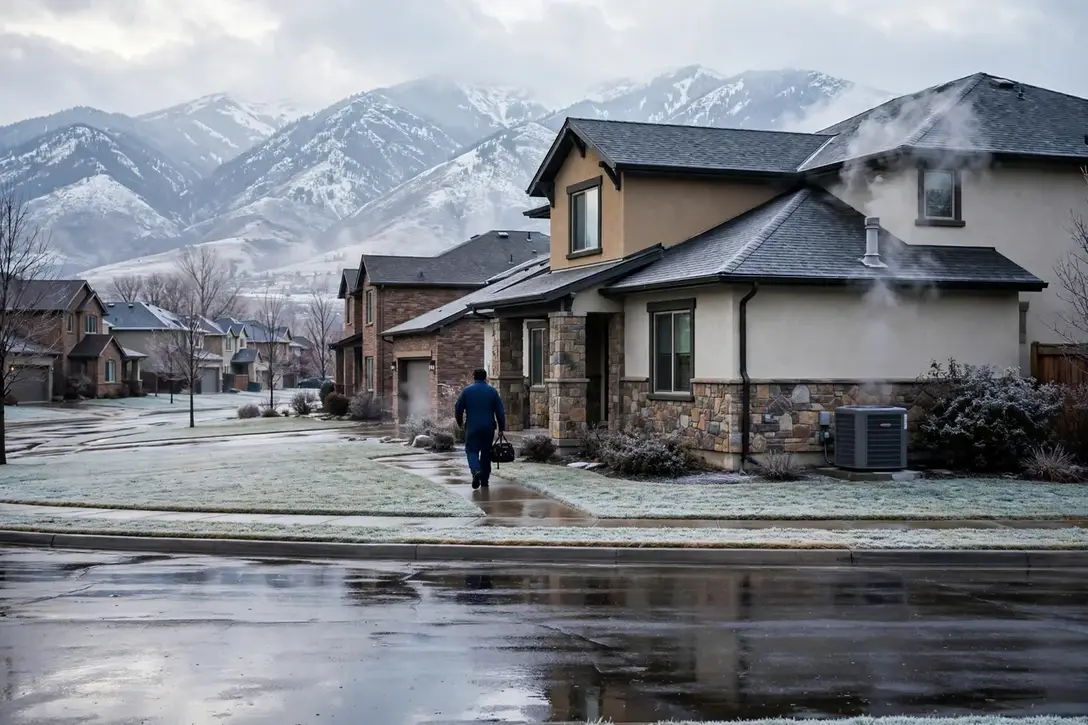


Start with the stock, and the rest of the page follows: Salt Lake City's housing eras, its climate record at SALT LAKE CITY INTL AP, UT US, and the failure patterns those two manufacture together — ranked, evidenced and answered below. When the pattern matches your home, one call routes you to an independent local HVAC technician who works these streets.
Call center hours: Mon-Fri 7:00 AM-10:00 PM ET | Sat 8:00 AM-10:00 PM ET | Sun 7:00 AM-9:00 PM ET
The median Salt Lake City home was built in 1986; 43.7% of the stock predates 1980, and the pattern this metro's own data ranks first is the refrigerant transition reaching older systems. TempReach USA is a referral service, not an HVAC company: one call connects you with an independent local HVAC technician serving your ZIP code.
Start with the raw material: 1,261,337 people, 464,304 housing units, and a housing stock whose middle home was built in 1986. That single date organises everything on this page. On one side of it stand the older districts — 18.5% of homes predate 1960, 43.7% predate 1980 — heated and cooled by systems renewed in pieces for decades, in homes across Salt Lake, Tooele. On the other side, the 31.0% built since 2000 run matched modern equipment, and fail in the newer ways. A Salt Lake City technician reads a home's build year the way a doctor reads a chart: it predicts, before a single panel is opened, which systems deserve suspicion first.
Stand in one of Salt Lake City's older neighbourhoods and you are standing in its HVAC's back catalogue. The homes there — part of the 202,901 built before 1980 across this metro — went up when a furnace was built to serve for a generation and central cooling was still spreading street by street. That generation has now elapsed several times over. What it leaves behind is not universal failure but universal exposure: every duct joint, igniter and condenser coil in those districts is operating past the horizon its makers planned for, in Salt Lake County and beyond, and the failures arrive in the order the parts tire.
The growth side of the metro tells the opposite story in the same language. West Valley City, West Jordan and the subdivisions still filling in account for much of the 143,934 homes built since 2000 — matched systems, planned ductwork, heat pumps where the lots suit them. Their HVAC is not old; it is uniform, which creates its own calendar: everything installed in the same boom reaches each wear point in the same years, from the first condenser replacements to the first control-board failures, while 1,420 cooling degree days of annual heat keep demand on the system high.
One more record sits over the whole metro, and it is the one the equipment itself keeps: the weather's. SALT LAKE CITY INTL AP, UT US logs 15.52 inches of precipitation in an average year and swings between 62.2 days at 90 degrees or more and 111.8 nights at or below freezing. Heating systems ride that swing in their run hours; cooling systems ride it in their cycle counts; ducts ride it in the attics, expanding and contracting between the seasons. Cross the swing with the housing ages above and the selection of problems further down this page stops looking like a list and starts looking like an arithmetic result.
Housing eras and climate, joined — the two datasets every section of this page is built from.
The distribution, in one breath: of every hundred Salt Lake City homes, 18.5 were standing before 1960, 25.2 went up in the two decades after, 25.3 in the two after that, and 31.0 have arrived since 2000. Percentages flatten the picture, so hold the counts beside them — 85,896 oldest-era homes, 143,934 newest — and the metro's heating and cooling stops being an abstraction: it is that many systems, of those ages, failing in that order.
A metro that mostly built itself after 2000 has HVAC with a distinctive trait: uniformity. The same subdivisions, the same system designs, the same installation years — and therefore the same maintenance waves, arriving at the same streets in the same seasons. Salt Lake City's older pockets still produce the deepest individual jobs, but the volume lives in the new stock: condensers cycling together, thermostats ageing together, heat pump questions surfacing together. Reading those waves early is most of what local knowledge means here.
The runner-up era is 1980-1999, with 25.3% of homes. That stock has left its carefree decades and entered its maintenance decades, and it shows in the call pattern around West Valley City and the other districts of those years: condensers on their second cycle, furnaces reaching their wear points together, ducts still young enough to reward attention over replacement.
Salt Lake City's weather, reduced to what a system experiences: 62.2 hot days a year loading the cooling, 111.8 freezing nights loading the heating, and 15.52 inches of rain feeding the humidity both seasons complain about. NOAA's normals at SALT LAKE CITY INTL AP, UT US — 5,154 heating degree days, 1,420 cooling degree days — are the long average of that experience, and they are why this metro's problem list is not interchangeable with a milder or harsher metro's.
Hold the two halves together and the rest of this page explains itself: the problems ranked highest here are the ones where Salt Lake City's dominant housing era and its climate record overlap. Change either dataset and the ranking changes — which is precisely why this profile is rebuilt from the records for every metro instead of carried over from the last one.
Ranked for this metro alone, from its Census housing profile and NOAA climate record.
A generation change is moving through Salt Lake City's cooling equipment, and it arrives one repair decision at a time. For decades, residential systems ran on R-22; production and import of that refrigerant ended in the United States in 2020, so the supply that remains is reclaimed stock, and servicing a leaking R-22 system means weighing a scarce, aging refrigerant against the age of the machine it serves. Newer systems moved to R-410A, and equipment now arriving uses lower-impact refrigerants such as R-454B, with their own handling and code requirements. The transition matters to a homeowner at specific moments: when an older system needs a charge, when a coil or compressor fails on a machine whose refrigerant is effectively retired, when a repair quote must be compared honestly against replacement. Nothing about it is a reason for panic — R-22 systems are not banned from being serviced — but every significant repair on one is now also a planning conversation, and households in Salt Lake City with equipment from the R-22 era benefit from having it before the hottest week, not during it.
The mechanics underneath the policy are simple. A refrigerant is the working fluid of the cooling cycle: it evaporates indoors to absorb heat and condenses outdoors to release it, thousands of times a season. Each generation of fluid was engineered to improve on the last one's environmental profile and operating pressures, and each required its own hardware — compressors built for different pressures, oils that mix with one fluid and not another, metering set for one fluid's characteristics. That is why the generations cannot be swapped like brands of the same product, and why 'topping up' an older system always means its own fluid, sourced from whatever supply its generation still commands. In Salt Lake City, where systems from all three generations stand in neighboring yards, the diversity is a service reality: diagnosis begins with identification, because the same symptom — a system low on charge — carries three different expense structures depending on the nameplate.
The climate loads the stakes: a leaking system in Salt Lake City underperforms through 62.2 days a year at 90 degrees or more at SALT LAKE CITY INTL AP, UT US, so the household pays the transition's toll twice — in refrigerant and in lost cooling — until the underlying decision is made.
Renovation writes its own chapter in this pattern. Homes in Salt Lake City have been extended, finished and re-divided for decades — a garage converted, a basement finished, an addition tied into ductwork sized for the original house. Each alteration borrows air from the existing network, and the borrowing is rarely repaid with new capacity or rebalanced runs. The result is a duct system whose map no longer matches the house it serves: original rooms over-supplied, added rooms fed by a hopeful tap into a trunk that was never asked to carry them. Add the slow leaks of age on top of the redesigns of renovation, and the far rooms' complaints stop being mysterious. The remedy starts with honesty about the map — what was designed, what was improvised, and what each run can actually deliver — before any cleaning, sealing or resizing is worth doing.
Households judge their heating and cooling at the thermostat, but the thermostat only reports the room it sits in. Judge the system at its furthest register instead: the air arriving there, its temperature against the supply at the unit, its volume against the room's need. In Salt Lake City that furthest room is the honest auditor of the duct network — it inherits every leak, every sag and every degree of attic heat between it and the air handler. The homes whose far rooms match their near rooms have networks that were sealed when they were built and checked as they aged. The homes whose far rooms lag are not necessarily homes with weak equipment; they are homes whose delivery network has been quietly resigning, joint by joint, while the equipment took the blame and the service calls. The register, not the nameplate, is where the resignation is announced.
Climate sharpens the accounting: in Salt Lake City the supply runs cross attic air during 62.2 days a year at 90 degrees or more, and crawl-space cold through 111.8 freezing nights. A leak in those spaces is not a small percentage lost politely — it is conditioned air exchanged with the harshest air the house contains.
There is a stage in every system's life when maintenance stops being a formality and becomes the main event. In Salt Lake City, with 202,901 pre-1980 homes and the equipment generations stacked inside them, a large part of the metro lives in that stage permanently. The tune-up of an older system is diagnostic work: pressures and temperatures that reveal a thinning refrigerant charge, electrical readings that show a motor working harder than its nameplate allows, a heat exchanger that deserves eyes rather than assumptions. Done yearly, it converts ageing from a surprise generator into a managed slope — the household learns each year what the system spent and what it has left. Skipped for years, the same visit becomes an archaeology dig, and the findings arrive all at once, usually in the season the household could least use them.
A serious look at an ageing system follows a short order. First, identity: the nameplate's age, model and refrigerant, because those three facts set the realistic horizon. Second, the electrical profile: starting components, motor draws, the condition of connections and the disconnect. Third, the air side: filter, coil cleanliness, blower condition and the temperatures across the system, which together say whether the machine is moving its rated air. Fourth, the combustion side on heating equipment: ignition condition, flame quality, exchanger inspection and venting. Last, the conversation those readings support — what is sound, what is spent, what to watch, and what the household should plan for in which season. In Salt Lake City's older housing that order matters more, not less, because the findings compound: an old system behind dirty coils and a drifting charge is three small problems impersonating one large one.
Climate presses the point. A system in Salt Lake City works both ends of the year — 5,154 heating degree days against 1,420 cooling degree days at SALT LAKE CITY INTL AP, UT US — so its components accumulate in twelve months the wear a single-season climate would spread over two years.
The no-heat call in deep cold has a recognizable biography in Salt Lake City. The furnace usually announced itself first: a startup that grew slower, a rattle at ignition, short runs that left the house short of the setting, a burner that lit with a sound it did not used to make. Cold weather raises the stakes of each symptom — a furnace cycling short in mild weather merely underheats; the same furnace in a hard freeze cannot hold the house at all, and the pipes in the exterior walls begin their own countdown. That is why technicians treat winter furnace symptoms as scheduling information rather than background noise: the system is filing its report early, and the household that books on the report rather than the failure chooses its own timing instead of the weather's.
The wear itself follows the physics of the machine. A gas furnace lives by controlled fire: it must move air across a heat exchanger that swings from room temperature to several hundred degrees and back, many times a day, all winter. Metal fatigues under that cycling — slowly, invisibly, and faster in a unit that short-cycles because of a dirty filter or an oversized installation. Ignition components live an equally hard life at the small scale: a hot-surface igniter is a ceramic element heated to glowing in seconds, and each heating is a thermal shock. In Salt Lake City's 5,154 heating degree days, a furnace may fire tens of thousands of times across its life. The season's failures are rarely mysteries; they are the arithmetic of cycles, arriving on schedule in the coldest weeks because that is when the cycles concentrate.
Housing adds its evidence: with a median build year of 1986, much of Salt Lake City's heating plant serves homes whose ductwork and insulation ask more per cold night than modern construction would. The furnace wears against the house as well as the weather.
The freeze changes the meaning of symptoms. A furnace that lockouts and recovers in October is a nuisance; the same behavior with the temperature falling through the twenties outside is a system announcing that it may not be present for the coldest hours. In Salt Lake City, experienced households read winter heating symptoms against the forecast rather than the calendar: intermittent operation ahead of a cold snap is a reason to act that day, because the snap will test the system at exactly the load where its weakness lives, and it will do so at the hour when every other weak system in the metro is being tested too. The queue forms in the cold, all at once, for reasons that were visible in the mild weather before it. The freeze-risk pattern is therefore partly a story about timing — the gap between when a system files its intentions and when the weather collects on them.
Judge a heating system's freeze readiness in the autumn, by evidence, not in January by outcome. The evidence is a short list: ignition proven under a real call for heat, the safety chain and fault history read rather than assumed, condensate and venting paths walked where the cold can reach them, backup heat exercised on a heat pump, and a household that knows its own water main and its own first hour by heart. SALT LAKE CITY INTL AP, UT US's record — 111.8 freezing nights in an average year — is the examination date, published in advance. The homes that pass it without drama share the profile of having treated that date as real. A freeze does not grade on effort or intention; it grades the house and its heating plant exactly as it finds them, in the coldest hours, once a year, with the plumbing as the second paper. Preparation is simply the decision to sit the exam rehearsed.
Count the coupling: Salt Lake City's 464,304 housing units hold their plumbing inside the envelope their heating maintains. Every unit's freeze risk is therefore a joint property of its heating plant's condition and its pipes' placement — and both properties were set, house by house, by the era that built it.
Twice a year, Salt Lake City changes its mind. The shoulder seasons — the weeks when a house can need heating in the morning and cooling by afternoon, sometimes within the same day — ask more of a system and its household than either deep season does: both modes in working order at once, controls set for change rather than for a settled pattern, and equipment that may sit idle for stretches and then be called on without ceremony. The record at SALT LAKE CITY INTL AP, UT US frames the workload honestly — 5,154 heating degree days against 1,420 cooling degree days, a genuinely two-season climate — and the shoulders are where the two halves meet and negotiate. The checks that matter are changeover checks: the season just ending reviewed for what it spent — the filter, the wear items, the symptoms it filed — and the season arriving proven before it is needed, with a full run in the new mode while the weather is still forgiving. The thermostat's program belongs in the same check; last season's schedule, carried forward unexamined, is how a house ends up heating against an open-window afternoon. Households that treat the shoulders as their maintenance seasons get two calm, well-timed looks at their system a year — which is exactly the rhythm the equipment's manufacturers had in mind.
The season loads Salt Lake City's systems the way its record at SALT LAKE CITY INTL AP, UT US says it will: 5,154 heating degree days against 1,420 cooling degree days in an average year, against a housing stock whose median build year is 1986. The households that read the season early — filters, drains, a system run before the extreme weeks — are the ones whose calls stay schedulable.
There is a supply-side depth as well. A shrinking refrigerant does not vanish; it circulates — recovered from retired systems, reclaimed to specification, and returned to service at an expense that reflects the shrinking pool. In Salt Lake City that means the R-22 in a system serviced this year may have cooled three other homes before it, and may cool another after this system retires, provided it is recovered rather than vented. The chain gives older equipment a managed twilight rather than a cliff: service remains possible, performed by technicians qualified for the work, for as long as the economics hold for the household. Understanding that chain replaces two common errors — that old systems are already unserviceable, and that they can be serviced forever as cheaply as ever — with the true picture: a gradually tightening supply, a gradually aging fleet, and a decision that improves with information and worsens with delay.
Why here and not everywhere: Salt Lake City pairs 202,901 pre-1980 homes with 62.2 days a year at 90 degrees or more and 111.8 nights below freezing. Every metro pairs its housing with its weather somehow; this particular pairing is what puts the pattern where it sits on this page's list, ahead of problems that dominate metros built in other decades, under other skies.
Experienced local practice starts with the simple certainties — the observations that take minutes and decide the most:
Listed in the order this metro's housing and climate data supports.
Warm air from the vents is a symptom with several authors — capacitor, charge, airflow, controls — and AC repair in Salt Lake City separates them by measurement at your unit, not by parts swapped on hope.
Air conditioning in Salt Lake City works against the local calendar: 1,420 cooling degree days a year at SALT LAKE CITY INTL AP, UT US, with 62.2 days at 90 degrees or more. The failures follow that load — capacitors and contactors worn by relentless summer cycling, refrigerant charges drifting low on systems that have served a decade of heat, condensate drains clogging in the humid weeks. The older districts run the oldest condensers; the subdivisions around Salt Lake City run matched fleets installed in the same seasons, and both sides of the metro meet the repair call on the hottest week of the year. From West Valley City to West Jordan, the pattern repeats wherever the housing era matches.
Count the exposure from the Census side: a median build year of 1986 across 464,304 housing units means half the metro's air conditioners are older than the systems in the growth suburbs around West Valley City, and summer runtime is the statistic that matters — the repair calls follow it street by street.
In Salt Lake City this service is booked most often through the problem patterns at the top of this page — the metro's housing data, not habit, sets the order. If your home is in the 43.7% built before 1980, mention its age on the call: it changes the parts the technician loads before heading to Salt Lake City and the rest of the metro.
Post-renovation is the clearest case in the trade. Drywall dust and sanding residue settle through every open register, and one thorough cleaning after the work ends removes in hours what the system would otherwise circulate for years.
What comes out of a Salt Lake City duct system tells the home's biography: drywall dust from the renovation, pet hair in proportion to the household, the fine grit that 15.52 inches of yearly rain and the dry seasons between them work into every return. Cleaning matters most where the biography is long — the pre-1980 homes, 43.7% of the stock — and where a household's breathing argues for it. A technician who shows the before and after, and says plainly when a system does not need the work, is the one whose advice holds up. With a median build year of 1986, most of the metro's 464,304 housing units are working through the same ageing curve.
Count the systems and the diary fills itself: 439,639 households breathing through ductwork daily, the oldest of it in homes from the 1980s and the newest in the subdivisions past Sandy. What the cleaning finds follows the biography — dust in proportion to years, debris in proportion to renovations.
One local habit worth copying: Salt Lake City homeowners who mention their street's building era when they book get a better-matched visit, because a technician heading to a the 1980s home in Salt Lake County loads different parts than one heading to a new-build subdivision in West Valley City. The service is the same; the preparation is local.
Maintenance is a partnership with a division of labor: the household changes filters and keeps the outdoor unit clear; the professional brings instruments, the checklist and the judgment to read what the measurements are saying.
Maintenance in Salt Lake City is a calendar with two appointments a year, written by the climate: one before the 62.2 hot days arrive, one before the 111.8 freezing nights do. The cooling visit works the outdoor unit — coils washed, refrigerant pressures read, capacitors and contactors tested, the condensate drain cleared before the humid weeks can clog it. The heating visit works the furnace or heat pump — burners and ignition, the exchanger's condition, venting, airflow. Between them they catch the failures this metro's systems rehearse every year, while those failures are still small. That is the daily reality for the 439,639 households spread across Salt Lake, Tooele.
Tune-up demand follows the fleet's waves: the subdivisions' matched systems reaching service points together, the pre-1980 districts' individual units on individual schedules. Millcreek sits inside one of those patterns; the readings taken there this season predict its systems' next one.
Where this service gets booked in Salt Lake City follows the map on this page: the older districts generate the deep-end work, the post-2000 subdivisions the wear-and-tear work, and the 117,469 homes in between split the difference. Telling the call center your home's build decade — most Salt Lake City owners know it within a few years — puts the right kit on the van the first time.
The lights-then-dies pattern in a Salt Lake City home is most often a flame sensor whose signal has weakened with oxidisation; measured in minutes by a professional, misdiagnosed for weeks by guesswork.
Furnace work in Salt Lake City is set by 5,154 heating degree days a year at SALT LAKE CITY INTL AP, UT US and 111.8 nights at or below freezing. The failures the season produces are the working parts wearing in sequence: igniters that have fired ten thousand times, blower motors tired from two seasons a year of duty — heating in winter, air handling in summer — heat exchangers stressed by decades of expansion and contraction. In the older districts, where 43.7% of the metro's homes predate 1980, many furnaces are replacements of replacements, fitted into ductwork older than the equipment itself. Locally the workload concentrates where the stock is oldest — the districts built around the 1980s first.
Heating demand in Salt Lake City concentrates where the cold does its work: 111.8 nights a year at or below freezing, against a housing stock whose median build year is 1986. Around Herriman as in the old core, that combination is not an abstraction — it is the street's furnaces, house by house.
In Salt Lake City this service is booked most often through the problem patterns at the top of this page — the metro's housing data, not habit, sets the order. If your home is in the 43.7% built before 1980, mention its age on the call: it changes the parts the technician loads before heading to Salt Lake City and the rest of the metro.
An emergency is a trajectory, not a discomfort: temperatures heading somewhere unsafe, water in motion, an electrical fault worsening. Those failures cannot wait for a routine slot, and the response is sequenced accordingly.
HVAC emergencies in Salt Lake City keep the climate's hours: the cooling failure on the third day of a heat wave, the furnace that stops on the coldest night of the year. The metro's record at SALT LAKE CITY INTL AP, UT US — 62.2 days of serious heat, 111.8 freezing nights — sets the stakes at both ends, and the housing sets the vulnerability: a well-insulated new build coasts for a day without its system, while an older home in the the 1980s districts follows the outdoor temperature indoors within hours. The emergency visit triages in order: safety first, then the fault, then the honest question of repair against replacement. In Salt Lake City that holds across 50 ZIP codes, from Salt Lake City out to West Jordan.
Scale the problem by the Census count: 439,639 households depending on systems that cannot be improvised around — no heat in a freeze, no cooling in a heat wave. The emergency visit exists for the hours when waiting until Monday is not a plan, in Murray this month, somewhere else next.
One local habit worth copying: Salt Lake City homeowners who mention their street's building era when they book get a better-matched visit, because a technician heading to a the 1980s home in Salt Lake County loads different parts than one heading to a new-build subdivision in West Valley City. The service is the same; the preparation is local.
With a median build year of 1986, many Salt Lake City systems are reaching replacement age together; the professional you are connected with inspects ducts and electrics across 50 ZIP codes before recommending equipment.
With 464,304 homes and a median build year of 1986, Salt Lake City heating stock spans every era of furnace and flue — each installation assessed on its own house, not on the outgoing unit's label.
Heat pump services in Salt Lake City test the whole year-round system: the independent local professional covering Salt Lake, Tooele reads charge and airflow in both modes, proves defrost, and checks auxiliary heat logic before quoting any work.
Ductless installation in Salt Lake City is surveyed room by room across Salt Lake, Tooele: the independent local professional calculates each space's load, plans line and drain routes, and quotes the complete design before work begins.
With a median build year of 1986 across 464,304 homes, Salt Lake City holds both air problems at once — envelopes that leak air freely and envelopes sealed tight — and the local professional assesses which house yours is before recommending equipment.
In Salt Lake City, the thermostat question splits by housing era: homes from around the median build year of 1986 often lack a common wire in the wall, while newer builds across the 50 covered ZIP codes usually carry one — the local professional checks the cable before choosing the control.
In Salt Lake City, commercial work follows the stock: 464,304 housing units' worth of mixed buildings — offices, retail and restaurants from Salt Lake City across the 50 covered ZIP codes — each with rooftop units whose service rhythm the local professional sets per building.
There is a plainer way to say what this page's ranking means in practice: most calls in Salt Lake City are two calls. The first answers The refrigerant transition reaching older systems; the second answers leaky ducts losing air and energy. Between them they account for the shape of a local technician's week here — the districts visited, the parts stocked, the diagnoses made fastest because they are made most often. The remaining services divide the rest of the diary among them, essential but episodic, the supporting work around two leading patterns.
PROBLEM SOLUTION
Population 203,888
Population 137,955
Population 116,277
Population 94,723
Population 80,331
Population 63,342
Population 59,010
Population 57,336
Population 50,159
Population 49,904
Population 44,944
Population 37,265
Also in the Salt Lake City metro: Kearns metroship (population 37,058), Midvale (population 35,736).
Beyond Salt Lake City itself, the metro takes in West Valley City (137,955 residents), West Jordan (116,277) and the rest of the communities in the grid above — each fitted with heating and cooling in its own building era, which is why two streets in the same metro can need entirely different HVAC conversations. The ZIP list below is the full coverage footprint: if your code is on it, this page was written about your housing stock.
Beyond the largest communities sit Sandy (94,723), South Jordan (80,331), Millcreek (63,342), Taylorsville (59,010), Herriman (57,336) — smaller places across Salt Lake, Tooele, covered on the same terms. Their housing tends to be older on average than the big suburbs', and their calls follow the older patterns on this page. One routing covers them all: find your ZIP code below and the rest is a phone call.
The metro's weight is not evenly spread. Salt Lake City holds 203,888 of the 1,261,337 residents; West Valley City and West Jordan add 137,955 and 116,277; and the remainder scatters across the smaller places above, some no bigger than a few thousand people. HVAC follows the weight — most calls come from where most homes are — but era matters more than size: a small community of 1960s housing generates older-system work than a large new subdivision does.
Draw the metro by its paperwork and it resolves into Salt Lake, Tooele — 2 jurisdictions sharing one housing stock and one weather system. Salt Lake County holds the historic centre and the densest share of the older homes; the surrounding counties hold the rings of growth around it. Permits and inspections follow those boundaries even though temperature never does, which is part of why the technician this page connects you to works these streets specifically.
Three neighbouring coverage areas begin where this one ends: Provo, UT, some 48 miles off; Ogden, UT, 51 miles; and Logan, UT, 103 miles. Each keeps its own page because each keeps its own numbers — a different median build year, a different climate station, a different problem ranking. Boundary households should trust the ZIP list over the map: the code, not the compass, assigns the dataset.
The region around Salt Lake City is a set of variations on its theme: Provo, UT, 48 miles off, runs a median build year of 1999 on a metro population of 773,426; Ogden, UT (51 miles) medians 1990 on 672,784; Logan, UT (103 miles) medians 1990 on 160,889. Nearness is not sameness — a few decades of median build year separate their heating and cooling as surely as the miles separate their maps.
The stock has a shape as well as a size. Owners hold 67.8% of it and renters 32.2%, a split that decides who notices a comfort problem first and who arranges the repair. The generations split 1.4-to-one in favour of the pre-1980 homes. And the map divides into 14 named communities across Salt Lake, Tooele, each carrying its era's share of the 464,304 housing units the Census counts here.
Salt Lake City by the derived numbers — median home age 40 years · owners in 298,075 homes, renters in 141,564 · each covered ZIP code carrying about 1,718 pre-1960 homes · a heating-to-cooling degree-day ratio of 3.63 · 394 mm average annual rainfall.
County pages carry the local detail — land area, climate normals and the heating and cooling pressures on the ground in each county.
More plain-language help: the TempReach USA heating & cooling guides
One call connects you with an independent local heating and cooling professional serving Salt Lake City and the surrounding metro.
Call center hours: Mon-Fri 7:00 AM-10:00 PM ET | Sat 8:00 AM-10:00 PM ET | Sun 7:00 AM-9:00 PM ET