
This is Erie's heating and cooling page, built from Erie's own numbers: Census housing figures, the metro's ZIP codes and its NOAA climate record. TempReach USA routes your call to an independent local HVAC technician; the homework below is here so you know your home's likely problems before you ever make it.
Call center hours: Mon-Fri 7:00 AM-10:00 PM ET | Sat 8:00 AM-10:00 PM ET | Sun 7:00 AM-9:00 PM ET
The median Erie home was built in 1963; 71.2% of the stock predates 1980, and the pattern this metro's own data ranks first is leaky ducts losing air and energy. TempReach USA is a referral service, not an HVAC company: one call connects you with an independent local HVAC technician serving your ZIP code.
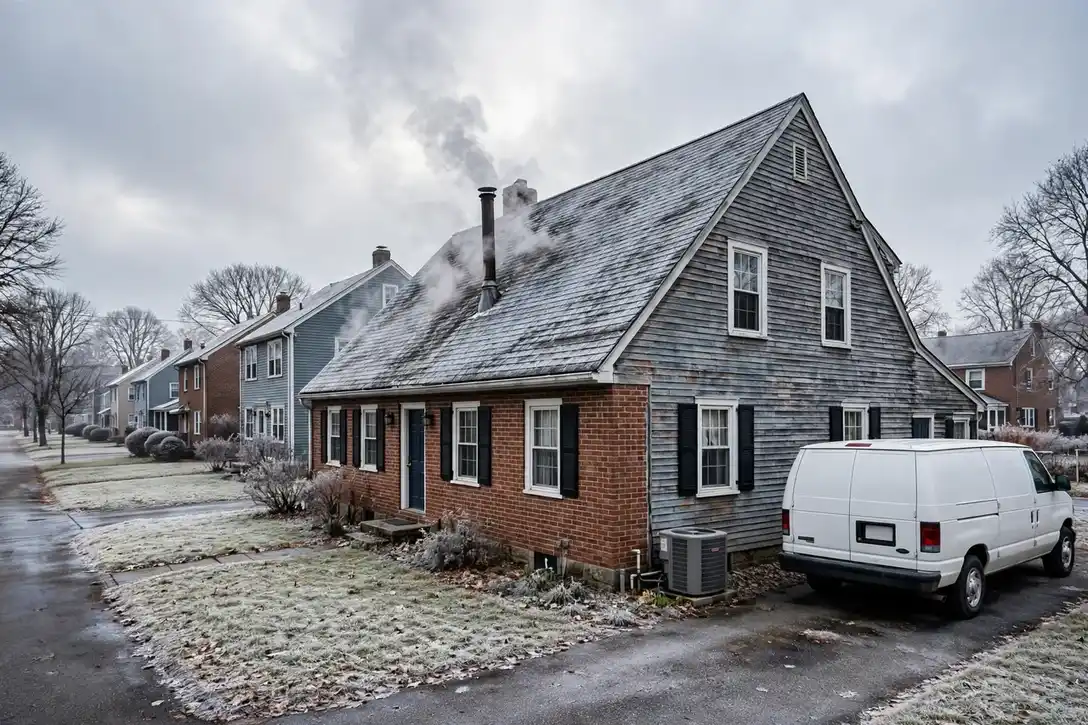
Start with the raw material: 269,544 people, 120,019 housing units, and a housing stock whose middle home was built in 1963. That single date organises everything on this page. On one side of it stand the older districts — 46.8% of homes predate 1960, 71.2% predate 1980 — heated and cooled by systems renewed in pieces for decades, in homes across Erie. On the other side, the 11.7% built since 2000 run matched modern equipment, and fail in the newer ways. A Erie technician reads a home's build year the way a doctor reads a chart: it predicts, before a single panel is opened, which systems deserve suspicion first.
The pre-1980 stock is where most of the metro's HVAC character lives. Homes from those decades in Erie County and across Erie were built with duct layouts from the first age of central systems, furnaces and condensers that have since been renewed piecemeal, and insulation standards from another era, and each of those choices is now at or beyond the age its makers expected of it. Owner-occupiers hold 68.3% of the metro's homes, so most of the people reading this page are reading about a system they own outright — one whose failures arrive as surprises only if nobody has looked at the pattern: cooling fading a little each summer, a furnace recovering a little more slowly, one room drifting a little further from the thermostat.
Growth wrote this metro's newest HVAC chapter in matched equipment and planned ducts: systems sized as a single design, controls by the catalogue, outdoor units placed by the plat across the subdivisions near Northwest Harborcreek and Corry. The chapter is young — its systems have decades in hand — but it is not exempt from the metro's arithmetic: 752 cooling degree days of demand work its condensers hard, and the winters test its heat pumps with the same cold that tests the oldest furnace in Erie County.
The climate written over all of it comes from the NOAA station at ERIE INTL AP, PA US: an average year brings 5,905 heating degree days, 752 cooling degree days and 42.98 inches of precipitation. Those are not abstractions to a furnace or a condenser — they set how many hours a heating system runs each winter, how hard a cooling system cycles in July, and how much moisture every coil has to pull out of the indoor air. The problem sections that follow are selected by exactly these numbers, combined with the housing-age profile above.
Housing eras and climate, joined — the two datasets every section of this page is built from.
The distribution, in one breath: of every hundred Erie homes, 46.8 were standing before 1960, 24.4 went up in the two decades after, 17.1 in the two after that, and 11.7 have arrived since 2000. Percentages flatten the picture, so hold the counts beside them — 56,169 oldest-era homes, 14,042 newest — and the metro's heating and cooling stops being an abstraction: it is that many systems, of those ages, failing in that order.
Vintage is destiny in this metro. With the pre-1960 band the largest of the four, the centre of gravity of Erie's heating and cooling sits in houses whose systems have already outlived several generations of equipment — ducts gone leaky inside walls, furnaces renewed and renewed again, cooling retrofitted into floor plans that never imagined it. The later bands matter, and the post-2000 subdivisions will write their own chapter in time, but the calls that define HVAC here come disproportionately from the oldest streets, and they will keep coming until that stock is modernised system by system.
The second band in the table is the 1960-1979 stock: 29,285 homes, 24.4% of the metro. It is the transition generation — cooling arriving, heating generations overlapping, ducts mixed street by street — and it supplies Erie with its most diagnostic HVAC: two homes of the same year needing opposite answers, decided by what the builder happened to specify.
A profile needs its climate column, and Erie's comes from ERIE INTL AP, PA US: an average year of 50.8 degrees, built from extremes at both ends. The heating load (5,905 degree days) and the cooling load (752) together set the system's working life; the precipitation total (42.98 inches) sets the moisture the cooling half must remove; the freeze count (111.4 nights) sets the stakes of every heating failure. Four numbers — and most of the metro's HVAC behaviour follows from them.
Hold the two halves together and the rest of this page explains itself: the problems ranked highest here are the ones where Erie's dominant housing era and its climate record overlap. Change either dataset and the ranking changes — which is precisely why this profile is rebuilt from the records for every metro instead of carried over from the last one.
Selected and ranked from this metro's housing-age profile and climate record — not copied from another city's page.
Renovation writes its own chapter in this pattern. Homes in Erie have been extended, finished and re-divided for decades — a garage converted, a basement finished, an addition tied into ductwork sized for the original house. Each alteration borrows air from the existing network, and the borrowing is rarely repaid with new capacity or rebalanced runs. The result is a duct system whose map no longer matches the house it serves: original rooms over-supplied, added rooms fed by a hopeful tap into a trunk that was never asked to carry them. Add the slow leaks of age on top of the redesigns of renovation, and the far rooms' complaints stop being mysterious. The remedy starts with honesty about the map — what was designed, what was improvised, and what each run can actually deliver — before any cleaning, sealing or resizing is worth doing.
Households judge their heating and cooling at the thermostat, but the thermostat only reports the room it sits in. Judge the system at its furthest register instead: the air arriving there, its temperature against the supply at the unit, its volume against the room's need. In Erie that furthest room is the honest auditor of the duct network — it inherits every leak, every sag and every degree of attic heat between it and the air handler. The homes whose far rooms match their near rooms have networks that were sealed when they were built and checked as they aged. The homes whose far rooms lag are not necessarily homes with weak equipment; they are homes whose delivery network has been quietly resigning, joint by joint, while the equipment took the blame and the service calls. The register, not the nameplate, is where the resignation is announced.
The load figures complete the case: 752 cooling degree days and 5,905 heating degree days at ERIE INTL AP, PA US mean the network is in service in earnest at both ends of the year. Duct loss here is not a summer inefficiency or a winter one; it is a twelve-month tax on a system that works both seasons.
Planning is where households regain the advantage. A Erie homeowner who knows their system's refrigerant, age and repair history can run the transition on their own schedule: service the current machine properly, watch the leak-and-wear indicators, and time any replacement for a shoulder season, chosen equipment and an unhurried installation. The homeowner who meets the transition for the first time through a breakdown meets it on the calendar's worst terms — mid-heat, limited deliberation, a decision between an expensive charge on an old machine and a replacement nobody had budgeted to choose that week. The transition itself is the same in both stories; the difference is purely when the household chose to read the nameplate. Technicians in this metro can recite both versions from memory, street by street, because the metro's equipment generations were installed street by street.
The mechanics underneath the policy are simple. A refrigerant is the working fluid of the cooling cycle: it evaporates indoors to absorb heat and condenses outdoors to release it, thousands of times a season. Each generation of fluid was engineered to improve on the last one's environmental profile and operating pressures, and each required its own hardware — compressors built for different pressures, oils that mix with one fluid and not another, metering set for one fluid's characteristics. That is why the generations cannot be swapped like brands of the same product, and why 'topping up' an older system always means its own fluid, sourced from whatever supply its generation still commands. In Erie, where systems from all three generations stand in neighboring yards, the diversity is a service reality: diagnosis begins with identification, because the same symptom — a system low on charge — carries three different expense structures depending on the nameplate.
The climate loads the stakes: a leaking system in Erie underperforms through 4.7 days a year at 90 degrees or more at ERIE INTL AP, PA US, so the household pays the transition's toll twice — in refrigerant and in lost cooling — until the underlying decision is made.
There is a stage in every system's life when maintenance stops being a formality and becomes the main event. In Erie, with 85,454 pre-1980 homes and the equipment generations stacked inside them, a large part of the metro lives in that stage permanently. The tune-up of an older system is diagnostic work: pressures and temperatures that reveal a thinning refrigerant charge, electrical readings that show a motor working harder than its nameplate allows, a heat exchanger that deserves eyes rather than assumptions. Done yearly, it converts ageing from a surprise generator into a managed slope — the household learns each year what the system spent and what it has left. Skipped for years, the same visit becomes an archaeology dig, and the findings arrive all at once, usually in the season the household could least use them.
The mechanics of ageing are unglamorous and cumulative. Bearings wear and draw more current. Capacitor values drift downward year by year, weakening every start they assist. Coil surfaces oxidize and foul, shedding their ability to exchange heat a fraction at a time. Refrigerant leaves through seals and joints at a pace too small to notice in a season and large enough to matter in five. Electrical connections loosen under thermal cycling and add resistance that becomes heat. None of these processes stops, but most of them are measurable long before they are fatal — which is precisely what separates maintenance from repair. A tune-up measures the drift; a repair replaces whatever the drift finally claimed. The household that buys measurement regularly buys the choice of when to spend on renewal, and that choice is worth the most on the oldest equipment.
Look at the replacement echoes: the 14,042 homes built since 2000 are now carrying first-generation equipment deep into its service life, joining the older cohorts. In Erie, ageing is not a niche condition of old houses; it is the metro's standard equipment profile.
This is the season the metro's housing is examined by the weather, and the examination is practical: heating plant against 5,905 heating degree days, envelopes against 111.4 freezing nights, condensate lines and vent terminations against snow and ice. The older districts sit the hardest paper — systems of advancing age serving the 85,454 pre-1980 homes across the metro — but no system is exempt; a new furnace with a frozen condensate run stops as completely as an old one with a spent igniter. Between cold snaps, the season's quieter work continues — filters loading, ducts breathing with the temperature swings — and the households that keep the small rhythm are the ones the big cold never gets a chance to interview.
The season loads Erie's systems the way its record at ERIE INTL AP, PA US says it will: 5,905 heating degree days against 752 cooling degree days in an average year, against a housing stock whose median build year is 1963. The households that read the season early — filters, drains, a system run before the extreme weeks — are the ones whose calls stay schedulable.
There is a deeper reason duct problems persist unsolved in Erie: they are invisible by location and deniable by symptom. The network hides in the spaces nobody enters, and its failures present as the equipment's failures, so the system's most-serviced component — the furnace or air conditioner — absorbs attention that belongs to its quietest one. A metro with 120,019 housing units and a median build year of 1963 has, in effect, an equal number of duct networks ageing unobserved alongside the equipment everyone watches. The closer look this pattern rewards is empirical: a delivered-air measurement ends the argument in an afternoon. Until that measurement is taken, duct loss remains the diagnosis of exclusion — suspected last, confirmed rarely, and meanwhile invoiced daily in longer run times and uneven rooms.
The numbers underneath it, for Erie: 120,019 housing units, a median build year of 1963, and a climate record at ERIE INTL AP, PA US of 5,905 heating degree days against 752 cooling degree days. Cross the housing record with the weather record and this pattern is what falls out at the top — rarely the most dramatic problem in heating and cooling, but the one this metro's stock and climate manufacture most steadily.
On a first visit for this pattern, a local technician's checks run in a practised order:
Listed in the order this metro's housing and climate data supports.
Method separates cleaning from stirring. Negative pressure on the whole network, agitation in every run, registers off and washed, the blower compartment cleared — anything less moves the dust from one room's duct to another's.
A word on timing, since Erie households ask: duct cleaning earns its appointment when the evidence calls for it — after construction or renovation dust, when a home changes hands after years of one household's accumulation, when the registers show visible load or the blower compartment tells the story. Booked on evidence, it is honest work with visible results. Booked on a calendar superstition, it is a van ride. Local technicians who work from the evidence are the ones this page's routing favours, in Erie and across the metro alike. It is why two Erie homes of the same age, on different streets, so often need the same visit in the same year.
Count the systems and the diary fills itself: 110,106 households breathing through ductwork daily, the oldest of it in homes from the 1960s and the newest in the subdivisions past Northwest Harborcreek. What the cleaning finds follows the biography — dust in proportion to years, debris in proportion to renovations.
Age informs an AC repair decision without deciding it — a sound system with a failed motor earns its repair, and an honest diagnosis in Erie will tell you which side of that line your unit stands on.
One more pattern belongs in the Erie picture: repair calls here are also a refrigerant story. Systems fitted in the older decades run on refrigerant generations the industry has been retiring, and every repair on those units weighs the charge's scarcity against the system's remaining life. The technician who explains that arithmetic plainly — what the repair restores, what it cannot assure anyone about next summer — is giving the household the real choice, and in the 85,454 pre-1980 homes it is a conversation held weekly. From Northwest Harborcreek to Corry, the pattern repeats wherever the housing era matches.
The local caseload behind this service is written in the climate figures: 752 cooling degree days a year and 4.7 days at 90 or above, pressing on a cooling fleet whose oldest members serve the 85,454 pre-1980 homes — in Edinboro (5,303 residents) as much as in the oldest districts.
A tune-up is scheduled while the system still works, which is the entire point: measurements taken in mild weather find the parts that hard weather would have found instead, at its own chosen hour.
Maintenance in Erie is a calendar with two appointments a year, written by the climate: one before the 4.7 hot days arrive, one before the 111.4 freezing nights do. The cooling visit works the outdoor unit — coils washed, refrigerant pressures read, capacitors and contactors tested, the condensate drain cleared before the humid weeks can clog it. The heating visit works the furnace or heat pump — burners and ignition, the exchanger's condition, venting, airflow. Between them they catch the failures this metro's systems rehearse every year, while those failures are still small. In Erie that holds across 33 ZIP codes, from Erie out to Corry.
Tune-up demand follows the fleet's waves: the subdivisions' matched systems reaching service points together, the pre-1980 districts' individual units on individual schedules. Lawrence Park sits inside one of those patterns; the readings taken there this season predict its systems' next one.
Furnace repair in Erie follows the sequence: the independent local professional covering Erie watches your furnace attempt a start, tests the stage that failed, and quotes before work begins.
In Erie, emergency means weather-relative: 5,905 heating degree days put no-heat calls on a freezing clock each winter, while 752 cooling degree days make a dead system a health question each summer — the call center triages against both, using the hours shown on this page.
With a median build year of 1963, many Erie systems are reaching replacement age together; the professional you are connected with inspects ducts and electrics across 33 ZIP codes before recommending equipment.
Heating installation in Erie starts with a heat-loss calculation across Erie: the independent local professional measures the home's loss, inspects ducts and venting, and quotes the full scope before work begins.
Heat pump services in Erie test the whole year-round system: the independent local professional covering Erie reads charge and airflow in both modes, proves defrost, and checks auxiliary heat logic before quoting any work.
Across 33 ZIP codes, Erie mini-split systems installed through local professionals are commissioned zone by zone in heating and cooling, with the filter and drain routine handed over in person.
With a median build year of 1963 across 120,019 homes, Erie holds both air problems at once — envelopes that leak air freely and envelopes sealed tight — and the local professional assesses which house yours is before recommending equipment.
Across Erie, one climate fact shapes the configuration: 5,905 heating degree days against 752 cooling degree days tells whether the control's year is mostly a heating story, mostly a cooling story, or a genuine heat pump balancing act.
Erie's commercial buildings span every era around a median build year of 1963 — and with the era goes the equipment, from aging single units over old storefronts to multi-zone systems in new developments, all serviced from a per-unit record.
Two patterns generate most of the bookings behind the services above: Leaky ducts losing air and energy and the refrigerant transition reaching older systems. That is why the order of this page's service list is what it is — the services answering those patterns come early, and the rest follow in the order the metro's data supports. A homeowner whose home matches the local profile — built in the metro's big decades, in one of its older districts — is, statistically, reading their own shortlist.
PROBLEM SOLUTION
Population 94,156
Population 8,908
Population 6,162
Population 5,303
Population 4,069
Population 3,786
Population 3,189
Population 3,014
Population 2,979
Population 2,911
Population 2,901
Population 1,571
Also in the Erie metro: Penn State Erie (Behrend) (population 1,561), Albion (population 1,269).
The communities in the grid are not suburbs of the page; they are its subject as much as Erie is. Northwest Harborcreek (8,908 residents) and Corry (6,162) carry their own building decades, their own equipment generations and their own positions in the problem ranking's logic — a system under a Northwest Harborcreek roof answers to the same data as one in the centre, but to a different era of it. Coverage here is defined by the ZIP list below; understanding is defined street by street, and this page's figures are the metro-wide version of a story each community tells in its own numbers.
Beyond the largest communities sit Edinboro (5,303), North East (4,069), Lawrence Park (3,786), Wesleyville (3,189), Fairview (3,014) — smaller places across Erie, covered on the same terms. Their housing tends to be older on average than the big suburbs', and their calls follow the older patterns on this page. One routing covers them all: find your ZIP code below and the rest is a phone call.
Every metro has a first city and a supporting cast, and the census figures draw the billing plainly here: Erie first, with 94,156 residents; Northwest Harborcreek second at 8,908; Corry third at 6,162; then the long tail of smaller communities in the grid above. The billing matters less than the building dates — each of these places was fitted with heating and cooling in its own decade, by its own builders — but between them they account for nearly every housing era, equipment generation and failure pattern this page describes.
One metro, 1 county lines drawn through it: Erie. The lines are invisible to the weather, but they structure everything administrative around an HVAC job — which office permits it, which inspector signs it, which code edition applies. Erie County, at the centre, carries the oldest housing and the heaviest share of the work this page describes; its neighbours carry the growth. A routed local technician navigates the patchwork so the homeowner does not have to.
Three neighbouring coverage areas begin where this one ends: Pittsburgh, PA, some 110 miles off; State College, PA, 143 miles; and Chambersburg, PA, 195 miles. Each keeps its own page because each keeps its own numbers — a different median build year, a different climate station, a different problem ranking. Boundary households should trust the ZIP list over the map: the code, not the compass, assigns the dataset.
The region around Erie is a set of variations on its theme: Pittsburgh, PA, 110 miles off, runs a median build year of 1960 on a metro population of 2,421,992; State College, PA (143 miles) medians 1980 on 157,393; Chambersburg, PA (195 miles) medians 1978 on 160,652. Nearness is not sameness — a few decades of median build year separate their heating and cooling as surely as the miles separate their maps.
The stock has a shape as well as a size. Owners hold 68.3% of it and renters 31.7%, a split that decides who notices a comfort problem first and who arranges the repair. The generations split 6.1-to-one in favour of the pre-1980 homes. And the map divides into 14 named communities across Erie, each carrying its era's share of the 120,019 housing units the Census counts here.
Erie by the derived numbers — median home age 63 years · owners in 75,202 homes, renters in 34,904 · each covered ZIP code carrying about 1,702 pre-1960 homes · a heating-to-cooling degree-day ratio of 7.85 · 1,092 mm average annual rainfall.
County pages carry the local detail — land area, climate normals and the heating and cooling pressures on the ground in each county.
More plain-language help: the TempReach USA heating & cooling guides
Describe the problem and the call center routes you to an independent local HVAC technician who works in the Erie metro.
Call center hours: Mon-Fri 7:00 AM-10:00 PM ET | Sat 8:00 AM-10:00 PM ET | Sun 7:00 AM-9:00 PM ET