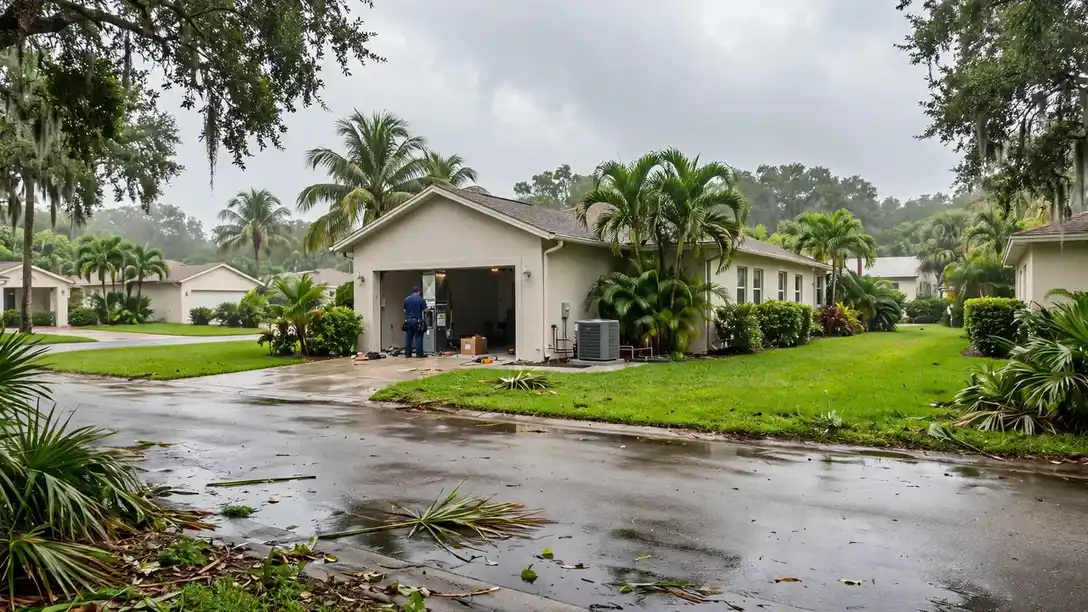


TempReach USA connects Sebastian–Vero Beach homeowners with independent local HVAC technicians. This page is built from the metro's own Census housing data, ZIP codes and climate record — the heating and cooling problems described here are the ones Sebastian–Vero Beach homes actually have.
Call center hours: Mon-Fri 7:00 AM-10:00 PM ET | Sat 8:00 AM-10:00 PM ET | Sun 7:00 AM-9:00 PM ET
The median Sebastian–Vero Beach home was built in 1991; 25.9% of the stock predates 1980, and the pattern this metro's own data ranks first is humidity burden on homes and cooling systems. TempReach USA is a referral service, not an HVAC company: one call connects you with an independent local HVAC technician serving your ZIP code.
Sebastian–Vero Beach is a metro of 163,856 people and 68,696 households, and its heating and cooling is a portrait of its building history. The median home here was built in 1991; 25.9% of homes predate 1980 and 5.7% predate 1960, while 36.3% have arrived since 2000. Every one of those eras heated and cooled differently — different furnaces, different duct designs, different refrigerant generations — and they fail differently, which is why this page is organised around the patterns the data actually produces in Sebastian–Vero Beach rather than HVAC in the abstract.
Ask how Sebastian–Vero Beach's older homes have been kept comfortable and the honest answer is: in pieces. A furnace here, a condenser there, one room's ducts renewed while the rest of the system carries on — across 22,039 pre-1980 homes, the patchwork is the norm rather than the exception. That history is written in the attics of Indian River County and everywhere else the early stock stands: systems that are part original, part renewed, and entirely individual. It is also why the guidance on this page keeps returning to patterns rather than single faults — in a patchwork system, the pattern is the diagnosis.
The newer side of Sebastian–Vero Beach — the 36.3% of homes built since 2000, concentrated around growing communities like Vero Beach South — runs on matched modern systems that age more gracefully but fail in their own ways: heat pumps and condensers worked hard by 3,391 cooling degree days of hot-season demand, control boards and sensors wearing out in houses that all reach the same age at the same time. One metro, two equipment generations, and the sections below take them in the order this metro's data ranks them.
Over everything sits the weather, and here it is measured rather than described: NOAA's station at FT PIERCE ST LUCIE CO INTL AP, FL US averages 73.1 degrees across the year, with 66.8 days reaching 90 or more and 1.7 nights at freezing or below. A furnace feels that record as a season of relentless cycling; a condenser feels it as a summer without a quiet week; a heat pump feels both. The problem ranking below is what those numbers, crossed with the housing profile, produce for Sebastian–Vero Beach specifically.
Housing eras and climate, joined — the two datasets every section of this page is built from.
Lay the eras side by side instead: 5.7% pre-1960 (4,850 homes), 20.2% from 1960-1979 (17,189), 37.8% from 1980-1999 (32,165), and 36.3% since 2000 (30,889). No single era tells the story — the proportions among them do, and those proportions are different in every metro this site covers.
The metro's HVAC present was installed between 1980 and 1999, and it is ageing as a cohort. That cohort's traits are consistent: sound bones, wearing surfaces. The systems beneath these homes are not failing from ancient design but from the accumulated cycles of two to four decades — and the work they generate is the steady, schedulable kind, provided it is scheduled. Left alone, cohort ageing has a way of arriving all at once; attended to, it is the most manageable profile a metro can have.
Behind the leading era, the growth band: 36.3% of homes arrived since 2000. Their systems are uniform by construction — one generation of equipment, one approach to duct design — which writes a shared calendar the whole street keeps. Reading that calendar early is most of what separates a planned replacement from a weekend emergency in Sebastian–Vero Beach's newest districts.
Sebastian–Vero Beach's weather, reduced to what a system experiences: 66.8 hot days a year loading the cooling, 1.7 freezing nights loading the heating, and 51.17 inches of rain feeding the humidity both seasons complain about. NOAA's normals at FT PIERCE ST LUCIE CO INTL AP, FL US — 418 heating degree days, 3,391 cooling degree days — are the long average of that experience, and they are why this metro's problem list is not interchangeable with a milder or harsher metro's.
A profile is only useful if it predicts something, and this one predicts the shape of an HVAC diary in Sebastian–Vero Beach: which streets will call about cooling, which about heating, which about airflow, and in which months. Everything after this section is that prediction written out as services, problems and answers — the numbers first, the narrative second, the way the evidence actually runs.
Sequenced by this metro's own problem ranking, not by a national catalogue order.
Source first, equipment second. A musty smell is moisture with an address; the professional finds the address, corrects it, and only then installs the filtration and ventilation that keep a corrected house corrected.
Indoor air in Sebastian–Vero Beach is a two-season problem. The hot season — 66.8 days at 90 or above — seals homes shut around their air conditioning, and whatever the system recirculates stays in circulation: pollen tracked in during the green months, humidity the coil cannot fully pull down, the ordinary chemistry of a lived-in house. The cold season seals homes the other way, around their heating. Air quality work — filtration, humidity control, ventilation, purification — is sized to that sealed-house reality and to the housing: older homes leak air freely, newer ones hold it tightly, and the remedies differ. That is the daily reality for the 68,696 households spread across Indian River.
Air quality demand in this metro is written by its sealed seasons: 66.8 hot days with the windows shut around the cooling, 1.7 freezing nights with them shut around the heat. The 30,889 post-2000 homes hold their air tightest; the older districts around Sebastian exchange theirs with attics and crawl spaces.
Refrigerant is never consumed, so a low charge in a Sebastian–Vero Beach home means a leak to be found, not just a top-up to be sold; the repair addresses the cause or the symptom is already on its way back.
Air conditioning in Sebastian–Vero Beach works against the local calendar: 3,391 cooling degree days a year at FT PIERCE ST LUCIE CO INTL AP, FL US, with 66.8 days at 90 degrees or more. The failures follow that load — capacitors and contactors worn by relentless summer cycling, refrigerant charges drifting low on systems that have served a decade of heat, condensate drains clogging in the humid weeks. The older districts run the oldest condensers; the subdivisions around Vero Beach South run matched fleets installed in the same seasons, and both sides of the metro meet the repair call on the hottest week of the year. It is why two Sebastian–Vero Beach homes of the same age, on different streets, so often need the same visit in the same year.
The local caseload behind this service is written in the climate figures: 3,391 cooling degree days a year and 66.8 days at 90 or above, pressing on a cooling fleet whose oldest members serve the 22,039 pre-1980 homes — in Vero Beach (16,785 residents) as much as in the oldest districts.
Across 9 ZIP codes, Sebastian–Vero Beach mini-split systems installed through local professionals are commissioned zone by zone in heating and cooling, with the filter and drain routine handed over in person.
In Sebastian–Vero Beach, duct loads follow the housing: a median build year of 1991 across 85,093 homes means many duct systems have carried decades of dust, pets and remodels, and the local professional reads that history from the returns before recommending anything.
With a median build year of 1991, many Sebastian–Vero Beach systems are reaching replacement age together; the professional you are connected with inspects ducts and electrics across 9 ZIP codes before recommending equipment.
From Vero Beach South to Vero Beach, a no-heat call through TempReach USA reaches a local professional whose visit includes the exchanger and venting checks that furnace work owes a Sebastian–Vero Beach household.
With 85,093 homes and a median build year of 1991, Sebastian–Vero Beach heating stock spans every era of furnace and flue — each installation assessed on its own house, not on the outgoing unit's label.
From Vero Beach South to Vero Beach, Sebastian–Vero Beach heat pump calls through TempReach USA reach a local professional who explains findings plainly and quotes after assessing — in the heating season and the cooling season alike.
In Sebastian–Vero Beach, the thermostat question splits by housing era: homes from around the median build year of 1991 often lack a common wire in the wall, while newer builds across the 9 covered ZIP codes usually carry one — the local professional checks the cable before choosing the control.
In Sebastian–Vero Beach, the maintenance calendar writes itself from the climate: 418 heating degree days and 3,391 cooling degree days mean both systems work a real season, so the fall and spring visits each have genuine work to inspect.
Across Indian River, the local professional who answers knows the stock — a median build year of 1991 across 85,093 homes means systems of every age failing in their characteristic ways, from Vero Beach South to the metro's newest subdivisions.
Sebastian–Vero Beach's commercial buildings span every era around a median build year of 1991 — and with the era goes the equipment, from aging single units over old storefronts to multi-zone systems in new developments, all serviced from a per-unit record.
Ask where this metro's HVAC diary fills up and the answer is a short story: Humidity burden on homes and cooling systems first, the refrigerant transition reaching older systems close behind, and the services that answer them doing the bulk of the booked work. Everything else on the list above is the supporting cast — necessary, frequent enough, but not what Sebastian–Vero Beach's housing stock, at its age and in its climate, principally demands. Read the service list as a weather report for the metro's systems and it stops looking like a catalogue.
Chosen by this metro's own housing and weather data — the same two records this whole page is built from.
The condensate drain is the burden's ledger, and in a humid Sebastian–Vero Beach season it runs like a small stream. Every gallon down that drain is water the coil pulled from the indoor air — evidence the system is drying as well as cooling. When the drain slows or clogs, the evidence turns: pans fill, safety switches stop the system, and the moisture the coil collected finds its way back into the house's air and materials. Drain care is therefore not a footnote of humidity work but a central chapter: a clear, trapped, correctly sloped drain line is what lets the system's drying actually leave the building. Households in the metro's humid months who learn to check that one line know more about their system's real condition than the thermostat ever tells them.
Working a humidity complaint follows the water. The first measurements are indoor: relative humidity readings in several rooms, at several times, since a single reading at the thermostat flatters the story. The second look is at the equipment's drying setup — system size against the home's actual load, airflow across the coil, cycle length on a typical afternoon, and the condensate drain's condition and output. The third look is at the sources: crawl space or basement moisture, bathroom and kitchen exhausts that vent into attics instead of outdoors, plumbing weeping quietly somewhere, grade and gutters delivering rainwater to the foundation. Only then does the remedy conversation make sense, because each layer has its own remedy — equipment setup, dedicated dehumidification, ventilation correction, source control — and prescribing from one layer for a problem living in another is how humidity complaints survive multiple service visits.
The precipitation record testifies first: 51.17 inches of rain in an average year at FT PIERCE ST LUCIE CO INTL AP, FL US means Sebastian–Vero Beach's air arrives wet for much of the season, and every cooling system in the metro is a dehumidifier by necessity, whether its setup honors the role or not.
There is a paperwork side to the transition that touches Sebastian–Vero Beach homes quietly. Refrigerant work is regulated work: recovery, handling and record-keeping rules apply to whoever services a system, and the newest refrigerants — mildly flammable by classification — arrive with their own sensors, labeling and code provisions that installers must follow. For the homeowner the visible part is small: a nameplate with a different designation, a technician explaining why a charge is measured and documented as it is, an installation that includes leak-detection provisions the older system never had. The invisible part matters more over time: as the newest generation becomes the metro's standard, parts, training and service practice consolidate around it, and the older generations become the specialty work. Owning an older-generation system is not a fault — but its service ecosystem is, year by year, becoming a smaller room.
A transition-aware service visit has a recognizable order. First, identification: the nameplate's refrigerant, model and year, stated aloud so the household and technician share the fact. Second, the leak question, taken seriously — a system low on charge has a leak until proven otherwise, and recharging without finding it is buying the same refrigerant twice on an installment plan. Third, the condition audit around the failure: compressor health, coil condition, electrical wear, because the decision the household faces is about the whole machine, not the one part that stopped. Fourth, the comparison itself, presented as what it is — the repair path with its realistic horizon, the replacement path with its — so the choice is made on the machine's merits and the household's plans for the home. In Sebastian–Vero Beach that conversation, held in a calm season, is unhurried and genuinely optional-feeling; held in a heat wave, the same facts arrive wearing a deadline.
Housing arithmetic shows the exposure: with 25.9% of Sebastian–Vero Beach's homes built before 1980 and equipment replaced in long cycles ever since, a substantial share of the metro's systems belong to refrigerant generations the market has already succeeded. The nameplates say so, one address at a time.
Ask what extreme heat breaks first and the honest answer is: whatever was already closest to the edge. In Sebastian–Vero Beach that is usually an electrical part rather than the compressor itself — a capacitor swollen by heat and hard starts, a contactor whose points have pitted through seasons of cycling, a condenser fan motor running hot in still air. The pattern shows in the timing: failures at the hottest hour, systems that restart after cooling down, cooling that fades as the afternoon builds. Those are load symptoms, and they point a technician toward the outdoor unit and its electrical cabinet before anything indoors. Homes around Vero Beach South and across the metro share the pattern because they share the weather; the age of the unit decides which home the heat collects from first.
The physics underneath is simple enough. An air conditioner does not create cold; it moves heat from indoors to outdoors, and it moves that heat against the temperature difference between the two. The hotter it is outside, the harder the compressor must work to push heat uphill, and the longer the system must run to hold the same indoor temperature. In Sebastian–Vero Beach the design assumptions behind older systems were written for a milder version of this contest. A unit installed when the surrounding streets were newer now serves a home with more heat gain — mature trees gone or grown, additions built, attic insulation settled — while its own capacity has thinned with age. The gap between what the house asks and what the unit can give widens a degree at a time, and extreme heat is when the gap becomes a number the thermostat reports every afternoon.
Read Sebastian–Vero Beach's housing and weather together and the strain stops looking random: a median build year of 1991 means much of the metro's cooling equipment is deep into its working life, and the heat at FT PIERCE ST LUCIE CO INTL AP, FL US asks the oldest systems for the longest runs of the year.
The humid season writes its signature in the condensate line. In Sebastian–Vero Beach, a cooling system in the wet months can pull a steady stream of water out of the indoor air, and every part of that path — coil, pan, drain — works at capacity while the temperature outside attracts all the attention. Preparation is therefore drainage-first: the drain flushed before the season, the pan checked, the safety switch understood rather than discovered. Add a filter rhythm that keeps airflow honest and a household habit of running the bath fan through the shower's steam rather than around it, and the season's burden is carried by design instead of by complaint.
The season loads Sebastian–Vero Beach's systems the way its record at FT PIERCE ST LUCIE CO INTL AP, FL US says it will: 418 heating degree days against 3,391 cooling degree days in an average year, against a housing stock whose median build year is 1991. The households that read the season early — filters, drains, a system run before the extreme weeks — are the ones whose calls stay schedulable.
There is a final depth to the pattern: humidity taxes the cooling system itself. A coil spending its capacity on water is a coil with less capacity for temperature, so in Sebastian–Vero Beach's humid months the effective size of every system shrinks exactly when the load peaks. Run times stretch, wear accumulates, and the strain story of the hot season is partly a moisture story in disguise. The condensate that leaves through the drain is capacity spent invisibly; the comfort that households feel is what remains. That is why experienced local practice treats a humidity complaint as system information rather than a comfort preference — the sticky house is reporting a load its equipment was never explicitly sized for, and the report deserves the same seriousness as a noise or a stop. The number that settles it is a humidity reading; everything before that number is weather talk.
Strip the pattern down to its inputs and the ranking stops being mysterious: 68,696 households depending on systems installed across a median build year of 1991, in a climate that swings between 66.8 days of serious heat and 1.7 freezing nights. Whatever pattern a metro with those inputs manufactures most, it manufactures here — the lead position is less a title than a consequence, recalculated from the same public records any sceptic can check.
Experienced local practice starts with the simple certainties — the observations that take minutes and decide the most:
PROBLEM SOLUTION
Population 29,365
Population 25,759
Population 21,517
Population 16,785
Population 10,802
Population 6,262
Population 4,995
Population 4,902
Population 4,658
Population 4,324
Population 3,081
Population 2,080
Also in the Sebastian–Vero Beach metro: Wabasso Beach (population 1,966), Wabasso (population 1,648).
Beyond Vero Beach South itself, the metro takes in Sebastian (25,759 residents), Florida Ridge (21,517) and the rest of the communities in the grid above — each fitted with heating and cooling in its own building era, which is why two streets in the same metro can need entirely different HVAC conversations. The ZIP list below is the full coverage footprint: if your code is on it, this page was written about your housing stock.
Beyond the largest communities sit Vero Beach (16,785), West Vero Corridor (10,802), Vero Lake Estates (6,262), Winter Beach (4,995), Fellsmere (4,902) — smaller places across Indian River, covered on the same terms. Their housing tends to be older on average than the big suburbs', and their calls follow the older patterns on this page. One routing covers them all: find your ZIP code below and the rest is a phone call.
The metro's weight is not evenly spread. Vero Beach South holds 29,365 of the 163,856 residents; Sebastian and Florida Ridge add 25,759 and 21,517; and the remainder scatters across the smaller places above, some no bigger than a few thousand people. HVAC follows the weight — most calls come from where most homes are — but era matters more than size: a small community of 1960s housing generates older-system work than a large new subdivision does.
Draw the metro by its paperwork and it resolves into Indian River — 1 jurisdictions sharing one housing stock and one weather system. Indian River County holds the historic centre and the densest share of the older homes; the surrounding counties hold the rings of growth around it. Permits and inspections follow those boundaries even though temperature never does, which is part of why the technician this page connects you to works these streets specifically.
Three neighbouring coverage areas begin where this one ends: Port St. Lucie, FL, some 34 miles off; Palm Bay–Melbourne, FL, 42 miles; and Lakeland, FL, 71 miles. Each keeps its own page because each keeps its own numbers — a different median build year, a different climate station, a different problem ranking. Boundary households should trust the ZIP list over the map: the code, not the compass, assigns the dataset.
Set Sebastian–Vero Beach among its neighbours and the contrasts sharpen the profile: Port St. Lucie, FL — metro population 568,721, median build year 1990 — sits 34 miles away; Palm Bay–Melbourne, FL (663,982, median 1987) 42 miles; Lakeland, FL (874,790, median 1991) 71 miles. Three different housing stocks under three nearby skies, which is why each keeps its own page and its own problem ranking rather than borrowing this one.
Count the metro per unit of itself: 9,455 housing units per covered ZIP code; 68,696 households per county; 14 communities sharing 1 county governments. Then weigh the generations against each other — 0.7 older homes for each newer one — and the service pattern on this page stops being a list and becomes a proportion: that much of the diary written by ageing systems, the rest by young ones wearing in.
One line of Sebastian–Vero Beach arithmetic — a median home 35 years old · 54,476 owner-occupied homes against 14,220 renter-occupied · 539 pre-1960 homes for every covered ZIP code · a heating-to-cooling degree-day ratio of 0.12 · 1,300 mm of rain in an average year.
County pages carry the local detail — land area, climate normals and the heating and cooling pressures on the ground in each county.
More plain-language help: the TempReach USA heating & cooling guides
One call connects you with an independent local heating and cooling professional serving Sebastian–Vero Beach and the surrounding metro.
Call center hours: Mon-Fri 7:00 AM-10:00 PM ET | Sat 8:00 AM-10:00 PM ET | Sun 7:00 AM-9:00 PM ET