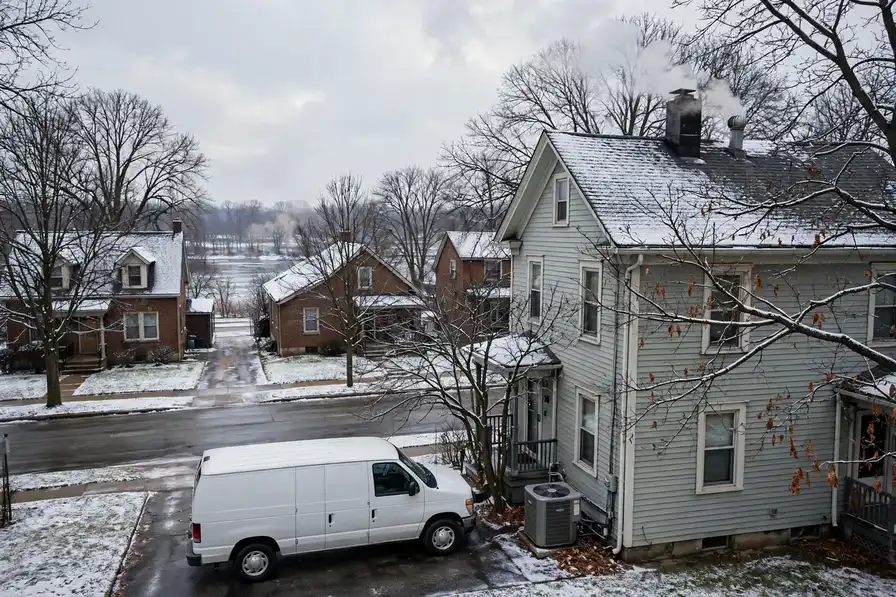


Everything on this page was computed for Green Bay and nowhere else: the problem ranking from its Census housing profile, the seasonal risks from its NOAA station record, the coverage from its own ZIP codes. TempReach USA connects you to an independent local HVAC technician; the page itself is the homework, done in public, so the call you make is an informed one.
Call center hours: Mon-Fri 7:00 AM-10:00 PM ET | Sat 8:00 AM-10:00 PM ET | Sun 7:00 AM-9:00 PM ET
The median Green Bay home was built in 1980; 50.3% of the stock predates 1980, and the pattern this metro's own data ranks first is the refrigerant transition reaching older systems. TempReach USA is a referral service, not an HVAC company: one call connects you with an independent local HVAC technician serving your ZIP code.
Start with the raw material: 329,375 people, 147,446 housing units, and a housing stock whose middle home was built in 1980. That single date organises everything on this page. On one side of it stand the older districts — 24.9% of homes predate 1960, 50.3% predate 1980 — heated and cooled by systems renewed in pieces for decades, in homes across Brown, Kewaunee, Oconto. On the other side, the 22.9% built since 2000 run matched modern equipment, and fail in the newer ways. A Green Bay technician reads a home's build year the way a doctor reads a chart: it predicts, before a single panel is opened, which systems deserve suspicion first.
The pre-1980 stock is where most of the metro's HVAC character lives. Homes from those decades in Brown County and across Brown, Kewaunee, Oconto were built with duct layouts from the first age of central systems, furnaces and condensers that have since been renewed piecemeal, and insulation standards from another era, and each of those choices is now at or beyond the age its makers expected of it. Owner-occupiers hold 68.3% of the metro's homes, so most of the people reading this page are reading about a system they own outright — one whose failures arrive as surprises only if nobody has looked at the pattern: cooling fading a little each summer, a furnace recovering a little more slowly, one room drifting a little further from the thermostat.
Growth wrote this metro's newest HVAC chapter in matched equipment and planned ducts: systems sized as a single design, controls by the catalogue, outdoor units placed by the plat across the subdivisions near De Pere and Howard. The chapter is young — its systems have decades in hand — but it is not exempt from the metro's arithmetic: 508 cooling degree days of demand work its condensers hard, and the winters test its heat pumps with the same cold that tests the oldest furnace in Brown County.
The climate written over all of it comes from the NOAA station at GREEN BAY, WI US: an average year brings 7,505 heating degree days, 508 cooling degree days and 31.61 inches of precipitation. Those are not abstractions to a furnace or a condenser — they set how many hours a heating system runs each winter, how hard a cooling system cycles in July, and how much moisture every coil has to pull out of the indoor air. The problem sections that follow are selected by exactly these numbers, combined with the housing-age profile above.
Housing eras and climate, joined — the two datasets every section of this page is built from.
Break the stock down by building era and the profile sharpens. Before 1960: 24.9% of homes, roughly 36,714 of them. From 1960 to 1979: 25.4%, about 37,451. From 1980 to 1999: 26.8%, about 39,516. Since 2000: 22.9%, about 33,765. Four eras, four equipment generations — and the balance among them is this metro's HVAC character in a single paragraph.
This metro's stock was mostly built in HVAC's transitional decades, 1980 to 1999, and it shows a particular failure calendar: not the deep-design sagas of the old metros, but the wear-out wave of everything installed in those years arriving together — capacitors, igniters, control boards, the first of the modern systems ageing into their verdicts. Green Bay's HVAC story for the next decade is largely written: it is the story of that installed base reaching its limits neighbourhood by neighbourhood.
The second band in the table is the 1960-1979 stock: 37,451 homes, 25.4% of the metro. It is the transition generation — cooling arriving, heating generations overlapping, ducts mixed street by street — and it supplies Green Bay with its most diagnostic HVAC: two homes of the same year needing opposite answers, decided by what the builder happened to specify.
A profile needs its climate column, and Green Bay's comes from GREEN BAY, WI US: an average year of 45.7 degrees, built from extremes at both ends. The heating load (7,505 degree days) and the cooling load (508) together set the system's working life; the precipitation total (31.61 inches) sets the moisture the cooling half must remove; the freeze count (152.3 nights) sets the stakes of every heating failure. Four numbers — and most of the metro's HVAC behaviour follows from them.
A profile is only useful if it predicts something, and this one predicts the shape of an HVAC diary in Green Bay: which streets will call about cooling, which about heating, which about airflow, and in which months. Everything after this section is that prediction written out as services, problems and answers — the numbers first, the narrative second, the way the evidence actually runs.
Listed in the order this metro's housing and climate data supports.
Warm air from the vents is a symptom with several authors — capacitor, charge, airflow, controls — and AC repair in Green Bay separates them by measurement at your unit, not by parts swapped on hope.
Ask what fills an AC repair diary in Green Bay and the answer is written in its housing. The median home was built in 1980, and a good share of the metro's cooling equipment is older than the homes' current owners realise — units sized for a different era of insulation, charged with refrigerant generations that have since been phased down. A system in Brown County that cools a little less each summer is telling a story in instalments, and the repair visit reads the whole story: pressures, airflow, the coil's condition, the duct losses behind the walls. With a median build year of 1980, most of the metro's 147,446 housing units are working through the same ageing curve.
Count the exposure from the Census side: a median build year of 1980 across 147,446 housing units means half the metro's air conditioners are older than the systems in the growth suburbs around De Pere, and summer runtime is the statistic that matters — the repair calls follow it street by street.
Furnaces rehearse their failures: second-attempt ignition, shortening cycles, a louder blower. In Green Bay those early signs are the cheapest version of the repair, caught while the house is still warm.
Furnace work in Green Bay is set by 7,505 heating degree days a year at GREEN BAY, WI US and 152.3 nights at or below freezing. The failures the season produces are the working parts wearing in sequence: igniters that have fired ten thousand times, blower motors tired from two seasons a year of duty — heating in winter, air handling in summer — heat exchangers stressed by decades of expansion and contraction. In the older districts, where 50.3% of the metro's homes predate 1980, many furnaces are replacements of replacements, fitted into ductwork older than the equipment itself. From De Pere to Howard, the pattern repeats wherever the housing era matches.
Heating demand in Green Bay concentrates where the cold does its work: 152.3 nights a year at or below freezing, against a housing stock whose median build year is 1980. Around Ashwaubenon as in the old core, that combination is not an abstraction — it is the street's furnaces, house by house.
Safety outranks repair, always. A gas smell or a carbon monoxide alarm means leaving the house and calling the utility or emergency services first — the repair visit comes after the house is safe to be in.
Preparation is the quiet half of emergency work in Green Bay, and it is written in the metro's figures: a housing stock of 147,446 units, median vintage 1980, spread over 30 ZIP codes, will produce its no-heat and no-cooling nights on a schedule the climate roughly predicts. The households that come through those nights with the least damage are rarely the lucky ones; they are the ones who know where the system's shutoffs and breakers are, keep the number where it can be found, and treat the system's small warnings — the odd noise, the short cycle, the room that drifts — as the appointments they were. Ask in Ashwaubenon and the answer rhymes with Green Bay: same eras, same equipment generations, same calendar of failures.
The emergency caseload is written in the extremes: 5.5 days of serious heat and 152.3 freezing nights a year, against systems whose median home was built in 1980. In Allouez as across the metro, the urgent calls arrive when the weather and the equipment's age meet.
Across Brown, Kewaunee, Oconto, the cleaning question is answered the same way — look inside first. From Green Bay out through the 30 ZIP codes covered, matted buildup and renovation debris make the case; a light film makes the case for waiting.
In Green Bay, the maintenance calendar writes itself from the climate: 7,505 heating degree days and 508 cooling degree days mean both systems work a real season, so the fall and spring visits each have genuine work to inspect.
From Green Bay to Ashwaubenon, Green Bay replacements routed through TempReach USA end in commissioning — measured charge and airflow — so the installed system matches the calculated one.
With 147,446 homes and a median build year of 1980, Green Bay heating stock spans every era of furnace and flue — each installation assessed on its own house, not on the outgoing unit's label.
Heat pump services in Green Bay test the whole year-round system: the independent local professional covering Brown, Kewaunee, Oconto reads charge and airflow in both modes, proves defrost, and checks auxiliary heat logic before quoting any work.
From period homes near Green Bay to newer builds toward Ashwaubenon, Green Bay's ductless projects serve the rooms central systems miss — additions, conversions and homes built without ductwork.
Across Brown, Kewaunee, Oconto, the housing split decides the starting point: older, leakier homes around Green Bay usually need filtration and moisture work first, while tighter newer builds in the 30 covered ZIP codes usually need deliberate ventilation most.
Across Brown, Kewaunee, Oconto, one climate fact shapes the configuration: 7,505 heating degree days against 508 cooling degree days tells whether the control's year is mostly a heating story, mostly a cooling story, or a genuine heat pump balancing act.
Across Brown, Kewaunee, Oconto, one climate ledger drives the calendar: 7,505 heating degree days and 508 cooling degree days mean roof units work both seasons hard, so the spring and fall visits each carry a full checklist here.
If this page's services were ranked by Green Bay's call patterns rather than listed in catalogue order, they would come out much as they do here — because the ranking behind them is data, not habit. The refrigerant transition reaching older systems leads the metro's problem table and furnace wear in hard cold follows, so the services answering them lead the list. The long tail of a metro's HVAC life — thermostat calls, duct questions, the one room that never matches the rest — fills in the diary around them, here as everywhere.
Ranked for this metro alone, from its Census housing profile and NOAA climate record.
A generation change is moving through Green Bay's cooling equipment, and it arrives one repair decision at a time. For decades, residential systems ran on R-22; production and import of that refrigerant ended in the United States in 2020, so the supply that remains is reclaimed stock, and servicing a leaking R-22 system means weighing a scarce, aging refrigerant against the age of the machine it serves. Newer systems moved to R-410A, and equipment now arriving uses lower-impact refrigerants such as R-454B, with their own handling and code requirements. The transition matters to a homeowner at specific moments: when an older system needs a charge, when a coil or compressor fails on a machine whose refrigerant is effectively retired, when a repair quote must be compared honestly against replacement. Nothing about it is a reason for panic — R-22 systems are not banned from being serviced — but every significant repair on one is now also a planning conversation, and households in Green Bay with equipment from the R-22 era benefit from having it before the hottest week, not during it.
The mechanics underneath the policy are simple. A refrigerant is the working fluid of the cooling cycle: it evaporates indoors to absorb heat and condenses outdoors to release it, thousands of times a season. Each generation of fluid was engineered to improve on the last one's environmental profile and operating pressures, and each required its own hardware — compressors built for different pressures, oils that mix with one fluid and not another, metering set for one fluid's characteristics. That is why the generations cannot be swapped like brands of the same product, and why 'topping up' an older system always means its own fluid, sourced from whatever supply its generation still commands. In Green Bay, where systems from all three generations stand in neighboring yards, the diversity is a service reality: diagnosis begins with identification, because the same symptom — a system low on charge — carries three different expense structures depending on the nameplate.
The regulatory facts are the foundation: R-22 production and import ended in the United States in 2020, leaving reclaimed stock as the supply, while new equipment has moved through R-410A to the current lower-impact generation. In Green Bay every generation still stands in service — the transition is not coming to this metro; it is distributed across it, yard by yard.
The no-heat call in deep cold has a recognizable biography in Green Bay. The furnace usually announced itself first: a startup that grew slower, a rattle at ignition, short runs that left the house short of the setting, a burner that lit with a sound it did not used to make. Cold weather raises the stakes of each symptom — a furnace cycling short in mild weather merely underheats; the same furnace in a hard freeze cannot hold the house at all, and the pipes in the exterior walls begin their own countdown. That is why technicians treat winter furnace symptoms as scheduling information rather than background noise: the system is filing its report early, and the household that books on the report rather than the failure chooses its own timing instead of the weather's.
Judge a furnace by its coldest week, not its kindest. In its coldest week a Green Bay furnace shows its true condition: whether it lights first time every time, whether it holds the house through the night without the temperature sagging, whether its sounds are the sounds it made when it was younger. GREEN BAY, WI US's record — 152.3 freezing nights in an average year — makes the examination annual and unsparing. Households that come through it without drama have usually done one unglamorous thing: they treated the autumn symptoms as the season's advance copy. A furnace rarely fails without having filed its intentions first, in a slower start, a louder cycle, a room that stopped keeping up. The winter merely publishes what the furnace had already written.
The timing testifies. Furnace failures in Green Bay concentrate in the coldest stretches of the 152.3 freezing nights GREEN BAY, WI US records — the failures follow the load curve, which is the signature of wear meeting demand rather than chance meeting a machine.
When heat does stop in a freeze, the household's first hour matters more than any other. The house's thermal mass buys time — hours, not days, in a hard Green Bay freeze — and the order of actions is worth knowing cold: confirm the system truly will not run through its simple causes, thermostat, breaker, filter, switch and fuel supply, because a share of no-heat calls end at one of those. Protect the water early where runs are exposed: taps on exterior walls dripping slowly, cabinet doors open to let room air reach the pipes, the vulnerable spaces given whatever warmth the home still holds. Know where the water main closes, before there is a reason to close it in the dark. And make the call promptly, describing the house's exposure honestly — a home with pipes in a crawl space and a falling thermometer is triaged differently from one that can coast until morning, and the call center can only sort by what it is told.
A freeze-call diagnosis runs triage first and depth second. The first questions sort the stop into its great families: no power or no call for heat; a safety lockout reporting itself through the board's codes; a fuel or ignition failure; a condensate or venting stop on high-efficiency equipment; a heat pump standing on failed auxiliary heat. Each family has a different restoration path and a different implication for how long the house will be cold. In the same visit, the freeze-specific checks ride along: the condensate drain's exposed run, the intake and exhaust terminations against snow and ice, the state of the spaces the pipes cross. Where restoration will take time, the professional's advice turns to the house itself — which water to shut, which taps to open, which rooms to close off and consolidate warmth in — because in a freeze the building is the second patient, and its treatment window is shorter than the equipment's.
The climate record is the whole brief: 152.3 nights a year at or below freezing and 7,505 heating degree days at GREEN BAY, WI US. In Green Bay, a heating failure is never only a heating failure in those weeks — it is a timed exposure for every pipe the heat was guarding, and the record brings the test back annually.
Living with a real winter, as Green Bay does, means the season has a shape: the first hard freeze finds the unprepared systems, mid-winter tests endurance — igniters, motors and sensors carrying months of cycles — and the late thaws reveal what the cold quietly damaged. Households that prove their heating in autumn and treat mid-season symptoms as scheduling information get through most winters with nothing dramatic to report; the drama concentrates, year after year, in the systems nobody ran until the night they were needed at full load.
The season loads Green Bay's systems the way its record at GREEN BAY, WI US says it will: 7,505 heating degree days against 508 cooling degree days in an average year, against a housing stock whose median build year is 1980. The households that read the season early — filters, drains, a system run before the extreme weeks — are the ones whose calls stay schedulable.
In Green Bay the transition's map is the housing map, lagged by one equipment generation. The districts built around Green Bay and the the 1980s streets hold the metro's R-22 veterans, in homes that have already seen one full cycle of this story when the equipment before them was young. The middle suburbs hold the R-410A majority. The 33,765 homes built since 2000 carry early current-generation systems now reaching the age where their first major repairs will be quoted — into a market whose standard has already moved on again. Read as a whole, the metro's 147,446 housing units contain the refrigerant industry's last several decades standing in rows, and the service economy of the metro is, in part, the business of keeping all those decades running at once. The deep pattern for a homeowner is simple to state and slow to change: your system's generation is a property of your street's building era, and its implications were installed with the house.
Read the ranking backwards and it reads as a data summary: 329,375 residents in 147,446 housing units, 24.9% of the housing from before 1960, 31.61 inches of rain in an average year. The pattern leads because the exposure is broad — counted not in individual unlucky houses but in whole eras of the metro's building, stacked one on another.
The first visit follows a short, diagnostic list — each item ruling a branch of the problem in or out:
PROBLEM SOLUTION
Population 106,585
Population 25,368
Population 20,261
Population 16,931
Population 16,255
Population 14,023
Population 13,003
Population 10,418
Population 4,623
Population 3,330
Population 3,219
Population 2,979
Also in the Green Bay metro: Kewaunee (population 2,824), Luxemburg (population 2,722).
Beyond Green Bay itself, the metro takes in De Pere (25,368 residents), Howard (20,261) and the rest of the communities in the grid above — each fitted with heating and cooling in its own building era, which is why two streets in the same metro can need entirely different HVAC conversations. The ZIP list below is the full coverage footprint: if your code is on it, this page was written about your housing stock.
Beyond the largest communities sit Ashwaubenon (16,931), Bellevue (16,255), Allouez (14,023), Suamico (13,003), Hobart (10,418) — smaller places across Brown, Kewaunee, Oconto, covered on the same terms. Their housing tends to be older on average than the big suburbs', and their calls follow the older patterns on this page. One routing covers them all: find your ZIP code below and the rest is a phone call.
Green Bay (106,585 residents) anchors the metro, and De Pere (25,368) is its second centre of gravity. Between them they hold the bulk of the 135,165 households — and, not coincidentally, the bulk of every housing era this page discusses, from the pre-1960 core to the newest subdivisions. Howard (20,261) and the communities beyond it repeat the same eras at smaller scale.
Draw the metro by its paperwork and it resolves into Brown, Kewaunee, Oconto — 3 jurisdictions sharing one housing stock and one weather system. Brown County holds the historic centre and the densest share of the older homes; the surrounding counties hold the rings of growth around it. Permits and inspections follow those boundaries even though temperature never does, which is part of why the technician this page connects you to works these streets specifically.
This page ends at the metro boundary, but the region does not: Appleton, WI, Oshkosh, WI and Milwaukee, WI continue the coverage in their own directions, each with a profile built from its own Census and NOAA figures. If your home sits near the line between metros, go by your ZIP code — it places you in the dataset that describes your housing.
Set Green Bay among its neighbours and the contrasts sharpen the profile: Appleton, WI — metro population 249,876, median build year 1980 — sits 38 miles away; Oshkosh, WI (174,218, median 1975) 57 miles; Milwaukee, WI (1,575,010, median 1966) 103 miles. Three different housing stocks under three nearby skies, which is why each keeps its own page and its own problem ranking rather than borrowing this one.
Count the metro per unit of itself: 4,915 housing units per covered ZIP code; 45,055 households per county; 14 communities sharing 3 county governments. Then weigh the generations against each other — 2.2 older homes for each newer one — and the service pattern on this page stops being a list and becomes a proportion: that much of the diary written by ageing systems, the rest by young ones wearing in.
Green Bay by the derived numbers — median home age 46 years · owners in 92,318 homes, renters in 42,847 · each covered ZIP code carrying about 1,224 pre-1960 homes · a heating-to-cooling degree-day ratio of 14.78 · 803 mm average annual rainfall.
County pages carry the local detail — land area, climate normals and the heating and cooling pressures on the ground in each county.
More plain-language help: the TempReach USA heating & cooling guides
Describe the problem and the call center routes you to an independent local HVAC technician who works in the Green Bay metro.
Call center hours: Mon-Fri 7:00 AM-10:00 PM ET | Sat 8:00 AM-10:00 PM ET | Sun 7:00 AM-9:00 PM ET