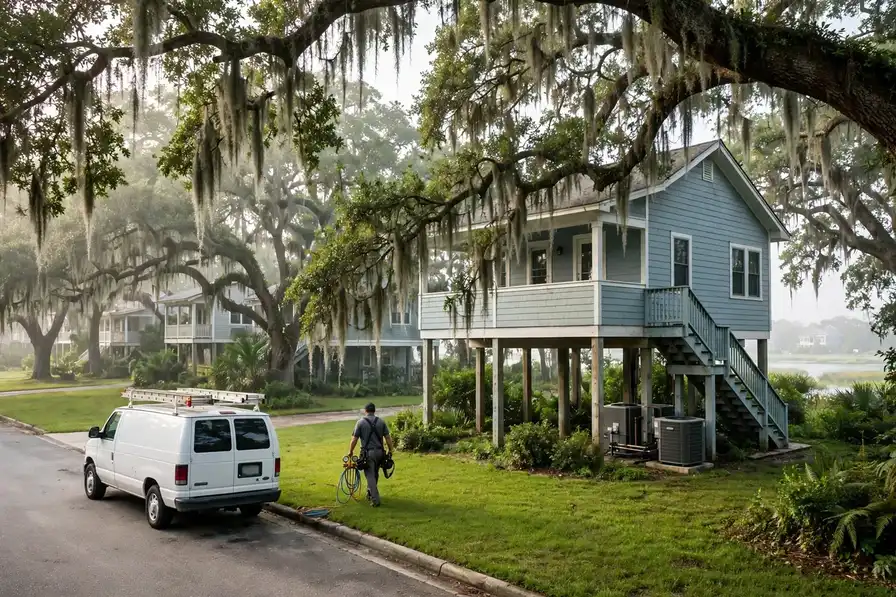


TempReach USA connects Daphne–Fairhope homeowners with independent local HVAC technicians. This page is built from the metro's own Census housing data, ZIP codes and climate record — the heating and cooling problems described here are the ones Daphne–Fairhope homes actually have.
Call center hours: Mon-Fri 7:00 AM-10:00 PM ET | Sat 8:00 AM-10:00 PM ET | Sun 7:00 AM-9:00 PM ET
The median Daphne–Fairhope home was built in 1998; 19.1% of the stock predates 1980, and the pattern this metro's own data ranks first is humidity burden on homes and cooling systems. TempReach USA is a referral service, not an HVAC company: one call connects you with an independent local HVAC technician serving your ZIP code.
Daphne–Fairhope is a metro of 239,945 people and 94,642 households, and its heating and cooling is a portrait of its building history. The median home here was built in 1998; 19.1% of homes predate 1980 and 5.4% predate 1960, while 45.3% have arrived since 2000. Every one of those eras heated and cooled differently — different furnaces, different duct designs, different refrigerant generations — and they fail differently, which is why this page is organised around the patterns the data actually produces in Daphne–Fairhope rather than HVAC in the abstract.
There is an equipment timeline buried in Daphne–Fairhope's housing figures, and it reads like a technician's diary. The 6,940 homes from before 1960 were heated first and cooled later, their ducts added around floor plans that never imagined them. The 17,607 that followed between 1960 and 1979 mixed those retrofits with the first planned central systems. Then came the 45,752 homes of 1980-1999, fitted with matched systems as standard. Each band of that timeline is now a band of characteristic failures, arriving in the order the equipment tires — which is why a home's build year, in this metro, is the single most predictive fact about its heating and cooling.
Growth wrote this metro's newest HVAC chapter in matched equipment and planned ducts: systems sized as a single design, controls by the catalogue, outdoor units placed by the plat across the subdivisions near Fairhope and Foley. The chapter is young — its systems have decades in hand — but it is not exempt from the metro's arithmetic: 2,193 cooling degree days of demand work its condensers hard, and the winters test its heat pumps with the same cold that tests the oldest furnace in Baldwin County.
The weather's part in this is written at FAIRHOPE 3 NE, AL US, where an average year carries 65.76 inches of precipitation, 47.0 days at ninety degrees or more and 29.7 nights at freezing or below. Systems experience that year as workload and as stakes in roughly equal measure — the workload in the run hours, the stakes on the single coldest night and the single hottest week. The problem ranking further down is simply the housing profile above, read under this sky.
Two public records, one metro: what was built here, and what the sky does to it.
Lay the eras side by side instead: 5.4% pre-1960 (6,940 homes), 13.7% from 1960-1979 (17,607), 35.6% from 1980-1999 (45,752), and 45.3% since 2000 (58,219). No single era tells the story — the proportions among them do, and those proportions are different in every metro this site covers.
New-stock metros have their own signature, and Daphne–Fairhope has it in full: most homes built since 2000, most systems young, most HVAC work a matter of waves — the condenser wave, the control-board wave, the first furnace questions — arriving street by street as identical subdivisions age in lockstep. The older pockets still produce the deepest single jobs, but the metro's HVAC centre of mass sits in its newest postcodes, and every year the waves get closer together.
The runner-up era is 1980-1999, with 35.6% of homes. That stock has left its carefree decades and entered its maintenance decades, and it shows in the call pattern around Fairhope and the other districts of those years: condensers on their second cycle, furnaces reaching their wear points together, ducts still young enough to reward attention over replacement.
The climate column of this profile is a workload statement. 1,800 heating degree days say how long the cold half of the year keeps furnaces and heat pumps working at their hardest; 2,193 cooling degree days say how relentlessly the hot half loads every condenser and coil; 29.7 freezing nights and 47.0 hot days mark the extremes where the failures concentrate. NOAA keeps these figures at FAIRHOPE 3 NE, AL US as thirty-year normals — which is to say, as the closest thing HVAC has to a settled forecast.
A profile is only useful if it predicts something, and this one predicts the shape of an HVAC diary in Daphne–Fairhope: which streets will call about cooling, which about heating, which about airflow, and in which months. Everything after this section is that prediction written out as services, problems and answers — the numbers first, the narrative second, the way the evidence actually runs.
Selected and ranked from this metro's housing-age profile and climate record — not copied from another city's page.
The condensate drain is the burden's ledger, and in a humid Daphne–Fairhope season it runs like a small stream. Every gallon down that drain is water the coil pulled from the indoor air — evidence the system is drying as well as cooling. When the drain slows or clogs, the evidence turns: pans fill, safety switches stop the system, and the moisture the coil collected finds its way back into the house's air and materials. Drain care is therefore not a footnote of humidity work but a central chapter: a clear, trapped, correctly sloped drain line is what lets the system's drying actually leave the building. Households in the metro's humid months who learn to check that one line know more about their system's real condition than the thermostat ever tells them.
Working a humidity complaint follows the water. The first measurements are indoor: relative humidity readings in several rooms, at several times, since a single reading at the thermostat flatters the story. The second look is at the equipment's drying setup — system size against the home's actual load, airflow across the coil, cycle length on a typical afternoon, and the condensate drain's condition and output. The third look is at the sources: crawl space or basement moisture, bathroom and kitchen exhausts that vent into attics instead of outdoors, plumbing weeping quietly somewhere, grade and gutters delivering rainwater to the foundation. Only then does the remedy conversation make sense, because each layer has its own remedy — equipment setup, dedicated dehumidification, ventilation correction, source control — and prescribing from one layer for a problem living in another is how humidity complaints survive multiple service visits.
The timing is the signature: humidity complaints in Daphne–Fairhope peak in the wet, saturated stretches rather than the hottest dry ones — the pattern of a moisture load, not a temperature load, announcing itself through the same equipment.
There is a daily rhythm to the complaint that helps diagnose it. Rooms that diverge mostly in the afternoon are reporting solar load and roof heat; rooms that diverge all day are reporting delivery; a house whose floors swap roles between summer and winter — upstairs hot in July, downstairs cold in January — is reporting stack effect and a single system asked to average two buildings' worth of physics. In Daphne–Fairhope all three rhythms run through the housing stock, sorted loosely by plan and era: the two-storey colonials of the growth decades, the sprawling single-level homes whose far wings were always a duct run too far, the renovated houses whose additions rewrote the load map without rewriting the network. Naming the rhythm correctly is most of the work; the remedy, once the name is right, is usually obvious to homeowner and technician alike.
Judge a multi-room home at its extremes, not at its thermostat. The thermostat sits, by convention, in the home's most average room, and it will report contentment while the nursery roasts and the end office freezes. The extremes are the system's true report card, and in Daphne–Fairhope they follow the climate record honestly: 47.0 hot days audit the upstairs, 29.7 freezing nights audit the far rooms over unheated spaces, and the household learns its home's real climate map from the rooms it avoids in each season. Homes whose extremes are comfortable have been sorted — by design, by correction or by dedicated equipment — and homes whose extremes are endured are carrying an unsorted map. The sorting is a solvable problem in essentially every case; what it cannot survive is being mistaken for an equipment failure and treated with a bigger version of the same single answer.
Look at the adaptation evidence in any affected Daphne–Fairhope home: the portable heater in the end room, the fan that lives in the upstairs hall, the bedroom doors propped for airflow. Households instrument this pattern with their own purchases long before anyone measures it — the adaptations are the data, waiting for a diagnosis.
The transition is, at bottom, a story about what is inside the pipes. A cooling system is not a generic appliance; it is built around a specific refrigerant, with a compressor, metering device and oils chosen for that chemistry, and the generations do not interchange. In Daphne–Fairhope all the generations are in service simultaneously — R-22 veterans in the older districts, R-410A systems across the middle decades, the newest refrigerant generation arriving in current installations — and a technician's van effectively serves three eras of the same trade at once. The homeowner's part in the story is knowledge of a single fact: which generation is in the backyard. That fact, readable from the nameplate, decides the economics of every leak, every charge and every major component from now on, and it is the first thing a good service conversation establishes.
A transition-aware service visit has a recognizable order. First, identification: the nameplate's refrigerant, model and year, stated aloud so the household and technician share the fact. Second, the leak question, taken seriously — a system low on charge has a leak until proven otherwise, and recharging without finding it is buying the same refrigerant twice on an installment plan. Third, the condition audit around the failure: compressor health, coil condition, electrical wear, because the decision the household faces is about the whole machine, not the one part that stopped. Fourth, the comparison itself, presented as what it is — the repair path with its realistic horizon, the replacement path with its — so the choice is made on the machine's merits and the household's plans for the home. In Daphne–Fairhope that conversation, held in a calm season, is unhurried and genuinely optional-feeling; held in a heat wave, the same facts arrive wearing a deadline.
The climate loads the stakes: a leaking system in Daphne–Fairhope underperforms through 47.0 days a year at 90 degrees or more at FAIRHOPE 3 NE, AL US, so the household pays the transition's toll twice — in refrigerant and in lost cooling — until the underlying decision is made.
What the shoulders reward is a habit of finishing seasons properly. The last cold week is the time to note the heating system's report card while it is still legible; the last hot week, the cooling system's. Between them sits a window — mild days, an unhurried diary for local technicians, a system that can be opened and tested without the household depending on it that night — that neither deep season gives. In Daphne–Fairhope that window opens twice a year on a climate of 47.0 hot days and 29.7 freezing nights, and the households that use it convert the two most failure-prone transitions of the year into the two calmest appointments on their calendar.
The season loads Daphne–Fairhope's systems the way its record at FAIRHOPE 3 NE, AL US says it will: 1,800 heating degree days against 2,193 cooling degree days in an average year, against a housing stock whose median build year is 1998. The households that read the season early — filters, drains, a system run before the extreme weeks — are the ones whose calls stay schedulable.
There is a final depth to the pattern: humidity taxes the cooling system itself. A coil spending its capacity on water is a coil with less capacity for temperature, so in Daphne–Fairhope's humid months the effective size of every system shrinks exactly when the load peaks. Run times stretch, wear accumulates, and the strain story of the hot season is partly a moisture story in disguise. The condensate that leaves through the drain is capacity spent invisibly; the comfort that households feel is what remains. That is why experienced local practice treats a humidity complaint as system information rather than a comfort preference — the sticky house is reporting a load its equipment was never explicitly sized for, and the report deserves the same seriousness as a noise or a stop. The number that settles it is a humidity reading; everything before that number is weather talk.
The numbers underneath it, for Daphne–Fairhope: 128,518 housing units, a median build year of 1998, and a climate record at FAIRHOPE 3 NE, AL US of 1,800 heating degree days against 2,193 cooling degree days. Cross the housing record with the weather record and this pattern is what falls out at the top — rarely the most dramatic problem in heating and cooling, but the one this metro's stock and climate manufacture most steadily.
Experienced local practice starts with the simple certainties — the observations that take minutes and decide the most:
Sequenced by this metro's own problem ranking, not by a national catalogue order.
Moisture cuts both ways. Too little through a heating season cracks wood and dries airways; too much through a cooling season feeds what grows in damp corners. Whole-home control aims at the moving middle, set against the weather outside.
Across Daphne–Fairhope's 94,642 households, the air quality diary follows the building map. The tight new subdivisions near Fairhope ask about ventilation and the chemistry of new materials; the the 1990s districts ask about dust, infiltration and the crawl spaces under raised floors; the households in between ask about allergies in the pollen months. One service name, three different sciences — which is why the visit begins with questions about the house and the people in it, not with a product sheet. It is why two Daphne–Fairhope homes of the same age, on different streets, so often need the same visit in the same year.
Air quality demand in this metro is written by its sealed seasons: 47.0 hot days with the windows shut around the cooling, 29.7 freezing nights with them shut around the heat. The 58,219 post-2000 homes hold their air tightest; the older districts around Fairhope exchange theirs with attics and crawl spaces.
Multi-zone arithmetic matters in Daphne–Fairhope: outdoor capacity is shared among indoor units, so the design is reasoned around the household's real hours, not around every room at full demand at once.
Ductless work in Daphne–Fairhope also follows the housing nobody else can easily serve: the historic core around Daphne, where walls were never built for ducts, and the accessory dwellings and in-law spaces appearing across Baldwin. Each installation is a small design project — line-set routes, condensate paths, the outdoor unit's placement — fitted to a building that predates the very idea of central air. Done well, the result is the quietest heating and cooling in the house. Locally the workload concentrates where the stock is oldest — the districts built around the 1990s first.
Scale the question by the Census count and it stays concrete: 128,518 housing units, a share of them holding rooms — additions, conversions, finished spaces — that no duct serves. The mini-split visit exists to give one of those rooms its own climate, sized to its exposure and use.
Ice on the line, a tripping breaker, run times that lengthen week by week — in Daphne–Fairhope these are the early chapters of a cooling failure, and a diagnosis caught at that stage is usually a component, not a system.
Air conditioning in Daphne–Fairhope works against the local calendar: 2,193 cooling degree days a year at FAIRHOPE 3 NE, AL US, with 47.0 days at 90 degrees or more. The failures follow that load — capacitors and contactors worn by relentless summer cycling, refrigerant charges drifting low on systems that have served a decade of heat, condensate drains clogging in the humid weeks. The older districts run the oldest condensers; the subdivisions around Daphne run matched fleets installed in the same seasons, and both sides of the metro meet the repair call on the hottest week of the year. Ask in Gulf Shores and the answer rhymes with Daphne: same eras, same equipment generations, same calendar of failures.
The local caseload behind this service is written in the climate figures: 2,193 cooling degree days a year and 47.0 days at 90 or above, pressing on a cooling fleet whose oldest members serve the 24,547 pre-1980 homes — in Orange Beach (8,244 residents) as much as in the oldest districts.
Across Baldwin, the cleaning question is answered the same way — look inside first. From Daphne out through the 23 ZIP codes covered, matted buildup and renovation debris make the case; a light film makes the case for waiting.
From Daphne to Gulf Shores, Daphne–Fairhope replacements routed through TempReach USA end in commissioning — measured charge and airflow — so the installed system matches the calculated one.
Across 23 ZIP codes, Daphne–Fairhope heating stock reflects a median build year of 1998 — furnaces at every age, each diagnosed on its own sequence and condition rather than its birthday.
With 128,518 homes and a median build year of 1998, Daphne–Fairhope heating stock spans every era of furnace and flue — each installation assessed on its own house, not on the outgoing unit's label.
Across 23 ZIP codes and housing from a median build year of 1998, Daphne–Fairhope heat pumps are specified and serviced from heat-loss figures and low-temperature performance data, not nominal tonnage.
Across Baldwin, one climate fact shapes the configuration: 1,800 heating degree days against 2,193 cooling degree days tells whether the control's year is mostly a heating story, mostly a cooling story, or a genuine heat pump balancing act.
Across Baldwin, the service record is the scarcest asset: with a median build year of 1998 across 128,518 homes, many systems around Daphne have no documented history — and a first tune-up's baseline is what every later decision stands on.
Across Baldwin, the local professional who answers knows the stock — a median build year of 1998 across 128,518 homes means systems of every age failing in their characteristic ways, from Daphne to the metro's newest subdivisions.
Daphne–Fairhope's commercial buildings span every era around a median build year of 1998 — and with the era goes the equipment, from aging single units over old storefronts to multi-zone systems in new developments, all serviced from a per-unit record.
Two patterns generate most of the bookings behind the services above: Humidity burden on homes and cooling systems and uneven temperatures and airflow across the house. That is why the order of this page's service list is what it is — the services answering those patterns come early, and the rest follow in the order the metro's data supports. A homeowner whose home matches the local profile — built in the metro's big decades, in one of its older districts — is, statistically, reading their own shortlist.
PROBLEM SOLUTION
Population 28,673
Population 23,360
Population 22,330
Population 15,785
Population 10,377
Population 8,244
Population 8,215
Population 6,985
Population 4,029
Population 3,094
Population 2,606
Population 2,209
Also in the Daphne–Fairhope metro: Lillian (population 1,889), Point Clear (population 1,858).
The communities in the grid are not suburbs of the page; they are its subject as much as Daphne is. Fairhope (23,360 residents) and Foley (22,330) carry their own building decades, their own equipment generations and their own positions in the problem ranking's logic — a system under a Fairhope roof answers to the same data as one in the centre, but to a different era of it. Coverage here is defined by the ZIP list below; understanding is defined street by street, and this page's figures are the metro-wide version of a story each community tells in its own numbers.
The map continues: Gulf Shores (15,785), Spanish Fort (10,377), Orange Beach (8,244), Bay Minette (8,215), Robertsdale (6,985). Different names, different decades — each community in Baldwin was fitted with heating and cooling in its own growth years, which is why two streets in the same metro can need entirely different HVAC conversations. The ZIP list below is the working definition of coverage; the housing behind each code is the working definition of the job.
Start with Daphne itself: 28,673 residents, 11.9% of the metro — the centre the rest of the map orbits. Fairhope (23,360) and Foley (22,330) form the next ring out, housing with its own building decades and its own equipment generations. Beyond them the metro thins into the smaller communities in the grid above, each a few thousand households deep — small in population, identical in one respect: their systems answer to the same eras and the same weather as the big city's.
Draw the metro by its paperwork and it resolves into Baldwin — 1 jurisdictions sharing one housing stock and one weather system. Baldwin County holds the historic centre and the densest share of the older homes; the surrounding counties hold the rings of growth around it. Permits and inspections follow those boundaries even though temperature never does, which is part of why the technician this page connects you to works these streets specifically.
Three neighbouring coverage areas begin where this one ends: Mobile, AL, some 27 miles off; Montgomery, AL, 142 miles; and Dothan, AL, 142 miles. Each keeps its own page because each keeps its own numbers — a different median build year, a different climate station, a different problem ranking. Boundary households should trust the ZIP list over the map: the code, not the compass, assigns the dataset.
The region around Daphne–Fairhope is a set of variations on its theme: Mobile, AL, 27 miles off, runs a median build year of 1979 on a metro population of 411,658; Montgomery, AL (142 miles) medians 1985 on 388,747; Dothan, AL (142 miles) medians 1983 on 156,266. Nearness is not sameness — a few decades of median build year separate their heating and cooling as surely as the miles separate their maps.
Count the metro per unit of itself: 5,588 housing units per covered ZIP code; 94,642 households per county; 14 communities sharing 1 county governments. Then weigh the generations against each other — 0.4 older homes for each newer one — and the service pattern on this page stops being a list and becomes a proportion: that much of the diary written by ageing systems, the rest by young ones wearing in.
Daphne–Fairhope by the derived numbers — median home age 28 years · owners in 73,348 homes, renters in 21,294 · each covered ZIP code carrying about 302 pre-1960 homes · a heating-to-cooling degree-day ratio of 0.82 · 1,670 mm average annual rainfall.
County pages carry the local detail — land area, climate normals and the heating and cooling pressures on the ground in each county.
More plain-language help: the TempReach USA heating & cooling guides
Describe the problem and the call center routes you to an independent local HVAC technician who works in the Daphne–Fairhope metro.
Call center hours: Mon-Fri 7:00 AM-10:00 PM ET | Sat 8:00 AM-10:00 PM ET | Sun 7:00 AM-9:00 PM ET