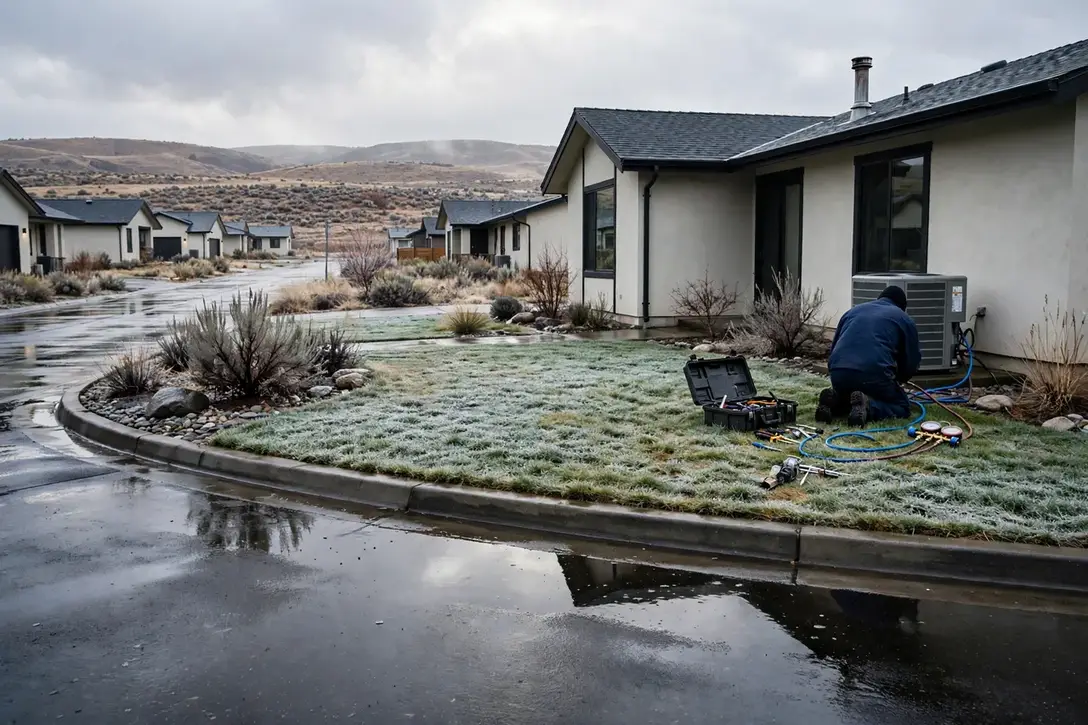


Everything on this page was computed for Kennewick and nowhere else: the problem ranking from its Census housing profile, the seasonal risks from its NOAA station record, the coverage from its own ZIP codes. TempReach USA connects you to an independent local HVAC technician; the page itself is the homework, done in public, so the call you make is an informed one.
Call center hours: Mon-Fri 7:00 AM-10:00 PM ET | Sat 8:00 AM-10:00 PM ET | Sun 7:00 AM-9:00 PM ET
The median Kennewick home was built in 1990; 43.0% of the stock predates 1980, and the pattern this metro's own data ranks first is the refrigerant transition reaching older systems. TempReach USA is a referral service, not an HVAC company: one call connects you with an independent local HVAC technician serving your ZIP code.
Two numbers frame everything that follows: 68.9% of Kennewick homes are owner-occupied, and the median one was built in 1990. Ownership matters to HVAC because owners inherit their systems whole — every equipment decision a builder made in the 1990s or earlier is still in the attic, the closet and the side yard, ageing on its original schedule. With 43.0% of homes predating 1980 and 36.2% arriving since 2000, the metro is really two housing stocks sharing one map, and they are taken separately below before the problems are ranked.
Ask how Kennewick's older homes have been kept comfortable and the honest answer is: in pieces. A furnace here, a condenser there, one room's ducts renewed while the rest of the system carries on — across 48,280 pre-1980 homes, the patchwork is the norm rather than the exception. That history is written in the attics of Benton County and everywhere else the early stock stands: systems that are part original, part renewed, and entirely individual. It is also why the guidance on this page keeps returning to patterns rather than single faults — in a patchwork system, the pattern is the diagnosis.
The newer side of Kennewick — the 36.2% of homes built since 2000, concentrated around growing communities like Kennewick — runs on matched modern systems that age more gracefully but fail in their own ways: heat pumps and condensers worked hard by 788 cooling degree days of hot-season demand, control boards and sensors wearing out in houses that all reach the same age at the same time. One metro, two equipment generations, and the sections below take them in the order this metro's data ranks them.
Over everything sits the weather, and here it is measured rather than described: NOAA's station at PASCO TRI CITIES AP, WA US averages 53.3 degrees across the year, with 54.7 days reaching 90 or more and 112.3 nights at freezing or below. A furnace feels that record as a season of relentless cycling; a condenser feels it as a summer without a quiet week; a heat pump feels both. The problem ranking below is what those numbers, crossed with the housing profile, produce for Kennewick specifically.
Housing eras and climate, joined — the two datasets every section of this page is built from.
The distribution, in one breath: of every hundred Kennewick homes, 18.0 were standing before 1960, 25.0 went up in the two decades after, 20.8 in the two after that, and 36.2 have arrived since 2000. Percentages flatten the picture, so hold the counts beside them — 20,210 oldest-era homes, 40,645 newest — and the metro's heating and cooling stops being an abstraction: it is that many systems, of those ages, failing in that order.
Growth is the headline in Kennewick: the post-2000 band is the largest, much of it subdivisions fitted with matched modern systems and ductwork designed as a single plan. The work here is young-stock work — first replacements arriving in waves as whole streets age together, heat pumps standard where their neighbours have furnaces, controls and sensors failing in preference to iron. The metro's older pockets still generate the deep problems, but the volume of its HVAC future is being written in the new subdivisions.
Close behind the leader come the 1960-1979 homes, 25.0% of the stock. Their systems are mid-change by construction — the decades when cooling spread mid-stream — so this band is where a Kennewick technician earns the diagnostic fee: airflow readings and pressure tests that say which side of the transition a given house was built on.
Kennewick's weather, reduced to what a system experiences: 54.7 hot days a year loading the cooling, 112.3 freezing nights loading the heating, and 7.62 inches of rain feeding the humidity both seasons complain about. NOAA's normals at PASCO TRI CITIES AP, WA US — 5,011 heating degree days, 788 cooling degree days — are the long average of that experience, and they are why this metro's problem list is not interchangeable with a milder or harsher metro's.
A profile is only useful if it predicts something, and this one predicts the shape of an HVAC diary in Kennewick: which streets will call about cooling, which about heating, which about airflow, and in which months. Everything after this section is that prediction written out as services, problems and answers — the numbers first, the narrative second, the way the evidence actually runs.
Chosen by this metro's own housing and weather data — the same two records this whole page is built from.
There is a paperwork side to the transition that touches Kennewick homes quietly. Refrigerant work is regulated work: recovery, handling and record-keeping rules apply to whoever services a system, and the newest refrigerants — mildly flammable by classification — arrive with their own sensors, labeling and code provisions that installers must follow. For the homeowner the visible part is small: a nameplate with a different designation, a technician explaining why a charge is measured and documented as it is, an installation that includes leak-detection provisions the older system never had. The invisible part matters more over time: as the newest generation becomes the metro's standard, parts, training and service practice consolidate around it, and the older generations become the specialty work. Owning an older-generation system is not a fault — but its service ecosystem is, year by year, becoming a smaller room.
A transition-aware service visit has a recognizable order. First, identification: the nameplate's refrigerant, model and year, stated aloud so the household and technician share the fact. Second, the leak question, taken seriously — a system low on charge has a leak until proven otherwise, and recharging without finding it is buying the same refrigerant twice on an installment plan. Third, the condition audit around the failure: compressor health, coil condition, electrical wear, because the decision the household faces is about the whole machine, not the one part that stopped. Fourth, the comparison itself, presented as what it is — the repair path with its realistic horizon, the replacement path with its — so the choice is made on the machine's merits and the household's plans for the home. In Kennewick that conversation, held in a calm season, is unhurried and genuinely optional-feeling; held in a heat wave, the same facts arrive wearing a deadline.
The regulatory facts are the foundation: R-22 production and import ended in the United States in 2020, leaving reclaimed stock as the supply, while new equipment has moved through R-410A to the current lower-impact generation. In Kennewick every generation still stands in service — the transition is not coming to this metro; it is distributed across it, yard by yard.
The rooms tell the story before any instrument does. In a Kennewick home with tired ductwork, the pattern is geographic: the rooms nearest the air handler are comfortable, the far rooms lag, and the rooms over the longest or leakiest runs barely participate. Households adapt without noticing — a fan in the far bedroom, a space heater in the end office — treating as architecture what is actually plumbing for air. Duct runs installed in the metro's big building decades have now spent years in attic heat and crawl-space damp; flex sections sag, inner liners tear, and connections at the plenum work loose a fraction with every season's expansion and contraction. The equipment cycles faithfully and the house still under-delivers, because a system can only condition the air that actually arrives.
Read a duct system the way a technician does and the examination has a shape: start at the air handler and work outward. At the plenum, connections are inspected where they are most stressed and most consequential. Along the runs, the checks are for the known failure family — separated joints, fallen insulation, sagging flex, crushed sections, takeoffs that were sealed with hope rather than mastic. At the registers, temperatures and airflow are compared room by room, and the map of strong and weak rooms is laid over the map of the runs themselves; the two maps explain each other with remarkable consistency. Returns get the same walk, with attention to panned cavities and any path that lets the system breathe from outside the envelope. Cleaning belongs in this picture where the inspection finds accumulation — but cleaning a leaking network without sealing it polishes the inside of a system that is losing its cargo through the walls.
Consider the delivery assumption: every system in Kennewick was sized on the expectation that its air would arrive. With 43.0% of homes built before 1980 — and their networks renovated, extended and re-sealed by turns ever since — that expectation's reliability varies house by house, which is why the measurement, not the assumption, has to govern.
The physics of the complaint are stacked against the single-thermostat house. Warm air rises, so a second storey collects the first floor's heat all day and adds its own roof load on top; in a Kennewick summer, the upstairs of a two-storey home is simply a hotter building than its ground floor, served by the same machine. Duct design compounds it: runs to the far and upper rooms are the longest, the most jointed and the first to lose pressure, so the rooms with the greatest need often receive the least delivery. Households compensate in the classic ways — closing registers downstairs to push air up, which raises system pressure and can harm the equipment, or overcooling the whole house to satisfy its warmest room, paying to refrigerate satisfied rooms as the toll for one comfortable room. The complaint persists because its cause is structural; it yields to structural answers.
Airflow is the substrate everything else stands on, and its rules are unforgiving. A blower moves a volume of air against the network's resistance; lengthen a run, crush a section, close registers, or clog the path and the volume redistributes itself according to physics, not intention — favoring short, wide, open paths and starving long ones. Balancing is the craft of arranging that redistribution deliberately: damper positions, register adjustment, return paths sized for the supply they serve. In a Kennewick home the balance drifts over the years as filters load, furniture rearranges the rooms' air, renovations close paths that used to be open, and duct sections sag or separate. A system can therefore be out of balance without anything being broken — which is both the good news and the diagnostic difficulty, since the remedy is a methodical walk of the whole network rather than a replaced part.
Look at the adaptation evidence in any affected Kennewick home: the portable heater in the end room, the fan that lives in the upstairs hall, the bedroom doors propped for airflow. Households instrument this pattern with their own purchases long before anyone measures it — the adaptations are the data, waiting for a diagnosis.
Twice a year, Kennewick changes its mind. The shoulder seasons — the weeks when a house can need heating in the morning and cooling by afternoon, sometimes within the same day — ask more of a system and its household than either deep season does: both modes in working order at once, controls set for change rather than for a settled pattern, and equipment that may sit idle for stretches and then be called on without ceremony. The record at PASCO TRI CITIES AP, WA US frames the workload honestly — 5,011 heating degree days against 788 cooling degree days, a genuinely two-season climate — and the shoulders are where the two halves meet and negotiate. The checks that matter are changeover checks: the season just ending reviewed for what it spent — the filter, the wear items, the symptoms it filed — and the season arriving proven before it is needed, with a full run in the new mode while the weather is still forgiving. The thermostat's program belongs in the same check; last season's schedule, carried forward unexamined, is how a house ends up heating against an open-window afternoon. Households that treat the shoulders as their maintenance seasons get two calm, well-timed looks at their system a year — which is exactly the rhythm the equipment's manufacturers had in mind.
The season loads Kennewick's systems the way its record at PASCO TRI CITIES AP, WA US says it will: 5,011 heating degree days against 788 cooling degree days in an average year, against a housing stock whose median build year is 1990. The households that read the season early — filters, drains, a system run before the extreme weeks — are the ones whose calls stay schedulable.
In Kennewick the transition's map is the housing map, lagged by one equipment generation. The districts built around Kennewick and the the 1990s streets hold the metro's R-22 veterans, in homes that have already seen one full cycle of this story when the equipment before them was young. The middle suburbs hold the R-410A majority. The 40,645 homes built since 2000 carry early current-generation systems now reaching the age where their first major repairs will be quoted — into a market whose standard has already moved on again. Read as a whole, the metro's 112,280 housing units contain the refrigerant industry's last several decades standing in rows, and the service economy of the metro is, in part, the business of keeping all those decades running at once. The deep pattern for a homeowner is simple to state and slow to change: your system's generation is a property of your street's building era, and its implications were installed with the house.
Strip the pattern down to its inputs and the ranking stops being mysterious: 105,814 households depending on systems installed across a median build year of 1990, in a climate that swings between 54.7 days of serious heat and 112.3 freezing nights. Whatever pattern a metro with those inputs manufactures most, it manufactures here — the lead position is less a title than a consequence, recalculated from the same public records any sceptic can check.
Experienced local practice starts with the simple certainties — the observations that take minutes and decide the most:
Ordered by what this metro's data says its homes need most.
Ice on the line, a tripping breaker, run times that lengthen week by week — in Kennewick these are the early chapters of a cooling failure, and a diagnosis caught at that stage is usually a component, not a system.
One more pattern belongs in the Kennewick picture: repair calls here are also a refrigerant story. Systems fitted in the older decades run on refrigerant generations the industry has been retiring, and every repair on those units weighs the charge's scarcity against the system's remaining life. The technician who explains that arithmetic plainly — what the repair restores, what it cannot assure anyone about next summer — is giving the household the real choice, and in the 48,280 pre-1980 homes it is a conversation held weekly. The 7.62 inches of rain in an average year here is part of the story too — humidity loads every cooling coil in the metro.
The local caseload behind this service is written in the climate figures: 788 cooling degree days a year and 54.7 days at 90 or above, pressing on a cooling fleet whose oldest members serve the 48,280 pre-1980 homes — in Pasco (78,446 residents) as much as in the oldest districts.
The evidence lives in the returns. Matted dust, debris from construction, hair woven into the load: that is the case for cleaning, made by the ductwork itself. A light film in a tidy system is the case for waiting, and an honest visit says so.
Duct cleaning in Kennewick is booked in waves that follow the housing: after the renovation seasons in the older districts, at move-in across the subdivisions, alongside system replacements everywhere. The work pairs naturally with the inspection that surrounds it — leaking joints found and sealed, a disconnected run in an attic discovered, insulation fallen where it should not be. The cleaning is the appointment; the findings are often the value. That is the daily reality for the 105,814 households spread across Benton, Franklin.
Duct demand concentrates in the metro's long-biography homes: 48,280 pre-1980 systems that have carried decades of household air, and the renovated homes around West Richland (17,126 residents) whose construction dust is still in the runs.
The maintenance rhythm is light but real — washable filters rinsed on cycle, drains checked before they drip — and Kennewick handovers demonstrate it unit by unit rather than mentioning it in passing.
Ductless systems find their Kennewick homes where ductwork never went: the older districts' additions and converted spaces, the pre-1960 homes — 18.0% of the metro — built around boilers or gravity heat, the workshops and finished basements of the growth suburbs. A mini-split heats and cools a defined space without asking the house to grow ducts, which is why the assessment starts with the space itself: its exposure, its insulation era, how it is actually used across 54.7 hot days and the winter's coldest weeks. It is why two Kennewick homes of the same age, on different streets, so often need the same visit in the same year.
The search territory for ductless is the metro's unducted stock: 20,210 pre-1960 homes built before central systems, plus the additions and conversions scattered through 105,814 households — in Finley and the historic core alike, spaces the main system never reached.
In Kennewick, the maintenance calendar writes itself from the climate: 5,011 heating degree days and 788 cooling degree days mean both systems work a real season, so the fall and spring visits each have genuine work to inspect.
In Kennewick, emergency means weather-relative: 5,011 heating degree days put no-heat calls on a freezing clock each winter, while 788 cooling degree days make a dead system a health question each summer — the call center triages against both, using the hours shown on this page.
From Kennewick to West Richland, Kennewick replacements routed through TempReach USA end in commissioning — measured charge and airflow — so the installed system matches the calculated one.
Furnace repair in Kennewick follows the sequence: the independent local professional covering Benton, Franklin watches your furnace attempt a start, tests the stage that failed, and quotes before work begins.
Heating installation in Kennewick starts with a heat-loss calculation across Benton, Franklin: the independent local professional measures the home's loss, inspects ducts and venting, and quotes the full scope before work begins.
Heat pump services in Kennewick test the whole year-round system: the independent local professional covering Benton, Franklin reads charge and airflow in both modes, proves defrost, and checks auxiliary heat logic before quoting any work.
In Kennewick, air work follows the climate ledger: 5,011 heating degree days dry the indoor air out each winter while 788 cooling degree days load it with humidity each summer — most homes here need the humidity answer in both directions across the year.
In Kennewick, the thermostat question splits by housing era: homes from around the median build year of 1990 often lack a common wire in the wall, while newer builds across the 16 covered ZIP codes usually carry one — the local professional checks the cable before choosing the control.
In Kennewick, commercial work follows the stock: 112,280 housing units' worth of mixed buildings — offices, retail and restaurants from Kennewick across the 16 covered ZIP codes — each with rooftop units whose service rhythm the local professional sets per building.
Ask where this metro's HVAC diary fills up and the answer is a short story: The refrigerant transition reaching older systems first, leaky ducts losing air and energy close behind, and the services that answer them doing the bulk of the booked work. Everything else on the list above is the supporting cast — necessary, frequent enough, but not what Kennewick's housing stock, at its age and in its climate, principally demands. Read the service list as a weather report for the metro's systems and it stops looking like a catalogue.
PROBLEM SOLUTION
Population 84,389
Population 78,446
Population 61,912
Population 17,126
Population 6,213
Population 5,734
Population 5,080
Population 3,559
Population 1,527
Population 1,157
Population 631
Population 453
Also in the Kennewick metro: Kahlotus (population 171).
Beyond Kennewick itself, the metro takes in Pasco (78,446 residents), Richland (61,912) and the rest of the communities in the grid above — each fitted with heating and cooling in its own building era, which is why two streets in the same metro can need entirely different HVAC conversations. The ZIP list below is the full coverage footprint: if your code is on it, this page was written about your housing stock.
Also on the Kennewick map: West Richland (17,126), Prosser (6,213), Finley (5,734), Connell (5,080), Benton City (3,559) — communities spread across Benton, Franklin, each with housing from its own growth years. A technician routed through TempReach USA to any of them is working from this same page: the metro data does not change at the city limit, but the housing on your street — its age, its equipment, its attic — is what the visit is really about.
Every metro has a first city and a supporting cast, and the census figures draw the billing plainly here: Kennewick first, with 84,389 residents; Pasco second at 78,446; Richland third at 61,912; then the long tail of smaller communities in the grid above. The billing matters less than the building dates — each of these places was fitted with heating and cooling in its own decade, by its own builders — but between them they account for nearly every housing era, equipment generation and failure pattern this page describes.
Draw the metro by its paperwork and it resolves into Benton, Franklin — 2 jurisdictions sharing one housing stock and one weather system. Benton County holds the historic centre and the densest share of the older homes; the surrounding counties hold the rings of growth around it. Permits and inspections follow those boundaries even though temperature never does, which is part of why the technician this page connects you to works these streets specifically.
This page ends at the metro boundary, but the region does not: Yakima, WA, Spokane, WA and Seattle, WA continue the coverage in their own directions, each with a profile built from its own Census and NOAA figures. If your home sits near the line between metros, go by your ZIP code — it places you in the dataset that describes your housing.
The region around Kennewick is a set of variations on its theme: Yakima, WA, 73 miles off, runs a median build year of 1976 on a metro population of 259,185; Spokane, WA (134 miles) medians 1978 on 608,012; Seattle, WA (150 miles) medians 1985 on 4,161,883. Nearness is not sameness — a few decades of median build year separate their heating and cooling as surely as the miles separate their maps.
Count the metro per unit of itself: 7,018 housing units per covered ZIP code; 52,907 households per county; 13 communities sharing 2 county governments. Then weigh the generations against each other — 1.2 older homes for each newer one — and the service pattern on this page stops being a list and becomes a proportion: that much of the diary written by ageing systems, the rest by young ones wearing in.
One line of Kennewick arithmetic — a median home 36 years old · 72,906 owner-occupied homes against 32,908 renter-occupied · 1,263 pre-1960 homes for every covered ZIP code · a heating-to-cooling degree-day ratio of 6.36 · 194 mm of rain in an average year.
County pages carry the local detail — land area, climate normals and the heating and cooling pressures on the ground in each county.
More plain-language help: the TempReach USA heating & cooling guides
TempReach USA routes your call to an independent local heating and cooling professional serving Kennewick — the assessment and the work are theirs.
Call center hours: Mon-Fri 7:00 AM-10:00 PM ET | Sat 8:00 AM-10:00 PM ET | Sun 7:00 AM-9:00 PM ET