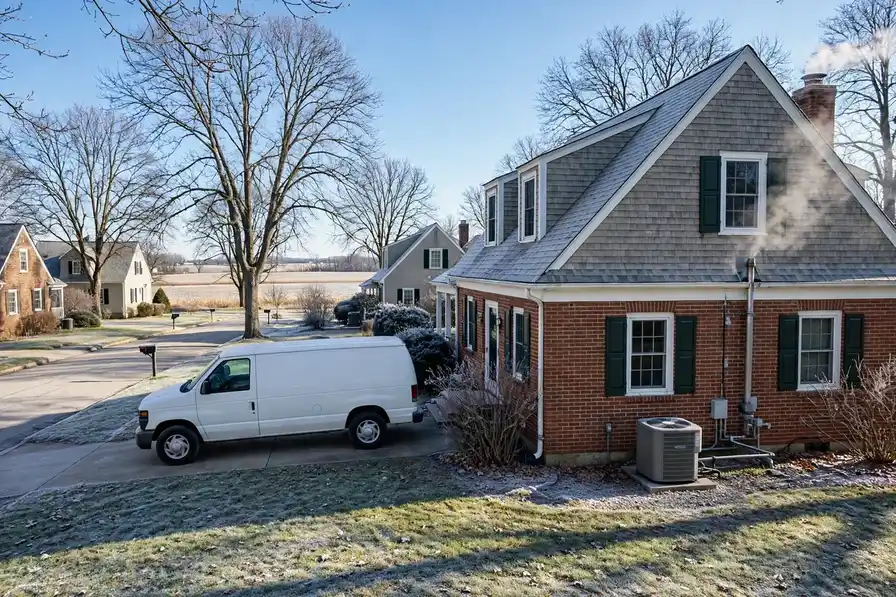


Everything on this page was computed for Terre Haute and nowhere else: the problem ranking from its Census housing profile, the seasonal risks from its NOAA station record, the coverage from its own ZIP codes. TempReach USA connects you to an independent local HVAC technician; the page itself is the homework, done in public, so the call you make is an informed one.
Call center hours: Mon-Fri 7:00 AM-10:00 PM ET | Sat 8:00 AM-10:00 PM ET | Sun 7:00 AM-9:00 PM ET
The median Terre Haute home was built in 1969; 63.4% of the stock predates 1980, and the pattern this metro's own data ranks first is the refrigerant transition reaching older systems. TempReach USA is a referral service, not an HVAC company: one call connects you with an independent local HVAC technician serving your ZIP code.
Two numbers frame everything that follows: 68.0% of Terre Haute homes are owner-occupied, and the median one was built in 1969. Ownership matters to HVAC because owners inherit their systems whole — every equipment decision a builder made in the 1960s or earlier is still in the attic, the closet and the side yard, ageing on its original schedule. With 63.4% of homes predating 1980 and 16.0% arriving since 2000, the metro is really two housing stocks sharing one map, and they are taken separately below before the problems are ranked.
Ask how Terre Haute's older homes have been kept comfortable and the honest answer is: in pieces. A furnace here, a condenser there, one room's ducts renewed while the rest of the system carries on — across 47,366 pre-1980 homes, the patchwork is the norm rather than the exception. That history is written in the attics of Clay County and everywhere else the early stock stands: systems that are part original, part renewed, and entirely individual. It is also why the guidance on this page keeps returning to patterns rather than single faults — in a patchwork system, the pattern is the diagnosis.
The growth side of the metro tells the opposite story in the same language. Brazil, Clinton and the subdivisions still filling in account for much of the 11,953 homes built since 2000 — matched systems, planned ductwork, heat pumps where the lots suit them. Their HVAC is not old; it is uniform, which creates its own calendar: everything installed in the same boom reaches each wear point in the same years, from the first condenser replacements to the first control-board failures, while 1,077 cooling degree days of annual heat keep demand on the system high.
One more record sits over the whole metro, and it is the one the equipment itself keeps: the weather's. TERRE HAUTE HULMAN RGNL AP, IN US logs 40.84 inches of precipitation in an average year and swings between 23.6 days at 90 degrees or more and 110.3 nights at or below freezing. Heating systems ride that swing in their run hours; cooling systems ride it in their cycle counts; ducts ride it in the attics, expanding and contracting between the seasons. Cross the swing with the housing ages above and the selection of problems further down this page stops looking like a list and starts looking like an arithmetic result.
Two public records, one metro: what was built here, and what the sky does to it.
Break the stock down by building era and the profile sharpens. Before 1960: 41.9% of homes, roughly 31,303 of them. From 1960 to 1979: 21.5%, about 16,062. From 1980 to 1999: 20.6%, about 15,390. Since 2000: 16.0%, about 11,953. Four eras, four equipment generations — and the balance among them is this metro's HVAC character in a single paragraph.
This is, by the numbers, an old-system metro. The largest slice of its housing predates 1960, which means the typical serious job here involves equipment generations in their final chapters: ducts that leak by modern standards, furnaces renewed into them more than once, cooling added decades after the houses were built for heat alone. The newer bands exist — the growth since 2000 is real — but they are the supporting cast. Terre Haute's HVAC identity was fixed by its earliest builders, and its problem list is written in their floor plans.
The second band in the table is the 1960-1979 stock: 16,062 homes, 21.5% of the metro. It is the transition generation — cooling arriving, heating generations overlapping, ducts mixed street by street — and it supplies Terre Haute with its most diagnostic HVAC: two homes of the same year needing opposite answers, decided by what the builder happened to specify.
Translate the climate record into HVAC terms and it comes out as three working conditions. Condition one, the freeze count — 110.3 nights a year when a heating failure stops being a comfort issue and becomes a household one. Condition two, the heat count — 23.6 days that load condensers, ducts and tempers simultaneously. Condition three, the moisture: 40.84 inches of precipitation arriving as humidity the cooling coil must remove. Terre Haute's systems are engineered, installed and aged inside those three conditions, and their failures carry the conditions' fingerprints.
A profile is only useful if it predicts something, and this one predicts the shape of an HVAC diary in Terre Haute: which streets will call about cooling, which about heating, which about airflow, and in which months. Everything after this section is that prediction written out as services, problems and answers — the numbers first, the narrative second, the way the evidence actually runs.
Selected and ranked from this metro's housing-age profile and climate record — not copied from another city's page.
A generation change is moving through Terre Haute's cooling equipment, and it arrives one repair decision at a time. For decades, residential systems ran on R-22; production and import of that refrigerant ended in the United States in 2020, so the supply that remains is reclaimed stock, and servicing a leaking R-22 system means weighing a scarce, aging refrigerant against the age of the machine it serves. Newer systems moved to R-410A, and equipment now arriving uses lower-impact refrigerants such as R-454B, with their own handling and code requirements. The transition matters to a homeowner at specific moments: when an older system needs a charge, when a coil or compressor fails on a machine whose refrigerant is effectively retired, when a repair quote must be compared honestly against replacement. Nothing about it is a reason for panic — R-22 systems are not banned from being serviced — but every significant repair on one is now also a planning conversation, and households in Terre Haute with equipment from the R-22 era benefit from having it before the hottest week, not during it.
A transition-aware service visit has a recognizable order. First, identification: the nameplate's refrigerant, model and year, stated aloud so the household and technician share the fact. Second, the leak question, taken seriously — a system low on charge has a leak until proven otherwise, and recharging without finding it is buying the same refrigerant twice on an installment plan. Third, the condition audit around the failure: compressor health, coil condition, electrical wear, because the decision the household faces is about the whole machine, not the one part that stopped. Fourth, the comparison itself, presented as what it is — the repair path with its realistic horizon, the replacement path with its — so the choice is made on the machine's merits and the household's plans for the home. In Terre Haute that conversation, held in a calm season, is unhurried and genuinely optional-feeling; held in a heat wave, the same facts arrive wearing a deadline.
The climate loads the stakes: a leaking system in Terre Haute underperforms through 23.6 days a year at 90 degrees or more at TERRE HAUTE HULMAN RGNL AP, IN US, so the household pays the transition's toll twice — in refrigerant and in lost cooling — until the underlying decision is made.
Returns deserve as much suspicion as supplies. A leaking supply loses conditioned air; a leaking return recruits unconditioned air — hot attic air in summer, cold crawl-space air in winter, and with it the dust and moisture of whichever space it crossed. In Terre Haute's older housing, returns are often the rougher half of the network: panned joist spaces, wall cavities pressed into service, connections made to a standard the era allowed. The symptoms point back confusingly — a system that seems to stir dust, rooms that smell of the attic in summer, humidity the air conditioner cannot quite pull down. A duct assessment that only walks the supply side reads half the network. The returns are where the house breathes in, and a home whose returns breathe from its attic will never quite feel the way the equipment's specifications intend.
Households judge their heating and cooling at the thermostat, but the thermostat only reports the room it sits in. Judge the system at its furthest register instead: the air arriving there, its temperature against the supply at the unit, its volume against the room's need. In Terre Haute that furthest room is the honest auditor of the duct network — it inherits every leak, every sag and every degree of attic heat between it and the air handler. The homes whose far rooms match their near rooms have networks that were sealed when they were built and checked as they aged. The homes whose far rooms lag are not necessarily homes with weak equipment; they are homes whose delivery network has been quietly resigning, joint by joint, while the equipment took the blame and the service calls. The register, not the nameplate, is where the resignation is announced.
Climate sharpens the accounting: in Terre Haute the supply runs cross attic air during 23.6 days a year at 90 degrees or more, and crawl-space cold through 110.3 freezing nights. A leak in those spaces is not a small percentage lost politely — it is conditioned air exchanged with the harshest air the house contains.
What ageing systems reward, above all, is records. A Terre Haute household that can say when its system was installed, what has been replaced, and what last year's readings were gives a technician a running machine to assess rather than a mystery to open. The metro's housing makes this more valuable, not less: with 74,709 housing units and equipment of every era in service, the difference between a system with a history and one without is the difference between a plan and a guess. Age itself is not the enemy — plenty of well-kept systems in this metro heat and cool reliably deep into their second decade and beyond. Unrecorded, unmeasured age is the enemy, because it converts a manageable slope into a cliff edge that only reveals itself in extreme weather, when every option is at its most expensive in time and trouble.
A serious look at an ageing system follows a short order. First, identity: the nameplate's age, model and refrigerant, because those three facts set the realistic horizon. Second, the electrical profile: starting components, motor draws, the condition of connections and the disconnect. Third, the air side: filter, coil cleanliness, blower condition and the temperatures across the system, which together say whether the machine is moving its rated air. Fourth, the combustion side on heating equipment: ignition condition, flame quality, exchanger inspection and venting. Last, the conversation those readings support — what is sound, what is spent, what to watch, and what the household should plan for in which season. In Terre Haute's older housing that order matters more, not less, because the findings compound: an old system behind dirty coils and a drifting charge is three small problems impersonating one large one.
Look at the replacement echoes: the 11,953 homes built since 2000 are now carrying first-generation equipment deep into its service life, joining the older cohorts. In Terre Haute, ageing is not a niche condition of old houses; it is the metro's standard equipment profile.
What the shoulders reward is a habit of finishing seasons properly. The last cold week is the time to note the heating system's report card while it is still legible; the last hot week, the cooling system's. Between them sits a window — mild days, an unhurried diary for local technicians, a system that can be opened and tested without the household depending on it that night — that neither deep season gives. In Terre Haute that window opens twice a year on a climate of 23.6 hot days and 110.3 freezing nights, and the households that use it convert the two most failure-prone transitions of the year into the two calmest appointments on their calendar.
The season loads Terre Haute's systems the way its record at TERRE HAUTE HULMAN RGNL AP, IN US says it will: 5,235 heating degree days against 1,077 cooling degree days in an average year, against a housing stock whose median build year is 1969. The households that read the season early — filters, drains, a system run before the extreme weeks — are the ones whose calls stay schedulable.
The closer look reveals an irony at the transition's core. The systems most exposed to it — the oldest refrigerant generation — are concentrated in the homes least able to treat replacement casually: Terre Haute's older housing, whose owners inherited their equipment's generation along with its era's ductwork and electrical service. For those households the repair-versus-replace decision carries more weight per dollar, and the quality of the conversation matters accordingly. Good local practice in this metro recognizes the stakes explicitly: present the leak, the machine's full condition, and both paths with their honest horizons, and let the decision be the household's, made with the nameplate fact on the table. The transition will complete itself across this metro one household decision at a time; the households served well are the ones whose decisions were informed rather than hurried.
Strip the pattern down to its inputs and the ranking stops being mysterious: 67,393 households depending on systems installed across a median build year of 1969, in a climate that swings between 23.6 days of serious heat and 110.3 freezing nights. Whatever pattern a metro with those inputs manufactures most, it manufactures here — the lead position is less a title than a consequence, recalculated from the same public records any sceptic can check.
Experienced local practice starts with the simple certainties — the observations that take minutes and decide the most:
Sequenced by this metro's own problem ranking, not by a national catalogue order.
Age informs an AC repair decision without deciding it — a sound system with a failed motor earns its repair, and an honest diagnosis in Terre Haute will tell you which side of that line your unit stands on.
Air conditioning in Terre Haute works against the local calendar: 1,077 cooling degree days a year at TERRE HAUTE HULMAN RGNL AP, IN US, with 23.6 days at 90 degrees or more. The failures follow that load — capacitors and contactors worn by relentless summer cycling, refrigerant charges drifting low on systems that have served a decade of heat, condensate drains clogging in the humid weeks. The older districts run the oldest condensers; the subdivisions around Terre Haute run matched fleets installed in the same seasons, and both sides of the metro meet the repair call on the hottest week of the year. With a median build year of 1969, most of the metro's 74,709 housing units are working through the same ageing curve.
Count the exposure from the Census side: a median build year of 1969 across 74,709 housing units means half the metro's air conditioners are older than the systems in the growth suburbs around Brazil, and summer runtime is the statistic that matters — the repair calls follow it street by street.
A duct system remembers everything the house has done: the remodel, the shedding dog, the winter the filter went unchanged. Cleaning reads that memory out under vacuum pressure and leaves the airways themselves — not just the grilles — clean.
Duct cleaning in Terre Haute is booked in waves that follow the housing: after the renovation seasons in the older districts, at move-in across the subdivisions, alongside system replacements everywhere. The work pairs naturally with the inspection that surrounds it — leaking joints found and sealed, a disconnected run in an attic discovered, insulation fallen where it should not be. The cleaning is the appointment; the findings are often the value. Locally the workload concentrates where the stock is oldest — the districts built around the 1960s first.
Duct demand concentrates in the metro's long-biography homes: 47,366 pre-1980 systems that have carried decades of household air, and the renovated homes around North Terre Haute (4,396 residents) whose construction dust is still in the runs.
The failures maintenance interrupts are unglamorous and specific — a condensate drain weeks from flooding, a capacitor drifting out of range, charge seeping from a joint. Each is a small job in spring and a breakdown in July.
Maintenance also has a paperwork virtue in Terre Haute: the recorded visit. Readings dated season by season — refrigerant pressures, temperature splits, capacitor values, the exchanger's noted condition — turn a system's decline from a surprise into a schedule. Households across Clay, Sullivan, Vermillion, Vigo who keep those records meet replacements as appointments, and the technicians who write them are leaving the next visit, whoever makes it, a map of the system's life. In a metro of this size, that map is most of what local knowledge means. It is why two Terre Haute homes of the same age, on different streets, so often need the same visit in the same year.
Tune-up demand follows the fleet's waves: the subdivisions' matched systems reaching service points together, the pre-1980 districts' individual units on individual schedules. West Terre Haute sits inside one of those patterns; the readings taken there this season predict its systems' next one.
Furnace repair in Terre Haute follows the sequence: the independent local professional covering Clay, Sullivan, Vermillion, Vigo watches your furnace attempt a start, tests the stage that failed, and quotes before work begins.
In Terre Haute, emergency means weather-relative: 5,235 heating degree days put no-heat calls on a freezing clock each winter, while 1,077 cooling degree days make a dead system a health question each summer — the call center triages against both, using the hours shown on this page.
Replacement in Terre Haute begins with a load calculation across Clay, Sullivan, Vermillion, Vigo: the independent local professional measures the home — not the old unit's label — and quotes the full scope before work begins.
Heating installation in Terre Haute starts with a heat-loss calculation across Clay, Sullivan, Vermillion, Vigo: the independent local professional measures the home's loss, inspects ducts and venting, and quotes the full scope before work begins.
Across 43 ZIP codes and housing from a median build year of 1969, Terre Haute heat pumps are specified and serviced from heat-loss figures and low-temperature performance data, not nominal tonnage.
From period homes near Terre Haute to newer builds toward North Terre Haute, Terre Haute's ductless projects serve the rooms central systems miss — additions, conversions and homes built without ductwork.
With a median build year of 1969 across 74,709 homes, Terre Haute holds both air problems at once — envelopes that leak air freely and envelopes sealed tight — and the local professional assesses which house yours is before recommending equipment.
Across Clay, Sullivan, Vermillion, Vigo, one climate fact shapes the configuration: 5,235 heating degree days against 1,077 cooling degree days tells whether the control's year is mostly a heating story, mostly a cooling story, or a genuine heat pump balancing act.
Across Clay, Sullivan, Vermillion, Vigo, one climate ledger drives the calendar: 5,235 heating degree days and 1,077 cooling degree days mean roof units work both seasons hard, so the spring and fall visits each carry a full checklist here.
Ask where this metro's HVAC diary fills up and the answer is a short story: The refrigerant transition reaching older systems first, leaky ducts losing air and energy close behind, and the services that answer them doing the bulk of the booked work. Everything else on the list above is the supporting cast — necessary, frequent enough, but not what Terre Haute's housing stock, at its age and in its climate, principally demands. Read the service list as a weather report for the metro's systems and it stops looking like a catalogue.
PROBLEM SOLUTION
Population 58,491
Population 8,064
Population 4,814
Population 4,396
Population 4,250
Population 2,073
Population 1,426
Population 1,325
Population 1,186
Population 1,135
Population 1,083
Population 1,052
Also in the Terre Haute metro: Tecumseh (population 870), St. Mary of the Woods (population 869).
The communities in the grid are not suburbs of the page; they are its subject as much as Terre Haute is. Brazil (8,064 residents) and Clinton (4,814) carry their own building decades, their own equipment generations and their own positions in the problem ranking's logic — a system under a Brazil roof answers to the same data as one in the centre, but to a different era of it. Coverage here is defined by the ZIP list below; understanding is defined street by street, and this page's figures are the metro-wide version of a story each community tells in its own numbers.
Also on the Terre Haute map: North Terre Haute (4,396), Sullivan (4,250), West Terre Haute (2,073), Fairview Park (1,426), Shelburn (1,325) — communities spread across Clay, Sullivan, Vermillion, Vigo, each with housing from its own growth years. A technician routed through TempReach USA to any of them is working from this same page: the metro data does not change at the city limit, but the housing on your street — its age, its equipment, its attic — is what the visit is really about.
Every metro has a first city and a supporting cast, and the census figures draw the billing plainly here: Terre Haute first, with 58,491 residents; Brazil second at 8,064; Clinton third at 4,814; then the long tail of smaller communities in the grid above. The billing matters less than the building dates — each of these places was fitted with heating and cooling in its own decade, by its own builders — but between them they account for nearly every housing era, equipment generation and failure pattern this page describes.
Administratively the metro is drawn from Clay, Sullivan, Vermillion, Vigo — 4 in all — with Clay County at its centre. County lines do not change how a system runs, but they do shape the paperwork around the work: permits, inspections and code details are county and city business, which is one reason the professional who serves your street is a local one.
This page ends at the metro boundary, but the region does not: Bloomington, IN, Indianapolis, IN and Lafayette, IN continue the coverage in their own directions, each with a profile built from its own Census and NOAA figures. If your home sits near the line between metros, go by your ZIP code — it places you in the dataset that describes your housing.
Set Terre Haute among its neighbours and the contrasts sharpen the profile: Bloomington, IN — metro population 165,231, median build year 1985 — sits 38 miles away; Indianapolis, IN (2,205,695, median 1982) 70 miles; Lafayette, IN (228,468, median 1981) 74 miles. Three different housing stocks under three nearby skies, which is why each keeps its own page and its own problem ranking rather than borrowing this one.
The stock has a shape as well as a size. Owners hold 68.0% of it and renters 32.0%, a split that decides who notices a comfort problem first and who arranges the repair. The generations split 4.0-to-one in favour of the pre-1980 homes. And the map divides into 14 named communities across Clay, Sullivan, Vermillion, Vigo, each carrying its era's share of the 74,709 housing units the Census counts here.
Terre Haute by the derived numbers — median home age 57 years · owners in 45,827 homes, renters in 21,566 · each covered ZIP code carrying about 728 pre-1960 homes · a heating-to-cooling degree-day ratio of 4.86 · 1,037 mm average annual rainfall.
County pages carry the local detail — land area, climate normals and the heating and cooling pressures on the ground in each county.
More plain-language help: the TempReach USA heating & cooling guides
One call connects you with an independent local heating and cooling professional serving Terre Haute and the surrounding metro.
Call center hours: Mon-Fri 7:00 AM-10:00 PM ET | Sat 8:00 AM-10:00 PM ET | Sun 7:00 AM-9:00 PM ET