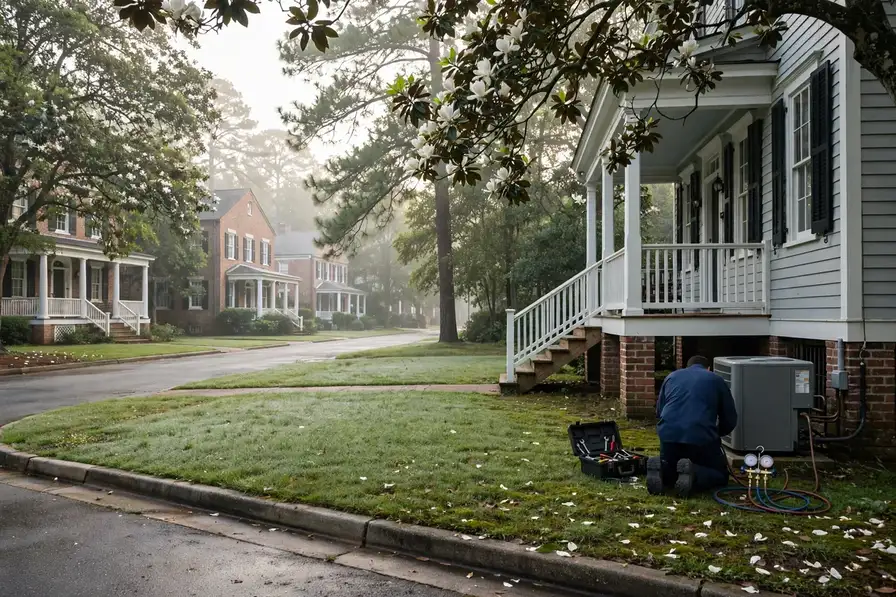


TempReach USA connects Montgomery homeowners with independent local HVAC technicians. This page is built from the metro's own Census housing data, ZIP codes and climate record — the heating and cooling problems described here are the ones Montgomery homes actually have.
Call center hours: Mon-Fri 7:00 AM-10:00 PM ET | Sat 8:00 AM-10:00 PM ET | Sun 7:00 AM-9:00 PM ET
The median Montgomery home was built in 1985; 44.0% of the stock predates 1980, and the pattern this metro's own data ranks first is the refrigerant transition reaching older systems. TempReach USA is a referral service, not an HVAC company: one call connects you with an independent local HVAC technician serving your ZIP code.
Two numbers frame everything that follows: 65.0% of Montgomery homes are owner-occupied, and the median one was built in 1985. Ownership matters to HVAC because owners inherit their systems whole — every equipment decision a builder made in the 1980s or earlier is still in the attic, the closet and the side yard, ageing on its original schedule. With 44.0% of homes predating 1980 and 26.7% arriving since 2000, the metro is really two housing stocks sharing one map, and they are taken separately below before the problems are ranked.
There is an equipment timeline buried in Montgomery's housing figures, and it reads like a technician's diary. The 26,729 homes from before 1960 were heated first and cooled later, their ducts added around floor plans that never imagined them. The 49,146 that followed between 1960 and 1979 mixed those retrofits with the first planned central systems. Then came the 50,698 homes of 1980-1999, fitted with matched systems as standard. Each band of that timeline is now a band of characteristic failures, arriving in the order the equipment tires — which is why a home's build year, in this metro, is the single most predictive fact about its heating and cooling.
Uniformity is the newer stock's defining trait. A subdivision in Prattville or Millbrook went up in a handful of years, fitted with one generation of equipment, one duct design, one thermostat class. That uniformity writes a calendar the whole street shares: the first heating wave, the first cooling wave, the first questions about refrigerant and charge arrive together, years before the same streets need anything structural. With 26.7% of the metro built since 2000, that calendar governs a large and growing share of Montgomery's HVAC work — predictable work, if a household reads the calendar early.
Over everything sits the weather, and here it is measured rather than described: NOAA's station at MONTGOMERY AP, AL US averages 66.4 degrees across the year, with 92.7 days reaching 90 or more and 37.0 nights at freezing or below. A furnace feels that record as a season of relentless cycling; a condenser feels it as a summer without a quiet week; a heat pump feels both. The problem ranking below is what those numbers, crossed with the housing profile, produce for Montgomery specifically.
Housing eras and climate, joined — the two datasets every section of this page is built from.
Lay the eras side by side instead: 15.5% pre-1960 (26,729 homes), 28.5% from 1960-1979 (49,146), 29.4% from 1980-1999 (50,698), and 26.7% since 2000 (46,042). No single era tells the story — the proportions among them do, and those proportions are different in every metro this site covers.
The 1980-1999 band runs this metro, and its HVAC has a particular flavour: mature but not ancient. Systems old enough to have histories, ducts still sound, equipment from the first efficiency era reaching its wear points in waves, condensers cycling through replacements on a schedule set by whole subdivisions. Montgomery's is a maintenance-era stock — the decades where attention compounds and neglect starts to invoice.
The second band in the table is the 1960-1979 stock: 49,146 homes, 28.5% of the metro. It is the transition generation — cooling arriving, heating generations overlapping, ducts mixed street by street — and it supplies Montgomery with its most diagnostic HVAC: two homes of the same year needing opposite answers, decided by what the builder happened to specify.
Start the climate half where the system starts: at the thermostat's two seasons. Montgomery's cooling answers 2,540 cooling degree days of load and its heating answers 2,000 heating degree days of cold at MONTGOMERY AP, AL US — an average temperature of 66.4 degrees that no individual week actually delivers. A heating and cooling system here is never in neutral; the record keeps it working at one end or the other all year.
A profile is only useful if it predicts something, and this one predicts the shape of an HVAC diary in Montgomery: which streets will call about cooling, which about heating, which about airflow, and in which months. Everything after this section is that prediction written out as services, problems and answers — the numbers first, the narrative second, the way the evidence actually runs.
Chosen by this metro's own housing and weather data — the same two records this whole page is built from.
A generation change is moving through Montgomery's cooling equipment, and it arrives one repair decision at a time. For decades, residential systems ran on R-22; production and import of that refrigerant ended in the United States in 2020, so the supply that remains is reclaimed stock, and servicing a leaking R-22 system means weighing a scarce, aging refrigerant against the age of the machine it serves. Newer systems moved to R-410A, and equipment now arriving uses lower-impact refrigerants such as R-454B, with their own handling and code requirements. The transition matters to a homeowner at specific moments: when an older system needs a charge, when a coil or compressor fails on a machine whose refrigerant is effectively retired, when a repair quote must be compared honestly against replacement. Nothing about it is a reason for panic — R-22 systems are not banned from being serviced — but every significant repair on one is now also a planning conversation, and households in Montgomery with equipment from the R-22 era benefit from having it before the hottest week, not during it.
Judge a refrigerant-era system by its leak history and its trend, not by a single charge reading. One low reading after many tight years is an event; a pattern of small losses is a biography, and the biography is what the economics should be based on. Montgomery's climate record loads the question at both ends — a leaking system underperforms exactly when MONTGOMERY AP, AL US's 92.7 hot days demand its full capacity, and its owner pays for refrigerant and lost performance simultaneously. The households that navigate this transition well keep one habit: they can state their system's age, refrigerant and last three repairs without looking them up. That small command of the facts converts an industry-wide generational change into a single household's managed decision, which is the scale at which it was always going to be decided anyway.
Housing arithmetic shows the exposure: with 44.0% of Montgomery's homes built before 1980 and equipment replaced in long cycles ever since, a substantial share of the metro's systems belong to refrigerant generations the market has already succeeded. The nameplates say so, one address at a time.
Humidity announces itself politely before it announces itself seriously. The polite version, in a Montgomery home, is a feeling: sheets that seem damp, a bathroom mirror that clears slowly, a basement corner with a smell that returns every wet week. The serious version builds quietly behind it — moisture condensing inside wall cavities and duct runs, conditions that invite mold growth in the places nobody opens, wood and finishes swelling and moving with the seasons. Cooling equipment stands in the middle of this story as the home's main dehumidifier, whether or not it was chosen for the role. When the equipment is oversized for the house, its runs are short and its drying is poor; when airflow is wrong, the coil's drying suffers; when duct leaks pull in humid air from the crawl space, the system imports the very burden it is asked to remove.
Judge a home's moisture by its wettest week, not its average one. Averages flatter: in Montgomery, an average year at MONTGOMERY AP, AL US delivers 51.16 inches of rain, but the burden arrives in episodes — the saturated stretch when the ground is wet, the air is wet, and the house's every surface is trading moisture with both. In that week the closet smells, the registers sweat, and the system's drying margin is audited honestly. The homes that pass the audit share a profile rather than a product: sources managed, a system sized and set up to run long enough to dry, a drain that carries the evidence away, and occupants who read indoor humidity the way they read temperature. Moisture problems are patient; they wait for the wet week. The preparation that defeats them is exactly as patient, and considerably cheaper in attention than in consequence.
The timing is the signature: humidity complaints in Montgomery peak in the wet, saturated stretches rather than the hottest dry ones — the pattern of a moisture load, not a temperature load, announcing itself through the same equipment.
Returns deserve as much suspicion as supplies. A leaking supply loses conditioned air; a leaking return recruits unconditioned air — hot attic air in summer, cold crawl-space air in winter, and with it the dust and moisture of whichever space it crossed. In Montgomery's older housing, returns are often the rougher half of the network: panned joist spaces, wall cavities pressed into service, connections made to a standard the era allowed. The symptoms point back confusingly — a system that seems to stir dust, rooms that smell of the attic in summer, humidity the air conditioner cannot quite pull down. A duct assessment that only walks the supply side reads half the network. The returns are where the house breathes in, and a home whose returns breathe from its attic will never quite feel the way the equipment's specifications intend.
Read a duct system the way a technician does and the examination has a shape: start at the air handler and work outward. At the plenum, connections are inspected where they are most stressed and most consequential. Along the runs, the checks are for the known failure family — separated joints, fallen insulation, sagging flex, crushed sections, takeoffs that were sealed with hope rather than mastic. At the registers, temperatures and airflow are compared room by room, and the map of strong and weak rooms is laid over the map of the runs themselves; the two maps explain each other with remarkable consistency. Returns get the same walk, with attention to panned cavities and any path that lets the system breathe from outside the envelope. Cleaning belongs in this picture where the inspection finds accumulation — but cleaning a leaking network without sealing it polishes the inside of a system that is losing its cargo through the walls.
Climate sharpens the accounting: in Montgomery the supply runs cross attic air during 92.7 days a year at 90 degrees or more, and crawl-space cold through 37.0 freezing nights. A leak in those spaces is not a small percentage lost politely — it is conditioned air exchanged with the harshest air the house contains.
There is a particular sound to a heat-stressed system: the outdoor unit starts, labors, and settles into a run that does not end. In Montgomery, where 2,540 cooling degree days stack the season's demand into long hot weeks, that endless run is the system telling the household its margin is gone. It may still be cooling — that is the trap. A unit can hold a house five degrees above the set point for days while spending its components to do it, and the repair that eventually follows is dated from when the margin ran out, not from when the cooling stopped. Reading the run time is therefore part of the diagnosis: a technician asks not only what failed, but how long the house had been asking for more than the system had left.
Look at a heat-season failure up close and it has usually left evidence before the stop. Run times stretch first. Then the temperature split between supply and return air narrows. The outdoor unit's cabinet runs hotter, the startup grows rougher, and short pauses replace the long confident cycles of a healthy system. Inside, the rooms furthest from the air handler drift warm while the thermostat's own room still reads close to the setting, which sends many households chasing the wrong problem. A technician's heat-season checks follow the evidence in order: airflow across the indoor coil, cleanliness of the outdoor coil, electrical health of the starting components, and refrigerant charge measured under load. Each check rules a branch of the failure in or out, and the branch that remains is very often a small part that extreme heat finished off — provided the compressor behind it was caught in time.
Read Montgomery's housing and weather together and the strain stops looking random: a median build year of 1985 means much of the metro's cooling equipment is deep into its working life, and the heat at MONTGOMERY AP, AL US asks the oldest systems for the longest runs of the year.
Heat is not an event in Montgomery; it is a season, and a long one. The record at MONTGOMERY AP, AL US counts 92.7 days a year at 90 degrees or more and 2,540 cooling degree days, which means the metro's air conditioners work their longest shifts exactly when the air they must reject heat into is at its hottest. The households that come through the season smoothly treat it as a campaign with a beginning: before the first serious heat, the outdoor coil is washed clear of the spring's debris, the filter is fresh, the condensate drain is proven clear, and the system is run long enough on a warm day to show how it behaves under load — startup, sound, the temperature it delivers at the registers. During the season, the checks are small and regular: the outdoor unit kept clear of growth and stored items, the filter watched monthly because a loaded filter in peak season throttles a system already at full stretch, and indoor temperatures read honestly — a house drifting upward through a hot afternoon is the system filing an early report, and answering it in June is a different errand from answering it in the season's hottest week.
The season loads Montgomery's systems the way its record at MONTGOMERY AP, AL US says it will: 2,000 heating degree days against 2,540 cooling degree days in an average year, against a housing stock whose median build year is 1985. The households that read the season early — filters, drains, a system run before the extreme weeks — are the ones whose calls stay schedulable.
There is a supply-side depth as well. A shrinking refrigerant does not vanish; it circulates — recovered from retired systems, reclaimed to specification, and returned to service at an expense that reflects the shrinking pool. In Montgomery that means the R-22 in a system serviced this year may have cooled three other homes before it, and may cool another after this system retires, provided it is recovered rather than vented. The chain gives older equipment a managed twilight rather than a cliff: service remains possible, performed by technicians qualified for the work, for as long as the economics hold for the household. Understanding that chain replaces two common errors — that old systems are already unserviceable, and that they can be serviced forever as cheaply as ever — with the true picture: a gradually tightening supply, a gradually aging fleet, and a decision that improves with information and worsens with delay.
Read the ranking backwards and it reads as a data summary: 385,159 residents in 172,442 housing units, 15.5% of the housing from before 1960, 51.16 inches of rain in an average year. The pattern leads because the exposure is broad — counted not in individual unlucky houses but in whole eras of the metro's building, stacked one on another.
The first visit follows a short, diagnostic list — each item ruling a branch of the problem in or out:
Ordered by what this metro's data says its homes need most.
Every repair through TempReach USA follows the same order: diagnosis at the equipment, findings explained, quote given before work begins, and a full test cycle before the technician leaves your Montgomery home.
Ask what fills an AC repair diary in Montgomery and the answer is written in its housing. The median home was built in 1985, and a good share of the metro's cooling equipment is older than the homes' current owners realise — units sized for a different era of insulation, charged with refrigerant generations that have since been phased down. A system in Autauga County that cools a little less each summer is telling a story in instalments, and the repair visit reads the whole story: pressures, airflow, the coil's condition, the duct losses behind the walls. That is the daily reality for the 149,998 households spread across Autauga, Elmore, Lowndes, Montgomery.
The local caseload behind this service is written in the climate figures: 2,540 cooling degree days a year and 92.7 days at 90 or above, pressing on a cooling fleet whose oldest members serve the 75,874 pre-1980 homes — in Prattville (38,850 residents) as much as in the oldest districts.
The MERV number is a match, not a score. The right filter figure is the highest the blower and ducts can pull air through without strain or bypass — chosen for the furnace in the basement, not the shelf in the store.
Across Montgomery's 149,998 households, the air quality diary follows the building map. The tight new subdivisions near Prattville ask about ventilation and the chemistry of new materials; the the 1980s districts ask about dust, infiltration and the crawl spaces under raised floors; the households in between ask about allergies in the pollen months. One service name, three different sciences — which is why the visit begins with questions about the house and the people in it, not with a product sheet. The MONTGOMERY AP, AL US record — 2,000 heating degree days, 2,540 cooling — is the backdrop Autauga County technicians plan around.
The local figures behind the service: 149,998 households, indoor humidity driven by 51.16 inches of yearly rain and long humid stretches, pollen seasons that load every return in Autauga County. The assessment measures a home against exactly that climate, not against a generic standard.
Verification is part of the service: a camera view, an opened panel, a register you can inspect yourself. The point of the visit is a duct system you have seen clean, not one you have been told is clean.
Duct cleaning in Montgomery is booked in waves that follow the housing: after the renovation seasons in the older districts, at move-in across the subdivisions, alongside system replacements everywhere. The work pairs naturally with the inspection that surrounds it — leaking joints found and sealed, a disconnected run in an attic discovered, insulation fallen where it should not be. The cleaning is the appointment; the findings are often the value. Locally the workload concentrates where the stock is oldest — the districts built around the 1980s first.
Count the systems and the diary fills itself: 149,998 households breathing through ductwork daily, the oldest of it in homes from the 1980s and the newest in the subdivisions past Holtville. What the cleaning finds follows the biography — dust in proportion to years, debris in proportion to renovations.
In Montgomery, the maintenance calendar writes itself from the climate: 2,000 heating degree days and 2,540 cooling degree days mean both systems work a real season, so the fall and spring visits each have genuine work to inspect.
With a median build year of 1985, many Montgomery systems are reaching replacement age together; the professional you are connected with inspects ducts and electrics across 44 ZIP codes before recommending equipment.
From Montgomery to Pike Road, a no-heat call through TempReach USA reaches a local professional whose visit includes the exchanger and venting checks that furnace work owes a Montgomery household.
Heating installation in Montgomery starts with a heat-loss calculation across Autauga, Elmore, Lowndes, Montgomery: the independent local professional measures the home's loss, inspects ducts and venting, and quotes the full scope before work begins.
Across 44 ZIP codes and housing from a median build year of 1985, Montgomery heat pumps are specified and serviced from heat-loss figures and low-temperature performance data, not nominal tonnage.
From period homes near Montgomery to newer builds toward Pike Road, Montgomery's ductless projects serve the rooms central systems miss — additions, conversions and homes built without ductwork.
In Montgomery, the thermostat question splits by housing era: homes from around the median build year of 1985 often lack a common wire in the wall, while newer builds across the 44 covered ZIP codes usually carry one — the local professional checks the cable before choosing the control.
In Montgomery, emergency means weather-relative: 2,000 heating degree days put no-heat calls on a freezing clock each winter, while 2,540 cooling degree days make a dead system a health question each summer — the call center triages against both, using the hours shown on this page.
Montgomery's commercial buildings span every era around a median build year of 1985 — and with the era goes the equipment, from aging single units over old storefronts to multi-zone systems in new developments, all serviced from a per-unit record.
If this page's services were ranked by Montgomery's call patterns rather than listed in catalogue order, they would come out much as they do here — because the ranking behind them is data, not habit. The refrigerant transition reaching older systems leads the metro's problem table and humidity burden on homes and cooling systems follows, so the services answering them lead the list. The long tail of a metro's HVAC life — thermostat calls, duct questions, the one room that never matches the rest — fills in the diary around them, here as everywhere.
PROBLEM SOLUTION
Population 198,440
Population 38,850
Population 16,923
Population 10,103
Population 7,182
Population 5,700
Population 5,231
Population 5,056
Population 4,228
Population 3,387
Population 2,618
Population 1,609
Also in the Montgomery metro: Fort Deposit (population 1,560), Elmore (population 1,482).
Beyond Montgomery itself, the metro takes in Prattville (38,850 residents), Millbrook (16,923) and the rest of the communities in the grid above — each fitted with heating and cooling in its own building era, which is why two streets in the same metro can need entirely different HVAC conversations. The ZIP list below is the full coverage footprint: if your code is on it, this page was written about your housing stock.
The map continues: Pike Road (10,103), Wetumpka (7,182), Holtville (5,700), Redland (5,231), Tallassee (5,056). Different names, different decades — each community in Autauga, Elmore, Lowndes, Montgomery was fitted with heating and cooling in its own growth years, which is why two streets in the same metro can need entirely different HVAC conversations. The ZIP list below is the working definition of coverage; the housing behind each code is the working definition of the job.
Montgomery (198,440 residents) anchors the metro, and Prattville (38,850) is its second centre of gravity. Between them they hold the bulk of the 149,998 households — and, not coincidentally, the bulk of every housing era this page discusses, from the pre-1960 core to the newest subdivisions. Millbrook (16,923) and the communities beyond it repeat the same eras at smaller scale.
The metro answers to 4 county governments (Autauga, Elmore, Lowndes, Montgomery), a patchwork that matters at permit time rather than at the thermostat. Autauga County carries the centre; the others carry the growth rings and the older outlying towns. A technician routed through this page works inside that patchwork daily — the weather does not care about the boundaries, but the job's paperwork does.
Beyond the metro line, the nearest covered metros are Auburn, AL (53 miles away), Birmingham, AL (78 miles) and Tuscaloosa, AL (93 miles) — separate pages, separate profiles, because their housing and weather records are their own. Homeowners near the boundary sit between two datasets; the ZIP list above, not the map's edge, decides which page was written about your stock.
The region around Montgomery is a set of variations on its theme: Auburn, AL, 53 miles off, runs a median build year of 1995 on a metro population of 208,013; Birmingham, AL (78 miles) medians 1983 on 1,197,766; Tuscaloosa, AL (93 miles) medians 1991 on 281,850. Nearness is not sameness — a few decades of median build year separate their heating and cooling as surely as the miles separate their maps.
Ratios tell the metro's story compactly. Renters occupy 35.0% of homes; owners hold the rest. For every home built since 2000 there are 1.6 from before 1980. Spread the stock across the coverage map and each ZIP code carries about 3,919 housing units — the density at which era patterns repeat street after street instead of scattering, and at which a routed round of calls stays inside a few districts.
One line of Montgomery arithmetic — a median home 41 years old · 97,499 owner-occupied homes against 52,499 renter-occupied · 607 pre-1960 homes for every covered ZIP code · a heating-to-cooling degree-day ratio of 0.79 · 1,299 mm of rain in an average year.
County pages carry the local detail — land area, climate normals and the heating and cooling pressures on the ground in each county.
More plain-language help: the TempReach USA heating & cooling guides
Describe the problem and the call center routes you to an independent local HVAC technician who works in the Montgomery metro.
Call center hours: Mon-Fri 7:00 AM-10:00 PM ET | Sat 8:00 AM-10:00 PM ET | Sun 7:00 AM-9:00 PM ET