HVAC Maintenance Checklist by Season
Heating and cooling maintenance is not a single annual event; it is four small seasons of attention, each matched to what the weather is about to ask of the system. This checklist organizes the work that way — what the household can do itself in an hour, what belongs to a professional visit, and when in the year each item earns its keep. The pattern underneath is simple: prove each mode before its season, keep air and water moving honestly during it, and close the season by reading what it spent. A household that keeps this rhythm learns its system's condition from gauges and calendars rather than from failures, and turns the two most dangerous weeks of the HVAC year — the first heat wave and the first hard freeze — into non-events. Print it, date the entries, and let the record accumulate; the record itself becomes diagnostic gold.
Call center hours: Mon-Fri 7:00 AM-10:00 PM ET | Sat 8:00 AM-10:00 PM ET | Sun 7:00 AM-9:00 PM ET
Early spring: proving the cooling before the heat arrives
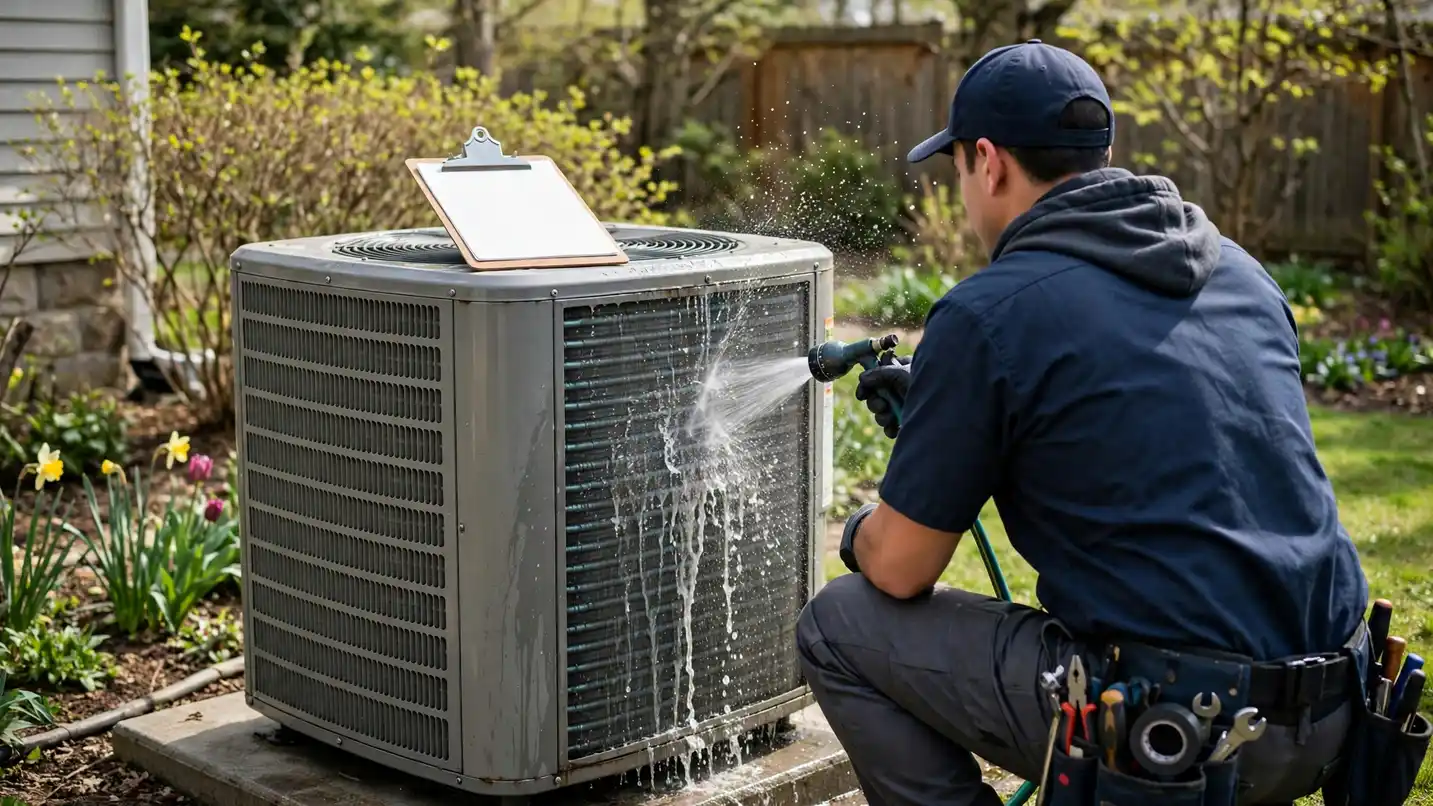
Spring's job is a rehearsal with stakes low enough to fix what it finds. Start the cooling on a mild warm day and give it a full run: listen to the outdoor unit's startup, feel the air at several registers, note whether the system reaches the setting without strain and how the house's rooms compare. Change or clean the filter now, whatever its anniversary says, because it carries the heating season's accumulation into the cooling season otherwise. Outside, clear the condenser of winter's deposits — leaves, debris, growth trimmed back from its breathing room — and rinse the coil fins gently if they are visibly loaded. Inside, pour a cup of water into the condensate drain's access if your system provides one and confirm it flows; the drain that is clear in April is the one that does not stop the system in August. Book the professional visit in this window if the system is due: spring diaries are calmer than July's, and every finding is still an appointment rather than an emergency.
Late spring: the professional tune-up, cooling edition
The spring service visit earns its name by measuring, not by glancing. Its core is a set of readings: refrigerant charge evaluated under operating conditions, electrical values on the starting components — capacitor and contactor above all — motor draws against their nameplate values, the temperature split across the indoor coil, and the condensate path inspected and cleared. Coils get cleaned where the readings say fouling is taxing the system. The blower and its compartment are checked for the accumulation a winter of heating leaves. This is also the visit to raise the household's standing questions — the room that lagged last summer, the sound that changed, the system's age and what its next years should plan for — because the answers are cheapest when nothing is currently broken. Leave the visit with the readings written down. A system's file of measurements, year over year, is how slow drift gets caught while it is still a cleaning and an adjustment rather than a failure.
Summer: the in-season rhythm of small checks
Summer asks for vigilance in small doses. The filter is a monthly look in cooling season — a system moving air all day through a season of open windows, pets and dust loads its filter faster than the calendar's habit, and airflow lost to a gray filter is capacity stolen at the peak of the season. Keep the outdoor unit's clearance honest as the garden grows; shrubs and stored items creep inward across a season. Check the condensate drain's flow during the humid weeks, when it runs at full volume — a slowing drain announces itself there first, and clearing it then is a hose-and-flush errand rather than a stopped system and a wet ceiling. Read the house monthly as an instrument: rooms compared with last month, run times noticed, the far register's air felt. Nothing in this rhythm takes more than minutes; what it buys is the earliest possible version of every warning the season intends to give.
Early fall: closing the cooling season, opening the heating one
Autumn is the system's handover, and it deserves the same deliberateness as spring's. Close the cooling season by reading its account: the filter replaced, the drain confirmed clear after its hardest months, any symptom the summer filed — a lagging room, a changed sound, a stretch where the house fell behind — written down while it is fresh, because those notes are next spring's first page. Then reverse the rehearsal: start the heating on a mild day and let it run a full cycle. The first firing of the season often carries a brief dusty smell from the heat exchanger's summer rest — normal if it clears within the first run, a report if it persists. Watch and listen to the full sequence: ignition, blower, steady heat at the registers. Verify the thermostat's program for the heating season rather than inheriting summer's schedule, and use this calm window for the heating tune-up booking — autumn diaries fill before the first cold snap writes its own appointments across them.
Fall: the professional tune-up, heating edition
The heating visit is a safety visit wearing a maintenance coat. Its center is the combustion train: ignition condition — the igniter is the classic wear item of the season — flame quality and sensing, and the heat exchanger inspected, because the exchanger is the component whose failure changes the conversation from repair to safety. Venting and intake paths are walked, including the outside terminations before snow can complicate them. On high-efficiency equipment, the condensate system gets its cold-weather check: the drain's route through any cold space, the pump's operation, the places freezing could stop the system in January. Electrical readings repeat the spring's discipline on the heating side — blower draw, controls, the safety chain's components observed through a full, uninterrupted cycle. Heat pumps get their own chapter: the defrost cycle witnessed or tested, and the auxiliary heat exercised and proven, months before the night it is needed at full load.
Winter: watching the system at full duty
Winter's checklist is observational, because the system is working too hard to be opened casually. Keep filters on the monthly rhythm — heating season loads them steadily, and a starved furnace overheats and short-cycles its way through its own protections. After snow or ice, walk the outside: intake and exhaust terminations cleared, the area around any outdoor unit kept open, ice on a heat pump's coil judged against its defrost rhythm — a coat that melts away each cycle is normal; a growing shell is a report. Listen at the same hour weekly: startups should sound like last week's, and a change — slower light-off, new rumble, blower noise — is the system filing its report in the only language winter gives it. Note lockouts even when they recover. And keep the household's cold-weather knowledge current: the water main's location, the most exposed plumbing, the plan if heat stops on the coldest night. Winter is the examination; this checklist is how you take notes during it.
Heat pumps and ductless systems: their own calendar items
Heat pumps compress both seasons into one machine, so their checklist merges and extends the others. The outdoor unit works all year and accumulates both seasons' fouling — coil cleanliness is a twice-a-year item, as is the clearance around it, in leaf season as much as in grass season. The auxiliary heat must be exercised before deep cold, not discovered during it: run it deliberately in autumn and confirm the house feels its contribution. Defrost behavior deserves one observed cycle in the first cold weather — steam and a brief reversal are the healthy version. Ductless indoor units add their own small liturgy: their washable filters, one per head, clog quietly and throttle the very rooms they serve, and a monthly rinse in season is the difference between rated performance and a shrug. Their condensate paths, often pumped, deserve the same respect as any drain in a humid summer.
The house around the system: envelope, ducts and drains
A checklist that stops at the equipment misses the system the equipment serves. Once a year, walk the delivery network: duct runs in the attic or crawl space sighted for separated joints, fallen insulation and sagging flex; registers and returns confirmed open and unblocked by the year's furniture decisions; the return path's doors and gaps as they are actually lived with. Once a year, walk the water: the condensate drain's full route, the area under the indoor unit for any sign of past overflow, the drain pan's condition. Once a year, walk the envelope with the system's eyes — the attic hatch's seal, the obvious drafts, the exhaust fans' dampers — because every leak in the shell is load the system must carry and moisture it must process. None of this is glamorous, and all of it is leverage: the system's seasonal readings only mean what they should when the house around it is holding up its side of the arrangement.
Records: the checklist behind the checklist
Close the year by maintaining the one asset that makes every other item smarter: the record. Keep a single page — paper on the unit or a file in the phone — with the system's make, model, serial and refrigerant, its installation date as far as you know it, and a dated line for every service, repair and reading. Note the filter size on the same page, and the sizes and locations of every filter in the house if there are several. The record pays in three currencies. Diagnosis: a technician handed two years of readings and repairs starts halfway down the search tree. Decisions: repair-versus-replace stops being an argument and becomes arithmetic when the history is on one page. And memory: households change, systems outlast their installers' visits, and the record is how the house explains itself to the next person who maintains it — including a future you, in a cold hallway, at the least convenient hour of the year.
 PROBLEM
 SOLUTION
Related service: HVAC Maintenance & Tune-Ups
How often should the filter really be changed?
Is an annual professional tune-up worth it if the system seems fine?
What can I safely do myself, and what should I never attempt?
When is the right month to book each tune-up?
My system is under a service plan. Do I still need this checklist?
What should I do differently for a heat pump?
How do I maintain a ductless mini-split between visits?
What is the single most neglected item on this whole checklist?
Need an HVAC technician now?
One call connects you with an independent local heating and cooling professional in your metro.
Call center hours: Mon-Fri 7:00 AM-10:00 PM ET | Sat 8:00 AM-10:00 PM ET | Sun 7:00 AM-9:00 PM ET