Furnace Won't Start: Troubleshooting Guide
A silent furnace on a cold morning presents a short list of possibilities, and many of them are not breakdowns. Modern furnaces are designed to refuse to run when a condition is unproven — no draft, no flame signal, a door open, a drain full — and that refusal, frustrating as it feels from the hallway, is the safety system working in the open. This guide works the list the way a technician's first questions do: the call for heat itself, the power and the simple conditions, the furnace's own report through its fault lights, and the line where troubleshooting ends and diagnosis belongs to instruments. Follow it in order. Whatever you find — including finding nothing — becomes the most useful thing you can tell the person who comes to fix it.
Call center hours: Mon-Fri 7:00 AM-10:00 PM ET | Sat 8:00 AM-10:00 PM ET | Sun 7:00 AM-9:00 PM ET
Confirm the call for heat
Begin where the system begins: with the instruction. The thermostat must be set to heat, with a set point above the room temperature it shows — raise it several degrees to remove all doubt, and listen for the furnace to acknowledge the call within a minute or so. If the thermostat runs on batteries, replace them even if the display looks alive; fading batteries are a classic cause of a control that shows a temperature but no longer sends a reliable signal. Check any program or hold that might be scheduling the house cooler than you think, and if the home has more than one thermostat, confirm you are adjusting the one that governs this furnace. A surprising share of no-start mornings are decided at this step, because the furnace was not refusing to work — it was never successfully asked.
Power, switch and breaker: the three silent offs
A furnace needs electricity even though it makes heat from fuel — the blower, the controls and the ignition all run on power. Check the breaker at the panel: a tripped furnace circuit can hide in a row of similar switches, and the handle may sit only slightly off line. Then find the furnace's own service switch — usually a ordinary-looking switch on or near the unit, on a wall, or at the top of the basement stairs — which generations of households have mistaken for a light switch and turned off in passing. Finally, look for a small fuse on the furnace's control board area if you can see it safely without opening panels; a blown board fuse is information for the technician. If power was interrupted and restored, give the system a few minutes — some furnaces observe delays before attempting a start.
The filter and the blower door: safety by design
Two conditions stop furnaces deliberately. The first is airflow: a filter loaded to the point of starvation can make the furnace overheat and shut itself down on a safety limit, after which it may refuse further attempts until it has cooled or been reset by a power cycle. Pull the filter and read it against the light; replace it if it is gray through. The second is the blower door: furnaces carry a switch that kills power when the front panel is off, so a panel left slightly unseated after a filter change can leave the whole system dead while appearing closed. Press the panel home and confirm it sits true. These are not tricks; they are the machine protecting itself and the household, and clearing them is legitimate troubleshooting that technicians themselves perform first.
Reading the furnace's own report: the blinking light
Most modern furnaces keep a small sight glass or window on the front panel, behind which an LED blinks a code. That code is the furnace's testimony — count the pattern of flashes, and look for the legend printed on the inside of the door or the unit's label, which translates patterns into fault families: ignition, flame sensing, pressure proving, overheating, and others. Do not open panels to chase it if doing so feels beyond you; the code count alone, reported accurately on the phone, lets a technician arrive with the right branch of the system already in mind. Note also the rhythm of the failure if you can observe one start attempt: does the small inducer fan run, does the igniter glow, does the burner light and die, or does nothing move at all? Each behavior names a different chapter of the start sequence, and the chapter is the diagnosis's headline.
The start sequence, and where yours stops
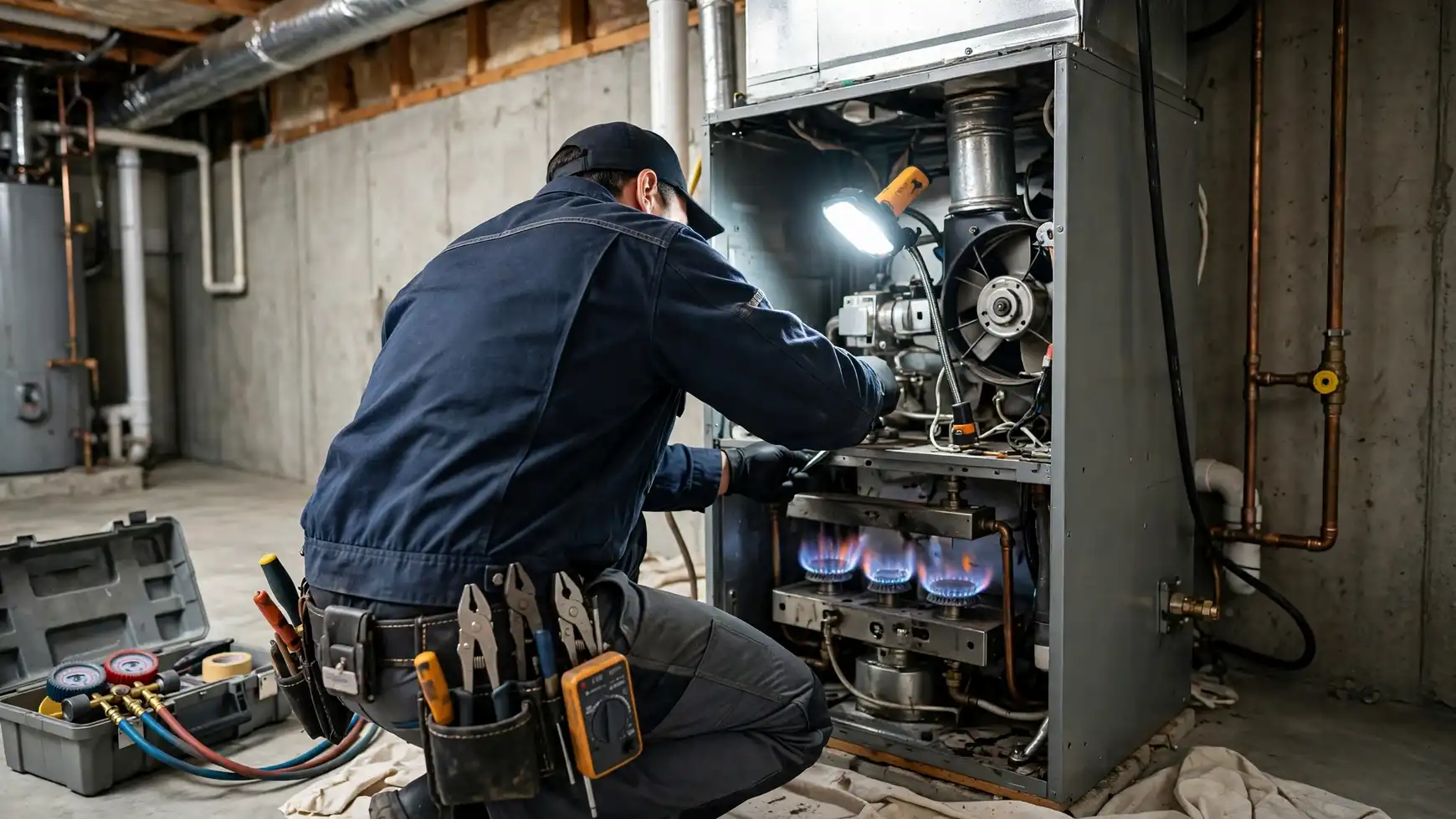
A furnace start is a procession, each step proving a condition for the next. The thermostat calls; the inducer fan starts and must prove, through a pressure switch, that the vent path is clear; the igniter heats; the gas valve opens; the burner lights; a flame sensor confirms fire; only then does the main blower move warm air into the house. A furnace that will not start is a procession halted at one step, and the halt point sorts the causes: silence points backward toward power and the call; an inducer that runs without ignition points at the proving chain or the igniter; ignition that lights and dies within seconds points at flame sensing — often a sensor that needs cleaning; burners that run briefly before shutdown suggest overheating or a rollout of the flame the safeties caught. You are not expected to repair the step; you are learning to name it, which is what makes the repair visit fast.
Fuel and flame: gas supply and what not to touch
If the furnace is gas-fired, confirm the obvious supply facts: the gas valve at the unit is in its open position, and other gas appliances — a stove burner, a water heater — are working, which separates a house supply problem from a furnace problem. If you smell gas strongly, stop troubleshooting entirely: leave the house, keep phones and switches untouched on the way out, and call the gas utility or emergency services from outside. That rule outranks every other line in this guide. What not to touch bears stating plainly: the gas valve's internal components, the burners, and any sealed controls are a technician's territory. The household's legitimate ground is everything up to the furnace's cabinet door — settings, power, filter, panels, observation. Inside, the combination of fuel, ignition and safety chains deserves instruments and training, and the guide's remaining steps are about observation and honest reporting.
Condensate and venting: the cold-weather stoppers
High-efficiency furnaces make water as they work, and that water leaves through a condensate drain that can clog with growth or, where it crosses cold space, freeze — at which point a safety switch stops the furnace rather than let it flood itself. If yours stopped in hard cold and the fault pattern suggests it, look at the drain line's visible run and any small pump beside the furnace; a full pump reservoir or a drain line stiff with ice is a finding worth reporting word for word. Venting has its own cold chapter: the intake and exhaust terminations outside can be obstructed by snow, ice or wind-blown debris, and a furnace that cannot prove its draft will not fire — by design, and correctly. Clearing snow away from the terminations is household work; anything beyond that, including a drain that keeps stopping the system, is a service call with a precise story attached.
One reset, honestly observed
A furnace that has locked out can often be reset by turning its power off for a minute and restoring it — and a single reset, watched carefully, is a legitimate diagnostic act. What matters is the observation: restore power with the thermostat calling, stand where you can hear the sequence, and note exactly how far the procession gets before it halts, and whether the fault code changes. If the furnace then runs and heats steadily, report the whole episode at the next service rather than forgetting it — a lockout that happened is information even when it does not recur. If it halts at the same step, stop. Repeated resets do not persuade a safety chain; they erase the evidence it is keeping and can stress components. One reset, fully observed, is troubleshooting. A second and third are the household arguing with the machine, and the machine is usually right.
Protecting the house while you wait
If the furnace will not run and cold weather is pressing, the problem becomes two problems, and the second one — the house — has its own first steps. Close off unused rooms and consolidate the household into the warmest part of the home. Where pipes run through exterior walls or unheated spaces, open the cabinet doors beneath sinks to let room air reach them, and in a serious freeze let the most exposed taps drip slowly; moving water resists freezing far longer than still water. Know where the water main closes, before any need to close it in a hurry. Keep portable heaters attended, away from bedding and curtains, and never use an oven or outdoor grill as a heat source indoors — the carbon monoxide risk is real and silent. Tell the call center the house's exposure honestly; a home losing heat with plumbing in a crawl space is triaged differently from one that can coast, and that sorting only works on truthful information.
 PROBLEM
 SOLUTION
Related service: Furnace Repair
My furnace clicks but never lights. Where is it stuck?
The furnace lights, runs for a few seconds, then shuts off. What causes that?
Is it safe to keep resetting the furnace until it stays on?
How long can a house go without heat in freezing weather before pipes are at risk?
The furnace worked yesterday. What fails overnight?
My heat pump is running but the house keeps getting colder. Is that the same problem?
Should I open the furnace panels to look inside?
What information helps most when I call about a furnace that won't start?
Need an HVAC technician now?
One call connects you with an independent local heating and cooling professional in your metro.
Call center hours: Mon-Fri 7:00 AM-10:00 PM ET | Sat 8:00 AM-10:00 PM ET | Sun 7:00 AM-9:00 PM ET