AC Not Cooling: What to Check First
An air conditioner that runs but does not cool is one of the most common calls in the trade — and one of the most checkable before anyone picks up the phone. Some of its causes live at the thermostat, the filter and the outdoor unit, where a homeowner can find them safely in minutes. Others live inside the equipment, where they belong to a technician. This guide walks the checks in the order a professional would think about them: what the system is being asked to do, whether air is moving, whether the outdoor half is running, and what the pattern of the failure says about where the problem sits. Work through them in order, note what you find, and whatever remains unexplained at the end becomes a precise description to give the technician — which is worth more than any single check on the list.
Call center hours: Mon-Fri 7:00 AM-10:00 PM ET | Sat 8:00 AM-10:00 PM ET | Sun 7:00 AM-9:00 PM ET
Start at the thermostat: the order the system never received
Before touching any equipment, confirm the system is actually being asked to cool. Check that the thermostat is set to cool, that the set temperature is below the room temperature it displays, and that the fan is on auto rather than a setting left over from another season. If the thermostat uses batteries, replace them — a weak battery can leave a display lit while its instructions to the equipment fade. If someone in the house has changed a program or a hold setting, the system may be obeying instructions nobody remembers giving. This check sounds too simple to matter, but a meaningful share of no-cooling situations are decided here, in thirty seconds, because the equipment was never told to run. Only when the order is certain does it make sense to go looking for a failure in how the order was carried out.
The filter: the cheapest airflow problem there is
A clogged filter starves the indoor coil of air, and a starved coil cannot absorb heat the way it was designed to — cooling weakens, run times stretch, and in the worse cases the coil ices over, which makes the airflow worse still. Pull the filter and look at it against the light. If you cannot see light through it, it is not a filter any more; it is a wall the air is negotiating with. Replace it, note the size printed on the frame so the next one is already in the house, and give the system time to recover before judging the result — a coil that has iced needs the system off, with the fan running, until the ice has melted and drained before cooling can be assessed honestly. Households with pets, construction dust or long cooling seasons load filters faster than the calendar suggests, so check by condition, not by month.
Registers and returns: is the air completing its circuit?
Walk the house with the system running. Supply registers should be open and unobstructed — a surprising number of cooling complaints trace to registers closed for the winter, covered by furniture or rugs, or blocked by the rearrangements of a room's life. Hold a hand at each: the air should arrive cool and with some authority. Then check the return path. Returns are how the system breathes in, and a return grille blocked by furniture or a door closed on a room with no return path of its own can starve a room of circulation even when its supply is fine. Rooms are part of the air circuit; a closed door with a tight gap underneath it is a damper nobody installed on purpose. Nothing here requires tools — only the recognition that air, like water, has to complete a loop, and that the loop runs through the rooms, not around them.
The outdoor unit: is the other half of the system running?
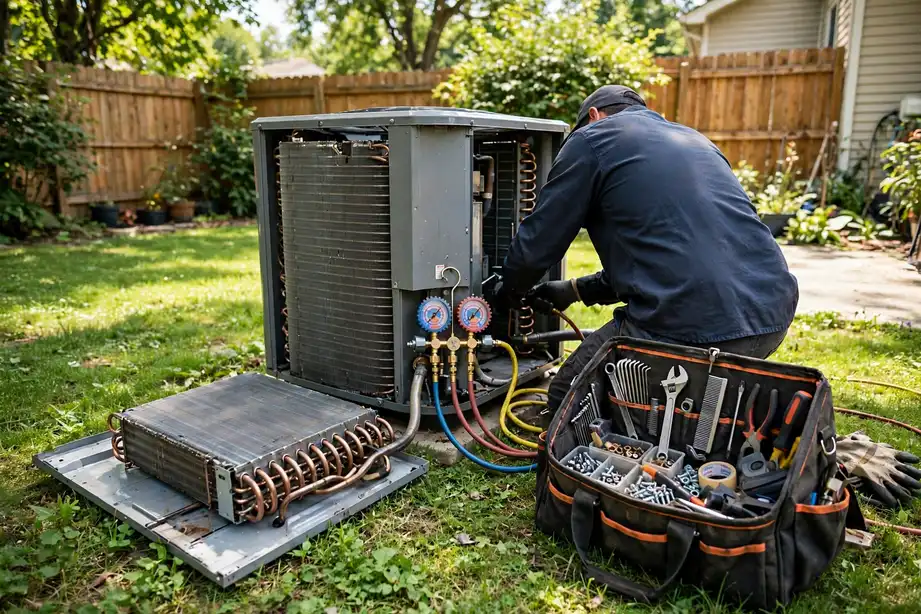
Half of your air conditioner lives outside, and it has the harder job: releasing indoors' heat into hot outdoor air. Go out and look at it while the system calls for cooling. The fan on top should be spinning and the compressor's deeper hum should be present beneath it. If the unit is silent while the indoor fan runs, the problem is on the outdoor side or in the signal reaching it. If it runs, check its breathing room: the coil fins around the cabinet should be clear of leaves, grass and stored items, and the unit should have open space above and around it — a condenser wrapped in shrubs is trying to reject heat into a blanket. A garden hose can rinse dust and cottonwood from the fins gently, from the inside out if the design allows, with the power off at the disconnect. What you are establishing is simple: is the outdoor half alive, fed and able to breathe?
Warm air, weak air, no air: reading the pattern
The character of the failure narrows the search faster than any single test. Air that arrives warm suggests the indoor half is moving air the outdoor half is not cooling — look outside first. Air that arrives cool but feeble suggests an airflow story: filter, coil, blower or ducts. Air that arrives in diminishing waves as the day heats up suggests a capacity margin being spent — a system coping in the morning and losing the afternoon. And a system that cools adequately some days and not others, on similar weather, is reporting something intermittent: an electrical component near the end of its tolerance, a control behaving differently hot than cold. Write down which pattern yours matches, with the outdoor temperature at the time. Patterns are the language technicians diagnose in, and a household that can state its pattern has already done a third of the diagnosis.
Ice anywhere is a message, not a symptom to power through
Ice on the refrigerant line, the indoor coil or the outdoor unit means the system has been running cold enough to freeze the moisture it collected — and ice always has a reason. The common reasons are restricted airflow, which lets the coil run too cold, or a refrigerant charge running low, which does the same by a different route. Either way, the correct response is not to keep the system running and hope: ice insulates the coil, strains the compressor and melts into water where water does damage. Turn the cooling off, run the fan alone to thaw the coil completely — this can take hours — and let the meltwater drain. If the system ices again after a thaw with a clean filter and open registers, the cause is inside the equipment's refrigerant circuit or airflow path, and that is a technician's diagnosis, made with gauges and readings rather than guesses.
The breaker, the disconnect and the drain: three quiet stoppers
Three unglamorous items stop cooling systems without anything being broken. The breaker: the outdoor unit has its own circuit, and a tripped breaker — sometimes half-tripped and hard to read — leaves the indoor half running pointlessly. Reset it once; if it trips again, stop and call, because a breaker that insists is reporting an electrical fault. The disconnect: the outdoor unit's service switch may have been left off after other work. The drain: many systems have a safety switch in the condensate pan or line that stops the equipment when water backs up, to prevent a ceiling's worth of water damage. A unit stopped by its float switch is a unit that saved the house — clear or report the slow drain rather than defeating the switch. Checking these three takes five minutes and a flashlight, and it separates a stopped system from a broken one.
When the checks run out: what belongs to a technician
Everything so far has been observation and settings. Beyond this point the causes live where gauges, meters and refrigerant handling begin: a charge measured under load, a capacitor's value tested against its rated value, contactor points inspected, motor windings checked, a leak searched with proper instruments. This division is not a formality. Refrigerant work is regulated work, and sealed-system diagnosis without the instruments is guesswork that can convert a worn twenty-minute part into a damaged compressor. The value of your checks, when you reach this line, is that they have cleared the field: the technician who arrives knows the thermostat's order was real, the filter is new, the registers are open, the outdoor unit's state was witnessed, and the failure pattern is recorded. Diagnosis starts several steps in, and the visit is shorter and more accurate for it.
Making the call count: what to tell the technician
When you call, you are handing over a case file — make it a good one. State the pattern first: warm air, weak air, afternoon fade, ice. State what you checked and what you found, including the negatives; 'the outdoor fan runs, the compressor hums, the filter is new' eliminates whole branches of the search before the van moves. Give the system's age and make if you know them, its refrigerant generation if the nameplate is reachable, and any recent work or changes — a new thermostat, a renovation, a room that was added. Mention when the problem began and whether it arrived suddenly or by degrees, because sudden and gradual failures have different biographies. Then let the description do its work: a well-briefed call gets a better-matched visit, with the right parts on the vehicle and the right questions already half answered.
 PROBLEM
 SOLUTION
Related service: AC Repair
My AC runs all day but the house never reaches the setting. What is the most likely story?
The outdoor fan spins but I do not hear the compressor. What does that mean?
There is ice on the copper line. Can I just let the system keep running?
How long should I give the system after replacing a clogged filter?
Is it normal for the AC to lose ground on the very hottest days?
My thermostat says the room is warmer than it feels. Should I trust it?
The breaker to the outdoor unit tripped. Can I reset it and carry on?
What should I do while I wait for the technician on a very hot day?
Need an HVAC technician now?
One call connects you with an independent local heating and cooling professional in your metro.
Call center hours: Mon-Fri 7:00 AM-10:00 PM ET | Sat 8:00 AM-10:00 PM ET | Sun 7:00 AM-9:00 PM ET